
Facebook Has Added You As An Informant. Relying on the goodwill of members to help Facebook remain transparent is one thing.
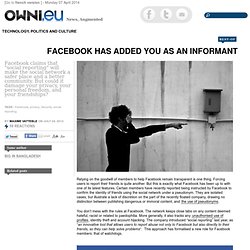
Forcing users to report their friends is quite another. But this is exactly what Facebook has been up to with one of its latest features. Certain members have recently reported being instructed by Facebook to confirm the identity of friends using the social network under a pseudonym. They are isolated cases, but illustrate a lack of discretion on the part of the recently floated company, drawing no distinction between publishing dangerous or immoral content, and the use of pseudonyms.
You don’t mess with the rules at Facebook. Facebook members are invited to become a support to security, helping those teams root out the rule-breakers. People use Facebook to keep in touch with friends and family, to know what’s happening in the world and to share and express what’s important to them. But beyond these good intentions lies a very simple reality.
Image Credits: Camille Chenchai (CC-BY-NC-ND) Stallman: Facebook IS Mass Surveillance - RT 111202. On Facebook, deleting an app doesn’t delete your data from their system. Facebook announced some intended changes to its data use policy to "enhance transparency", according to a Friday post on its Facebook and Privacy page.

The updates include better explanations, examples, and "tips" denoted in the text with a lightbulb, as well as some revelations about how third parties deal with users' data. In the revised data use policy, Facebook makes explicit that any time one of your Facebook friends starts using an app, game, or partner website (that is, a site where you can log in using Facebook credentials), Facebook hands that service all of the "publicly available" information on that user. Information that is always publicly available only includes basic stuff like your name or cover photo, but users can have their entire profile publicly available, and thus handed to a service. Not only does this data dance apply to direct users, it seems to apply to users' friends as well. Your friend might also want to share the music you “like” on Facebook. Facebook's Zuckerberg Says The Age of Privacy is Over.
Facebook founder Mark Zuckerberg told a live audience yesterday that if he were to create Facebook again today, user information would by default be public, not private as it was for years until the company changed dramatically in December.
In a six-minute interview on stage with TechCrunch founder Michael Arrington, Zuckerberg spent 60 seconds talking about Facebook's privacy policies. His statements were of major importance for the world's largest social network - and his arguments in favor of an about-face on privacy deserve close scrutiny. Zuckerberg offered roughly 8 sentences in response to Arrington's question about where privacy was going on Facebook and around the web.
The question was referencing the changes Facebook underwent last month. Facebook vous agace ? Rendez-lui la pareille. "Contre ce nouveau Facebook très indiscret, SVP rendez […]".
Ce genre de message pullule sur nos murs. Si les nouvelles fonctionnalités mises en place par Mark et ses “amis” vous ennuient, une solution : rendez-leur la pareille. Qui, que, quoi, dont, où, qu’est-ce ? Il semblerait qu’il y ait une solution plus efficace que quelques messages sur nos murs. Référons nous aux arcanes des lois européennes inhérentes à la confidentialité et à l’accès aux donnés : une entreprise a l’obligation de vous envoyer vos données personnelles si vous les lui demandez.
Criticism of Facebook. Facebook has received criticism on a wide range of issues, including its treatment of its users, online privacy, child safety, hate speech, and the inability to terminate accounts without first manually deleting the content.
In 2008, many companies removed their advertising from the site because it was being displayed on the pages of individuals and groups they found controversial. The content of some user pages, groups, blogs, and forums has been criticized for promoting or dwelling upon controversial and often divisive topics (e.g., politics, religion, sex, etc.). There have been several censorship issues, both on and off the site. In the lifespan of its service, Facebook has made many changes that directly impact its users, and their changes often result in criticism. Of particular note are the new user interface format launched in 2008, and the changes in Facebook's Terms of Use, which removed the clause detailing automatic expiry of deleted content. The anti-Facebook movement. Tu es un terroriste - une vidéo High-tech et Science. Facebook mission Guerre Mondiale Illuminati Nouvel Ordre mondial Bildelberg Club du Siecle.
Liens facebook CIA - une vidéo Actu et Politique. Surprise! Facebook doesn't like privacy countermeasures. Les limites de la fouille sociale de données. Lors de la conférence de sécurité informatique Black Hat qui se tenait récemment à Las Vegas, Alessandro Acquisti, professeur agrégé de technologie de l’information et de politique publique à l’Ecole de Heinz de l’université Carnegie Mellon, a montré comment une photographie d’une personne pouvait être utilisée pour retrouver sa date de naissance, son numéro de sécurité sociale et d’autres informations en utilisant la technologie de reconnaissance faciale pour faire correspondre l’image à celles que l’on trouve sur les sites sociaux type Facebook.

Acquisti reconnaît les limites de confidentialité de son travail, mais avertie que le plus gros problème ne repose pas tant sur la violation de la vie privée que sur l’inexactitude des données extraites des techniques d’extraction. Facebook's Privacy Issues Are Even Deeper Than We Knew.