
Design Responsivo na prática: do rascunho ao digital. Você já convenceu o seu chefe ou cliente que Design Responsivo é a última bolacha de chocolate do pacote, já sabe como trabalhar com media queries e como desenvolver códigos bonitos, semânticos e cheirosos.

Mas a dúvida ainda persiste – por onde começar? Você não está sozinho. Esta é uma dúvida bem frequente. Por isto resolvi escrever um artigo básico só com dicas de prototipagem para design responsivo coletando algumas ferramentas úteis, artigos interessantes e comentando também um pouco da minha experiência pessoal ao lidar com o assunto no dia-a-dia gerindo um pequeno estúdio de webdesign. Neste artigo vamos criar juntos um layout do wireframe ao design final. Elementos de interface utilizando apenas CSS3. Se por um lado está na hora de você parar de usar jQuery para tudo e investir mais em códigos JavaScript , por outro já é possível criar elementos animados e interativos utilizando apenas CSS3. É claro que você vai precisar abrir mão de efeitos em navegadores antigos (ou, na maioria dos casos, da implementação inteira). Criando um Menu Horizontal com CSS. Se você não quiser ler, mas ver como fazer, assista um vídeo.

Neste vídeo é mostrado como fazer um menu horizontal com CSS. E se quiser aprender mais, visite o Campus Online e cadastre-se grátis para ver vídeos sobre desenvolvimento web. Seletores do CSS nível 4 - CSS3. Desde setembro de 2011 a W3C vem trabalhando nos seletores de CSS nível 4.

Calma! Isso não significa que eles estão criando o CSS4, já que nem finalizaram o CSS3 ainda… Apenas que um novo pacote de pseudo-classes e classes que podem substituir as atuais, ou expandir o seu uso. Claro que, por ser algo recente, não são todos os browsers que dão suporte… Mas é bom tomar conhecimento. » Using Multiple HTML5 Canvases as Layers. DEMO Here’s our finished canvas with full source code.

The reasons why you would want to layer multiple canvases on top of each other are many but they all have a common root. There is a requirement in the W3C definition of the 2d context… There is only one CanvasRenderingContext2D object per canvas, so calling the getContext() method with the 2d argument a second time must return the same object. Having just one 2d context means that you have to keep track of everything on the context even if you only want to change part of the canvas. An example of using layers is animation.
In this example, our three canvases have transparent areas that allow you to see what is on the canvas beneath each. First, let’s look at our three canvases separately and then we’ll stack them on top of each other. Our bottom layer The code for this animation is fully explained here. HTML5 Canvas Image Loader Tutorial. When HTML5 Canvas applications require multiple images, it's usually a good idea to load all of the images before drawing on the canvas.
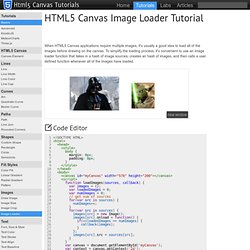
To simplify the loading process, it's convenient to use an image loader function that takes in a hash of image sources, creates an hash of images, and then calls a user defined function whenever all of the images have loaded. new window Code Editor Modified on April 8th, 2013 by Eric Rowell. 20 Shockingly Cool HTML5 Canvas Applications. HTML5 offers a wide variety of advanced functionality over what HTML was originally capable of.
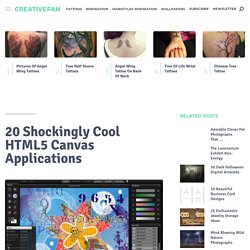
Perhaps the most powerful aspect of HTML5 is the HTML5 canvas. The canvas element is a drawable region defined in HTML code with height and width attributes. JavaScript code can access the canvas through a full set of drawing functions allowing for dynamically generated graphics. In this post, you’ll find 20 shockingly cool HTML5 canvas applications that show just a bit of the power of the canvas and demonstrates what you can accomplish with it. If you’re just getting started with HTML5, check out our other posts: Hopefully you find these really cool and inspirational! Let us know what you think in the comments!
Sketchpad Sketchpad by Michael Deal uses the canvas element and a lot of JavaScript to create an impressive painting application. Tiler3D-HTML5. O funciona o Flexbox do CSS3. Fairway Technologies. Brett Humphrey Chief Executive Officer Brett founded Fairway Technologies in early 2002 as a means to support his desire to work directly with local high-tech businesses.

Previously, he had worked as a senior consultant at a San Diego-based software company, and it was his endeavor to provide reliable and friendly software consulting services to clients in and around the San Diego area. Fairway’s business model of low-cost, longer-term client engagements quickly evolved into more than what Brett could manage alone, and attracting more high-caliber technology professionals was a natural progression for the growing number of clients that relied on him for their technology consulting. Brett contributes over a decade of IT industry experience, including certifications in several programming frameworks. Mike Mannion Chief Operations Officer Mike is a graduate of the University of California – Santa Cruz.
Noah Heldman Director of Technology Ray Mitchell. Isotope.