
The UCSC Genome Browser Introduction. Biotechnology Annual Review - UCSC Genome Browser: Deep support for molecular biomedical research. Molecular Biotechnology, Volume 38, Number 3. For beginners in the field, this review highlights the key features of the genome browser at UCSC for data display, and provides nearly step-by-step procedures for creating publication quality maps.
The browser offers an engine (Blat) for searching a known genomic DNA for correspondence with protein and DNA sequences specified by the user. The results provide links to graphical displays, known as maps. Users can create “designer maps” by adding Tracks to view various types of data and specific landmarks. The browser offers an extensive list of options. They include the position of annotated genes, the position of reference cDNA sequences (RefSeq from GenBank), the position of alternatively spliced mRNA species, and predictions derived from computational models to identify potential transcription start sites and potential protein binding elements in genomic DNA.
UCSC genome browser tutorial. [Genomics. 2008. The UCSC genome browser: what every mol... [Curr Protoc Mol Biol. 2009. The UCSC Genome Browser database: update 2... [Nucleic Acids Res. 2010. UCSC Genome Browser Home. Genome Browsers - Tyra Wolfsberg (2012) BITs: Genome browsers and interpretation of gene lists. BITS: UCSC genome browser - Part 1. BITS training - UCSC Genome Browser - Part 2. Rnomics Twitter timeline / dna limits. What the ‘limits of DNA’ story reveals about the challenges of science journalism in the ‘big data’ age. As a science journalist, I sympathize with book reviewers who wrestle with the question of whether to write negative reviews.
It seems a waste of time to write about a dog of a book when there are so many other worthy ones; but readers deserve to know if Oprah is touting a real stinker. On 2 April, Science Translational Medicine published a study on DNA’s shortcomings in predicting disease. My editors and I had decided not to cover the study last week after we saw it in the journal’s embargoed press packet, because my sources offered heavy critiques of its methods. All genomes are dysfunctional: broken genes in healthy individuals. Breakdown of the number of loss-of-function variants in a "typical" genome I don’t normally blog here about my own research, but I’m making an exception for this paper. There are a few reasons to single this paper out: firstly, it’s in Science (!) ; and secondly, no fewer than five Genomes Unzipped members (me, Luke, Joe, Don and Jeff) are co-authors.
Cryptic genetic variation promotes rapid evolutionary adaptation in an RNA enzyme (Hayden et al, Nature, 2011) Background Cryptic genetic variation (CGV) is defined as “standing genetic variation that does not contribute to the normal range of phenotypes observed in a population, but that is available to modify a phenotype that arises after environmental change or the introduction of novel alleles” [Gibson & Dworkin, 2004].
As such, CGV fills the gap between : 1. expressed genetic variation, defined as genetic variation that contributes to the normal range of phenotypes actually present in a population ; 2. neutral genetic variation, that does not contribute to phenotypes under any likely genetic or environmental conditions ; a typical example of neutral genetic variation would be synonymous substitutions in protein coding sequences. NIH VideoCasting and Podcasting. VideoCasting - Cancer Genomes Analysis: Computational Challenges and Approaches. Scientific Program. 近年様々なローンが販売されるようになり、目的に応じた個性的なローンの人気が急上昇中です。

We Are Data : Evan Anthony. Bits and Base Pairs A reflection on bits and base pairs.
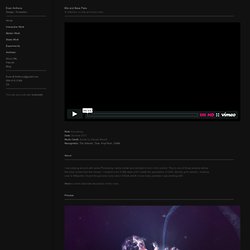
Role: EverythingDate: Summer 2011Music Credit: Apollo by Danger BeachRecognition: The Atlantic, Time, Pop! Tech, OWNI About I was playing around with some Processing I wrote earlier and decided to turn it into a short. The Genographic Project - Human Migration, Population Genetics, Maps, DNA - National Geographic. Here is a Twitter chat…with Misha Angrist. Introduction to automatic gene annotation (Cold Spring Harbor, NY, US) Chromosome Diagrams in Biopython. Online lecture series on genomics and bioinformatics. A current lecture course surveying genomics and bioinformatics is available online, hosted on YouTube by GenomeTV.
Handouts for the thirteen week course are hosted on the course website. We’re told that the course includes an update on technologies that have changed over the past two years. These lectures are introductory. They are aimed at biologists who wish to learn more about genomics or bioinformatics, perhaps because their upcoming work intersects with it, rather those who already have some detailed knowledge or experience of the field. I would add that, being lectures, they are high-flying in the sense that they do not deal with the actual hands-on work involved, which introduces finer detail and further issues not covered in these lectures.
The lectures cover a wide range of topics; the full schedule is shown below. Here’s the full course schedule: Readers looking for slides of the talks, should check the handouts available on the course website. The Genomic Landscape circa 2012 1. Richard Resnick: Welcome to the genomic revolution. Juan Enriquez on genomics and our future. Introduction to The 'Omics Age. Podcast : Frontiers in genetics and genomics. Guide to the UCSC Genome Browser. De novo genome assembly: what every biologist should know : Nature Methods. Asked how mature the field of genome assembly is, Ian Korf at the University of California, Davis, compares it to a teenager with great capabilities.
“It's got bold assertions about what it can do, but at the same time it's making embarrassing mistakes,” he says. Perhaps the biggest barrier to maturity is that there are few ways to distinguish true insight from foolish gaffe. Transcriptomes, bioinformatics, and light regulated genes « Fungal Evolutionary Genomics. A few papers from our work are now appearing.
This includes several collaborative papers that have been in progress for several years, so I’m happy to see them published. VISTA tools. VISTA is a comprehensive suite of programs and databases for comparative analysis of genomic sequences.
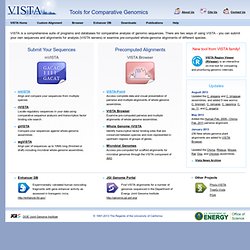
There are two ways of using VISTA - you can submit your own sequences and alignments for analysis (VISTA servers) or examine pre-computed whole-genome alignments of different species. mVISTAAlign and compare your sequences from multiple species rVISTALocate regulatory sequences in your data using comparative sequence analysis and transcription factor binding site search. gVISTACompare your sequences against whole-genome assemblies. wgVISTAAlign pair of sequences up to 10Mb long (finished or draft) including microbial whole-genome assemblies.
iSpecies. The Human Genome: A Decade of Discovery, Creating a Healthy Future: Agenda, Videos and Presentation Slides. 1000 Genomes Project data available on Amazon Cloud, March 29. Project is Exemplar of New White House Big Data Initiative The world's largest set of data on human genetic variation — produced by the international 1000 Genomes Project — is now publicly available on the Amazon Web Services (AWS) cloud, the National Institutes of Health and AWS jointly announced today.
The public-private collaboration demonstrates the kind of solutions that may emerge from the Big Data Research and Development Initiative announced today by the White House Office of Science and Technology Policy (OSTP) during an event at the American Association for the Advancement of Science in Washington, D.C. "The explosion of biomedical data has already significantly advanced our understanding of health and disease. Now we want to find new and better ways to make the most of these data to speed discovery, innovation and improvements in the nation’s health and economy," said NIH Director Francis S.
Collins, M.D., Ph.D. Current Topics in Genome Analysis 2012. Genomics Q & A: Insights and Impacts. Bio Nadav Ahituv Nadav Ahituv is an Assistant Professor in the Department of Bioengineering and Therapeutic Sciences and the Institute for Human Genetics at the University of California, San Francisco. Personal Cancer Genomics. Bio David Haussler David Haussler is the Distinguished Professor of Biomolecular Engineering and Director of the Center for Biomolecular Science & Engineering at the University of California, Santa Cruz. David Haussler's research lies at the interface of mathematics, computer science, and molecular biology. He develops new statistical and algorithmic methods to explore the molecular function and evolution of the human genome, integrating cross-species comparative and high-throughput genomics data to study gene structure, function, and regulation.
He is credited with pioneering the use of hidden Markov models (HMMs), stochastic context-free grammars, and the discriminative kernel method for analyzing DNA, RNA, and protein sequences. To download this program become a Front Row member. ZOOM IN: Learn more with related books and additional materials. Encyclopædia Britannica Article.