
Google Project Soli: hand control to replace touch screen (VIDEO). Like-A-Hug Vest Inflates When You Get a Facebook Like. Down The Digital Rabbit Hole As We Automate Everything. Eye-controlled 'i beam' tablet lets you strap-hang safely. Google Maps now lets armchair scuba divers explore the Great Barrier Reef and more. Watch the Human Mind Explode a Watermelon. Have you ever come home from a stressful day at work and felt like smashing a watermelon to pieces?

Only, you didn't feel like getting up from the couch to do so? Well, stress no more — now all you have to do is think. LVL1, a hackerspace in Louisville, Ky., designed a get-up that gives folks the ability to blow up a watermelon — using only their minds. Here's how it works: The user (or fruit-destroyer) wears an EEG headset to interpret his or her brain waves. Then those signals are transferred into wireless impulses and sent to a CO2 cannon mounted at the bottom of the fruit. (This almost surely would have put Gallagher and his Sledge-O-Matic act out of business back in the day.)
SEE ALSO: Fly This Mind-Controlled Quadrotor Using Your Thoughts. Opinion: Tablets are changing the tech you use, whether you own one or not. Developers Are Flocking To Leap Motion To Revolutionize The Way We Interact With Our Macs. Leap Motion‘s worldwide call for developers “to imagine and create the future” has resulted in a virtual stampede of interested parties applying for the Leap SDK, which will allow them to make apps using Leap Motion’s revolutionary 3D motion tracking technology.

Leap Motion is a San Francisco company developing the world’s most powerful and sensitive 3D motion-control and motion-sensing technology. Leap Motion’s first product, the Leap — featured with an exclusive hands-on video demonstration on Cult of Mac last month — will be available in early 2013. The Leap is the first product to let users navigate and interact with computer applications using natural hand and finger movements. Xbox 'Power Glove' Offers Precise, Kinect-Like Gesture Control.
Behold Ben's glove of power.
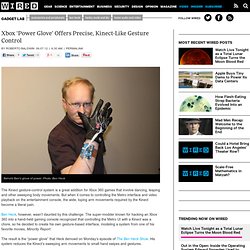
Photo: Ben Heck The Kinect gesture-control system is a great addition for Xbox 360 games that involve dancing, leaping and other sweeping body movements. But when it comes to controlling the Metro interface and video playback on the entertainment console, the wide, loping arm movements required by the Kinect become a literal pain. Leap Motion. 5 Exciting Innovations That Will Change Computing in 2012. The mouse, having played its role in the transformation of the personal computer, is now almost outdated.
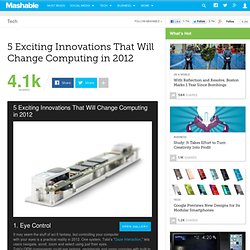
If you think about it, when the mouse was first invented in the 1960s, computers were unrecognizable from the sleek, sophisticated devices we use today. So has the mouse had its day? Technical innovations are incoming in the next year or so that promise to bridge the gap between the physical and digital worlds like never before, whether that's controlling your computer with gestures, opening programs with your eyes or extending the menu options for touchscreens with wearable devices. Take a look through our gallery of interesting innovations in the computing world. This May we'll be exploring the future of tech and many other digital trends at our signature conference, Mashable Connect.
Event Information Held in a unique location away from everyday distractions, Mashable Connect is a rare and valuable opportunity to be surrounded by digital leaders across industries. Stop and Start Your Music With Hand Gestures. Skipping tracks and pausing your music is something that you probably do twenty to thirty times a day.
If you’re at work and someone starts chatting with you, you’ll start seeking out the pause button until the conversation is done. What if you didn’t have to click a button at all? A new app by a company called Flutter lets you simply hold your hand up to your webcam to start and stop your music and it’s pretty freaking awesome. Microsoft Demos Super Fast Touchscreen Display. Brainwave-controlled skateboard is totally mental. Remember the Board of Awesomeness , the Kinect-controlled motorized skateboard from CES?
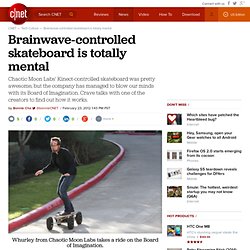
Well, it just got more awesome. Singing gloves give new meaning to jazz hands. Hand gestures can add a lot to a conversation.
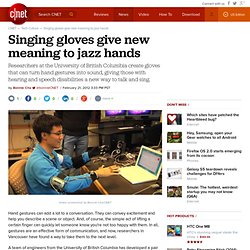
They can convey excitement and help you describe a scene or object. And, of course, the simple act of lifting a certain finger can quickly let someone know you're not too happy with them. In all, gestures are an effective form of communication, and now, researchers in Vancouver have found a way to take them to the next level. A team of engineers from the University of British Columbia has developed a pair of gloves that read hand gestures and convert them to speech and song, potentially giving those with speech and/or hearing disabilities another way to communicate. The project, called Digital Ventriloquized Actor (DIVA) and led by UBC professor of electrical and computer engineering Sidney Fels, tries to replicate the movements of real vocal cords through the use of hand gestures read by a system of sensors.
The right glove features 3D motion sensors that can detect whether your hand is open or closed. (Via New Scientist) Mattel plans to make ‘Back to the Future’ hover boards. Likely hoping to capture the same frenzied, nostalgic excitement that was created by the release of the Nike Mags, Mattel has just announced that the company will be creating a 1:1 replica of the hover board used by Michael J.

Fox’s character in both Back to the Future II and Back to the Future III. As mentioned on the Matty Collector blog, Mattel will be taking preorders for the hover board between March 1 to March 20, 2012. Apple introduces us to the Wild World of Coded Magnets. Apple's Patent Background Electronic devices are common in both home and work environments.
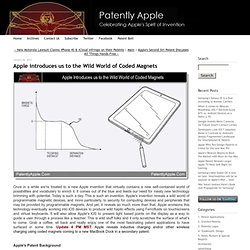
Such devices often transmit data back and forth in order to operate or share information. In many cases, data transmission is unsecured or conventionally secured by methods that are easy to defeat. Physical security of certain items, such as computing devices, also may be desirable. Magnetic structures may aid in securing physical access. What are described herein are apparatuses, methods and systems for implementing various types of security through the use of correlated magnetic structures. Key iPad and Stylus Example Apple's invention is very complex and in order to understand where Apple's invention could be implemented, we think it best that we first present you with Apple's primary product implementation example first, rather than towards the end of our report as is presented in Apple's patent application.
Lenovo IdeaCentre A720: a Microsoft Surface for the rest of us (hands-on video) Okay, so it's not a 46-inch table that supports 20 points of input, but Lenovo's IdeaCentre A720 does morph into a pretty sweet flat panel horizontal surface for only $1,299.
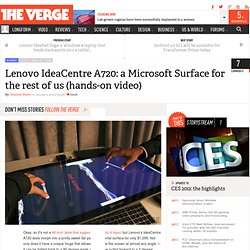
Not only does it have a unique hinge that allows it to adjust the screen at almost any angle — it can be folded back to a 90 degree angle and then be pulled forward to a 5 degree angle — it's also only 25.4mm thick. Lenovo's claiming that's the "industry's thinnest" 27-inch all-in-one, but I have to say that Samsung's Series 7 seems to have a thinner profile, although that only has a 23-inch display. The A720 won't be available for a while — though it will be sometime in the first half of the year — but we do know that it will have Intel Core processors, Nvidia graphics, and up to a terabyte of storage. Why Angry Birds is so successful and popular: a cognitive teardown of the user experience.
The usual question: Over the past 30+ years as a consultant in the field generally known as human factors engineering (aka usability engineering), I have been asked by hundreds of clients why users don’t find their company’s software engaging. The answer to this persistent question is complex but never truly elusive. This question yields to experience and professional usability analysis. The unusual question: Surprisingly, it is a rare client indeed who asks the opposing question: why is an interface so engaging that users cannot stop interacting with it? This is a difficult question because it requires cognitive reverse engineering to determine what interaction attributes a successful interface embodies that result in a psychologically engaging user experience. This question pops up when products become massively successful based on their user experience design – think iPhone, iPad, Google Instant Search, Nintendo Wii, Microsoft Kinect. Synaptics Demonstrates Windows 8 Trackpad Gestures On Video.
We heard a while back that Windows 8 would support multi-touch via the trackpad. Sure, there’s some stuff you can do right now, but the promise made by Microsoft and Synaptics has been deferred for the most part. But they’ve put up a video that shows just how you can expect to interact with Windows 8 and Metro using a multi-touch trackpad. You can watch the video here, but I’ve embedded it here as well for your convenience: I have to say that some of these things look extremely handy.
I use a PC desktop and a Mac laptop, and each one is jealous of the other for several reasons. Essentially what they’re doing is just mapping your input on the large touchscreen into the normal touch driver; the difficulty is probably the precision and filtering, determining exactly where that finger is so you can provide touchscreen-level accuracy. The Story of 'Pah!', The Voice-Controlled Mobile Game.
The Next Web has covered a broad spectrum of stories from Internet Week Europe, taking in everything from Jimmy Wales and Jason Calacanis, to what big tech firms mean for the UK startup scene and startup survivor stories. And today we were at the Power of One conference at Battersea Power Station in South West London, an event focused on getting developers and entrepreneurs together to celebrate how much the individual can achieve in today’s tech industry. A Brief Rant on the Future of Interaction Design. Gesture-Based Login Apps For iPad And iPhone Aim To Banish Passwords From Touchscreens.