
Mandatos de nosotros. The Citizen Lab. Canadian Internet Policy and Public Interest Clinic (CIPPIC) - Canadian Internet Policy and Public Interest Clinic (CIPPIC) Knowledge economy. MIT Center for Collective Intelligence. Forget IQ, Collective Intelligence is the New Measure of Smart (video. We may focus on the stories of individual genius, but it will be harnessing the intelligence of the collective that enables humanity to solve its future problems.

Do you know your IQ, that little number that’s supposed to measure how smart you are? Forget it. Individual intelligence is old news, collective intelligence (CI) is the future. And it’s already here. Google lets you access the collective records of the world via internet searches. Collective intelligence can include distributed computing. Another reason why CI will dominate IQ is that individual intelligence is subsumed by the collective. To this end, CCI at MIT is working to understand and guide collective intelligence. Collective intelligence can also take the form of collective art or creativity. Kim-Ung Yong might be the world’s smartest man, his IQ is reportedly 210. [sources: Indiana University, CCI at MIT] The Collective Intelligence Genome - The Magazine - MIT Sloan Management Review. Lewis Mumford. Lewis Mumford, KBE (October 19, 1895 – January 26, 1990) was an American historian, sociologist, philosopher of technology, and literary critic.
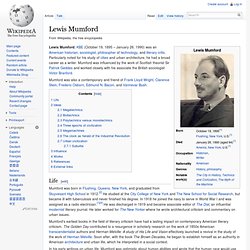
Particularly noted for his study of cities and urban architecture, he had a broad career as a writer. Mumford was influenced by the work of Scottish theorist Sir Patrick Geddes and worked closely with his associate the British sociologist Victor Branford. Life[edit] Mumford was born in Flushing, Queens, New York, and graduated from Stuyvesant High School in 1912.[2] He studied at the City College of New York and The New School for Social Research, but became ill with tuberculosis and never finished his degree. In 1918 he joined the navy to serve in World War I and was assigned as a radio electrician.[1][3] He was discharged in 1919 and became associate editor of The Dial, an influential modernist literary journal. Mumford's earliest books in the field of literary criticism have had a lasting impact on contemporary American literary criticism.
Technics and Civilization. Technics and Civilization is a 1934 book by American philosopher and historian of technology Lewis Mumford.

The book presents the history of technology and its role in shaping and being shaped by civilizations. According to Mumford, modern technology has its roots in the Middle Ages rather than in the Industrial Revolution. It is the moral, economic, and political choices we make, not the machines we use, Mumford argues, that have produced a capitalist industrialized machine-oriented economy, whose imperfect fruits serve the majority so imperfectly. Background[edit] Apart from its significance as a monumental work of scholarship in several disciplines, Mumford explicitly positioned the book as a call-to-action for the human race to consider its options in the face of the threats to its survival posed by possible ecological catastrophe or industrialised warfare. Synopsis[edit] Berkman Center. Civil liberties. Online Freedom. Economy: The New Paradigm.
Innovating civic media tools and practices and testing them in communities. Wikinews and Multiperspectival Reporting. Wikinews is a wiki in which users write news articles collaboratively.
The project, established in 2004, is run by the Wikimedia Foundation, the organization that also supports Wikipedia. Wikinews has produced over 37,000 articles in 22 languages, with roughly one quarter of those in the English language version of the site. The site foundered early; its output seems to have stabilized to about 4-6 news articles daily, compared to an average of 16 articles each day in 2004. Comparing Wikinews to other “participatory” news sites such as Ohmynews and Indymedia, Axel Bruns contrasted “multiperspectival coverage of the news” with the Wikinews collaborative model. Bruns concluded that Wikinews’ troubles stem, at least in part, from the project’s strong adherence to the neutral point of view (NPOV) principle adopted from the Wikipedia project–a complex concept that aims to ensure that a variety of different perspectives are fairly integrated into an article in an unbiased way.