
K... Construcción Colaborativa del Conocimiento. A lo largo de la historia de la humanidad, los procesos creativos en sus diferentes manifestaciones (científicos, tecnológicos o artísticos) se vieron limitados por la velocidad de la propagación de ideas y por la falta de contacto entre pares separados geográficamente.

Con el transcurso de los siglos se han reducido paulatinamente esas barreras, y en la actualidad pasamos por un momento de inflexión, de modo que la manera de colaborar con nuestros pares está por dar un vuelco radical. El contacto por internet está cambiando la forma de producir conocimiento. En especial durante el siglo xx, con el constante desarrollo de medios de comunicación y transporte, la producción y transmisión de conocimiento se fueron globalizando; pero, en buena medida, se mantuvieron regidas por corporaciones de medios, ya sean comerciales, artísticos o académicos. Este trabajo deriva de la intención de formalizar, desde un punto de vista multidisciplinario, cómo va operando esta transformación.
Culture, genes and the human revolution - Matt Ridley. FOXP2 is not the only gene associated with the human revolution (3).

However, it illustrates that when an evolutionary mutation is identified as crucial to the human capacity for cumulative culture, this might be a consequence rather than a cause of cultural change (8). The smallest, most trivial new habit adopted by a hominid species could— if advantageous—have led to selection of genomic variations that sharpened that habit, be it cultural exchange, creativity, technological virtuosity, or heightened empathy. This viewpoint is in line with recent understanding of the human revolution as a gradual but accelerating process, in which features of behaviorally modern human beings came together piecemeal in Africa over many tens of thousands of years (6). Recognizing the role of culture-driven gene evolution in the origins of modern humans provides a powerful reminder of how easy it is to confuse cause and effect in science.
References and Notes 1. 2. 3. 4. 5. 7. Stigmergy. Kind people have stigmergically translated this article into German, French, and Spanish.
This article is part of a series now incorporated into : ‘Binding Chaos’. Stigmergy is a mechanism of indirect coordination between agents or actions. The principle is that the trace left in the environment by an action stimulates the performance of a next action, by the same or a different agent. In that way, subsequent actions tend to reinforce and build on each other, leading to the spontaneous emergence of coherent, apparently systematic activity. Stigmergy is a form of self-organization. A personality based system can never allow for mass collaboration on a global scale without representation such as that seen in organizations like the United Nations. Currently, the typical response to a situation which requires an action is to create a noun, in the form of a committee, commission, organization, corporation, ngo, government body, etc. Most systems are now run by competitive organizations.
Nodes. What is Connected Learning. Ninth-grader Charles Raben has seen first-hand that by connecting the many spheres of his life -- peers, interests and academic pursuits -- new learning experiences can and will present themselves in both organized and unstructured ways.
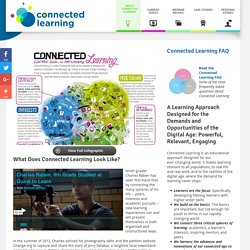
In the summer of 2012, Charles utilized his photography skills and the petition website Change.org to capture and share the story of Jerry Delakas, a longtime local newsstand operator who was in danger of losing his New York City license over a technicality. "I wanted to have that experience of creating change myself.
" The petition-making process proved to be a life-changing learning experience for the teen. Charles has become even more engaged in school, and all of his academic work is improving as a result of all of these activities because he has an identity now. A single sentence on his photography blog eloquently bares this newfound identity: "Each face tells a story and I try to capture just that. " Connected Learning.