
Castles. History. Ancient Web. Archives: Valuable resources on IBM's history. History of swimwear. The history of swimwear began with no swimwear in classical antiquity to no swimming in the middle ages, and cumbersome dresses in the early modern age to scanty and hi-tech swimwear in the modern ages.
Classical ages In classical antiquity swimming and bathing were done naked. There are Roman murals which show women playing sports and exercising wearing two-piece suits covering the areas around their breasts and hips in a fashion remarkably similar to the present-day bikini. However, there is no evidence that they were used for swimming. All classical pictures of swimming show nude swimmers. Osborne House. Coordinates: Osborne House is a former royal residence in East Cowes, Isle of Wight, UK.
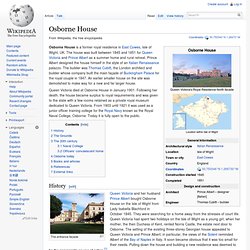
The house was built between 1845 and 1851 for Queen Victoria and Prince Albert as a summer home and rural retreat. Ship of Dreams. Gallo Roman. Fonthill Abbey - William Beckford. Viewzone Magazine: A look at life and human culture from different angles. Belton House. South (front) facade of Belton House Belton House is a Grade I listed country house in Belton near Grantham, Lincolnshire, England.
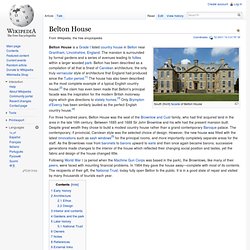
The mansion is surrounded by formal gardens and a series of avenues leading to follies within a larger wooded park. Belton has been described as a compilation of all that is finest of Carolean architecture, the only truly vernacular style of architecture that England had produced since the Tudor period.[1] The house has also been described as the most complete example of a typical English country house;[2] the claim has even been made that Belton's principal facade was the inspiration for the modern British motorway signs which give directions to stately homes.[3] Only Brympton d'Evercy has been similarly lauded as the perfect English country house.[4]
Woolsthorpe Manor. Apple tree in garden where Newton observed an apple fall Woolsthorpe Manor in Woolsthorpe-by-Colsterworth, near Grantham, Lincolnshire, England, was the birthplace of Sir Isaac Newton on 25 December 1642 (old calendar).
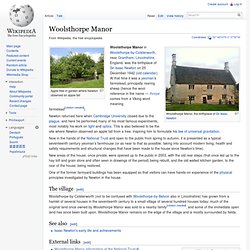
At that time it was a yeoman's farmstead, principally rearing sheep (hence the wool reference in the name — thorpe comes from a Viking word meaning farmstead[citation needed]). Newton returned here when Cambridge University closed due to the plague, and here he performed many of his most famous experiments, most notably his work on light and optics. This is also believed to be the site where Newton observed an apple fall from a tree, inspiring him to formulate his law of universal gravitation. Clouds Hill. The front of Clouds Hill Clouds Hill is an isolated cottage near Wareham in the county of Dorset in South West England.
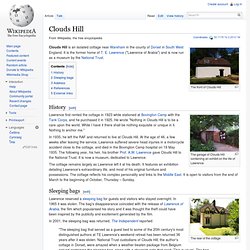
It is the former home of T. E. Nautilus. The Nautilus (1800).
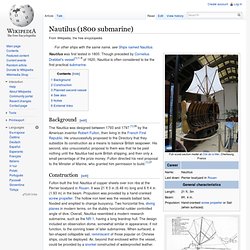
Nautilus was first tested in 1800. Though preceded by Cornelius Drebbel's vessel[1]:1–8 of 1620, Nautilus is often considered to be the first practical submarine. The Nautilus was designed between 1793 and 1797 [1]:36 by the American inventor Robert Fulton, then living in the French First Republic. He unsuccessfully proposed to the Directory that they subsidize its construction as a means to balance British seapower. His second, also unsuccessful, proposal to them was that he be paid nothing until the Nautilus had sunk British shipping, and then only a small percentage of the prize money. Nautilus was designed from the start to carry what Fulton called a "carcass", a naval mine intended to be dragged into contact with an enemy ship.
BBC/OU Open2.net - Management & Organisations - The Virtual Revolution. [Ancient] Rome. Trojan Horse. Rosetta stone. Ever since its rediscovery, the stone has been the focus of nationalist rivalries, including its transfer from French to British possession during the Napoleonic Wars, a long-running dispute over the relative value of Young and Champollion's contributions to the decipherment, and since 2003, demands for the stone's return to Egypt.
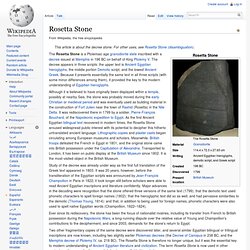
Strange Maps. Abandoned Buildings, Forgotten Places, Industrial waste grounds. Titian. During the course of his long life, Titian's artistic manner changed drastically[4] but he retained a lifelong interest in color.
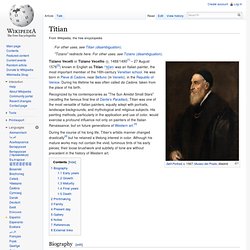
Although his mature works may not contain the vivid, luminous tints of his early pieces, their loose brushwork and subtlety of tone are without precedent in the history of Western art. Biography[edit] Early years[edit] The exact date of Titian's birth is uncertain. When he was an old man he claimed in a letter to Philip II, King of Spain, to have been born in 1474, but this seems most unlikely.[6] Other writers contemporary to his old age give figures which would equate to birthdates between 1473 to after 1482.[7] Most modern scholars believe a date nearer 1490 is more likely; the Metropolitan Museum of Art's timeline supports c.1488, as does the Getty Research Institute.[8] Antique Maps, Old maps, Vintage Maps, Antique Atlases, Old Atlases. History. Pruned. Myths and legends.
The Sutton Hoo Society. History-Victorian. Best of History Web Sites. Historyteacher.net. Smarthistory. Victor Ambrus. Mick Aston. Michael Antony "Mick" Aston, FSA (1 July 1946 – 24 June 2013) was an English archaeologist who specialised in Early Medieval landscape archaeology.
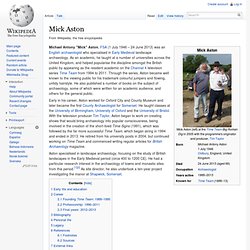
As an academic, he taught at a number of universities across the United Kingdom, and helped popularise the discipline amongst the British public by appearing as the resident academic on the Channel 4 television series Time Team from 1994 to 2011. Through the series, Aston became well known to the viewing public for his trademark colourful jumpers and flowing, untidy hairstyle. Current Archaeology - Home.