
Cultural Institute. Internet Archive: Genealogy Resources. 26 Topics: United States -- Genealogy, England -- Emigration and immigration, United States -- Biography,... favoritefavorite ( 4 reviews ) Topics: Cherokee Indians -- History, Cherokee Indians, Cherokee Indians -- Genealogy Edited by William Armstrong Crozier Topic: genealogy American Libraries by Egle, William Henry, 1830-1901 texts eye favorite 24 comment 0 Replace; Topics: Pennsylvania -- Emigration and immigration, Pennsylvania -- Genealogy University of Toronto - Robarts Library A collection of upwards of thirty thousand names of German, Swiss, Dutch, French and other immigrants in Pennsylvania from 1727 to 1776 : with a statement of the names of ships, whence they sailed, and the date of their arrival at Philadelphia, chronologically arranged, together with the necessary historical and other notes, also, an appendix containing lists of more than one thousand German and French names in New York prior to 1712 by Rupp, I.
Favorite 28 Allen County Public Library favorite 9 The Library of Congress. Internet Archive: United States Census's from 1790 to 1930. Internet Archive: 1930 United States Census. Fascinating records of more than 67,000 19th century criminals published online for the first time. By Daily Mail Reporter Published: 04:22 GMT, 14 June 2012 | Updated: 10:49 GMT, 14 June 2012 You certainly wouldn't want to meet any of this lot up a dark 19th century alley.
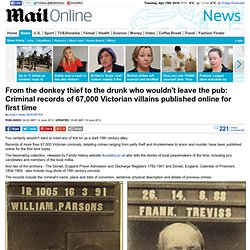
Records of more than 67,000 Victorian criminals, detailing crimes ranging from petty theft and drunkenness to arson and murder, have been published online for the first time today. The fascinating collection, released by Family history website Ancestry.co.uk also tells the stories of local peacemakers of the time, including jury candidates and members of the local militia. And two of the archives - The Dorset, England Prison Admission and Discharge Registers 1782-1901 and Dorset, England, Calendar of Prisoners 1854-1904 - also include mug shots of 19th century convicts. The records include the criminal's name, place and date of conviction, sentence, physical description and details of previous crimes. 'Others can uncover compelling information about forgotten members of society who were down on their luck.
Southwell workhouse correspondence. This series consists of correspondence of the Poor Law Commission, the Poor Law Board and the Local Government Board with Poor Law Unions and other Local Authorities.
It covers the years 1834 to 1900. Poor law unions were collections or groups of parishes brought together to administer poor relief. Earlier 'unions' were refered to as 'incorporations' and some of these existed until the 1860s (which is why for some areas there are no correspondence until the old incorporation was dissolved and the new union organised). The Victorian poor law was predicated on the 'workhouse test'. This is where poor relief would be offered via the 'deterrent workhouse', designed to be an institution of last resort.
The papers range through the whole field of poor law and (after 1871) local government and public health administration. Digital copies of selected 19th Century Poor Law Union and Workhouse records from MH 12 can be searched and downloaded. British Newspaper Archive. British Library newspaper archive puts 300 years of history online.