
Twenty Million Minds Foundation. Files/2012/08/01/-disaggregating-the-components-of-a-college-degree_184521175818.pdf. Stretching the higher education dollar - Education - AEI. Daphne Koller: What we're learning from online education. Sick of paying for textbooks? Get them now, free and online. In the same way that free open online courseware is threatening to disrupt traditional universities, open textbook initiatives such as OpenStax College from Rice University threaten to do the same to the traditional textbook market.
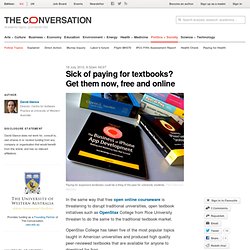
OpenStax College has taken five of the most popular topics taught in American universities and produced high quality peer-reviewed textbooks that are available for anyone to download for free. OpenStax College aims to try and save students at least $90 million over five years by capturing 10% of the US textbook market. Authors of textbooks in Flat World Knowledge receive a royalty on sales of printed versions of their textbooks, whereas authors contributing towards Rice University’s venture are volunteering their efforts. Bookboon funds open access through the inclusion of advertising in the books. Lessons learned from MITx’s prototype course. A series of screenshots from 6.002x, the first course offered through MITx (credit: MIT) Last December, MIT announced the creation of MITx, an ambitious project to recreate the MIT classroom experience online.
In March, the MITx prototype course — “Circuits and Electronics,” (6.002x) — debuted. In May, MIT and Harvard University jointly announced the creation of edX, an organization that will further develop the MITx platform and enable other universities to use it as well. Experts speculate on possible business models for MOOC providers. Massively open online courses, or MOOCs, do not currently lead to any widely recognized credential.
Still, with more than 1.5 million people having registered for MOOCs through Coursera, Udacity and edX, the demand for the novel online offerings is undeniable. StartX – Stanford Student Startup Accelerator – Apply Today! University of Florida Eliminates Computer Science Department, Increases Athletic Budgets. Hmm. Blog » From 100 Students to 100,000. Typically I teach around 100 students per year in my introductory database course.
This past fall my enrollment was a whopping 60,000. Admittedly, only 25,000 of them chose to submit assignments, and a mere 6500 achieved a strong final score. But even with 6500 students, I more than quadrupled the total number of students I’ve taught in my entire 18-year academic career. The story begins a couple of years earlier, when Stanford computer science faculty started thinking about shaking up the way we teach. What You (Really) Need to Know. Reinventing the Lecture. Educating the 21st Century. Plan Your Free Online Education at Lifehacker U: Spring Semester 2012. 400 Free Online Courses from Top Universities. Advertisment Take online courses from the world’s top universities for free.
Below, you will find 1,700 free online courses from universities like Yale, MIT, Harvard, Oxford and more. You can use this collection of online courses to learn everything you want–from history, philosophy and literature, to physics, biology, psychology, and computer science. Our site also features collections of Online Certificate Programs and Online Degree & Mini-Degree Programs. The Lean Launchpad. Stanford's open courses raise questions about true value of elite education. Can't Pay? Don't Pay! Or, Become An Edu-Punk: Some Solutions To The Problem Of Student Debt. A college education has become the key to entering the middle-class, but do student loans negate that possibility?
Chances are, if you have a college or postgraduate degree, you also have student loans to pay back. Nationwide, Americans have around $1 trillion in education debt; each year, the cost of tuition at universities is rising (it rose 5.9 percent in 2008 at private universities and 6.4 percent at public ones).
In a healthy economy, students would ideally find salaried jobs upon graduation and begin paying loans back. But with unemployment in the U.S. hovering around nine percent, many former students are struggling to pay back loans or defaulting. One of the issues most prominent on the 99 Percent tumblr blog is the burden of student debt. Alan Collinge, who founded StudentLoanJustice.org, was camped-out at Zuccotti Park in New York City with Occupy Wall Street, until the police raided it last Monday night.
Distance Learning Courses and Adult Education - The Open University. So who owns our universities then? The Nolan inquiry assumes that standards in public life need to be different and implicitly higher than in private life, or at the very least the public nature of the activity requires conduct to be more open and visible.
Most people would agree with that although some, including myself, would argue that the public/private distinction is in reality extremely blurred and that so-called "private" institutions should be subject to the same principles of openness and visibility as so-called "public" institutions. So what makes an organisation "public"? I suppose the key criteria are that it receives its funds from public sources, ie taxation, and is deemed to spend these funds for the public good. Government, both central and local, is in this category. Equally, those bodies known as quangos which make detailed allocations of government funds such as the Higher Education Funding Council seem pretty unambiguously public in this sense.
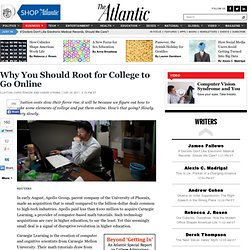
Released: Nation's First Interactive Web 2.0 Open Source Textbook Free to Students Through For-Profit Giant, Nonprofit Team - PR Newswire. Why You Should Root for College to Go Online - Clayton Christensen and Henry Eyring - Business. If tuition costs slow their fierce rise, it will be because we figure out how to take some elements of college and put them online.
How's that going? Connexions - Sharing Knowledge and Building Communities. Inkling - Interactive textbooks for iPad. Stanford School of Engineering - Stanford Engineering Everywhere. Friends Don’t Let Friends Take Education Advice From Peter Thiel. My friends, my followers on Twitter, and people who’ve read my previous posts know that I have a very strong opinion about education: that it is absolutely necessary in order for you to build a foundation for success.
Despite having appointments at five elite universities, I am not a proponent of elite education. Rather, my research led me to conclude that ivy-leaguers may be able to get their buddies from Sequoia and Kleiner to return emails, but aren’t going to be any more successful at building companies; that what matters is gaining a basic education and completing what you started—not the ranking of the school you graduate from. I am one of the people who Sarah Lacy predicted would be “pissed” when they read her post quoting Peter Thiel as saying “we’re in a bubble and it’s not the Internet. It’s higher education”. All Units. Chinese University Lectures : Free Education : Download & Streaming : Internet Archive. Virtual Labs. Imagine what your students could accomplish if they had access to the resources in the campus computer lab whenever, wherever they needed them.
The Dell Virtual Labs advantageDell Virtual Labs uses desktop virtualization technology to make this vision a reality. With Dell's solution, the campus lab is virtually located in a centralized data center that is remotely accessible by students, faculty and staff, which: Allows students access to lab applications and data from any device, anywhere — whether they’re in the library, their dorm rooms or off campus.
Provides the same performance to students, faculty and staff no matter what operating system or device they’re using. Reduces the time IT staff spends managing desktop devices and frees up time for more strategic projects.Using Intel® technology and desktop virtualization, Dell is helping students cross the digital divide without having to cross campus. Peter Thiel: We’re in a Bubble and It’s Not the Internet. It’s Higher Education. Fair warning: This article will piss off a lot of you.
UnCollege. OpenLearn - The Open University. Higher Education’s Toughest Test. Editor’s note: This post is co-authored by guest contributors Jon Bischke and Semil Shah. Bischke founded eduFire and RG Labs and is an advisor to Altius Education and Udemy. Disrupting College. SOURCE: AP/Matt Cilley This emerging disruptive innovation—online education—also presents an opportunity to rethink many of the age-old assumptions about higher education. By Clayton M. Christensen, Michael B. Horn, Louis Soares , and Louis Caldera | February 8, 2011 Download the full report (pdf) Download the executive sumary (pdf) Download the report to mobile devices and e-readers from Scribd Event: Disrupting College America is in crisis.
The institutions to which the country would turn to help tackle this challenge—its colleges and universities—are facing a crisis of their own. Our country’s dominant higher education policies have focused on expanding access for more than half a century—allowing more students to afford higher education. 300 Free Online Courses from Top Universities. Advertisment Take online courses from the world’s top universities for free. Below, you will find 1,700 free online courses from universities like Yale, MIT, Harvard, Oxford and more.
Our site also features collections of Online Certificate Programs and Online Degree & Mini-Degree Programs. Note: This page includes a lot of Massive Open Online Courses (MOOCs). If you want to enroll in a free version of a MOOC, please select the “Full Course, No Certificate” (edX) or “Audit” (Coursera) option. Humanities & Social Sciences Art & Art History Courses Classics Courses Communication Courses Economics & Finance Courses. Stanford offers ‘Introduction to Artificial Intelligence’ free online to anyone « SeekerBlog. COURSES — UCLA Office of Instructional Development.
PrepMe Online SAT, Online ACT, Online PSAT prep courses. AP Courses from MITE : Free Education : Download & Streaming : Internet Archive. The Higher Education Bubble. Student loans are one of the biggest problems facing our country at the moment.