Parcs Canada – Le coin de l’enseignant - Le Shale de Burgess - Un examen de la faune du Shale de Burgess. Un examen de la faune du Shale de Burgess Aperçu : On étudiera et on comparera aux animaux modernes, douze animaux fossilisés du célèbre Shale de Burgess (un site du patrimoine mondial de l’UNESCO, situé dans le parc national Yoho).
Il s’agit d’un exercice de taxinomie (classification) qui exige une pensée originale. Science. State Maine Calendar State Resources.
Earth History. Welcome to the USGS - U.S. Geological Survey. The Paleontology Portal. Paleogeography: From the Late Silurian through Early Devonian, continental positions changed little.
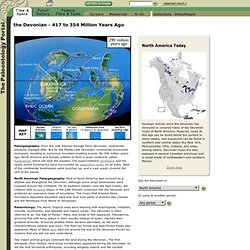
But by the Middle-Late Devonian, continental movement increased, resulting in numerous mountain-building events. By 390 million years ago, North America and Europe collided to form a large continent, called Euramerica, which sat near the equator. The supercontinent Gondwana and the newly joined Euramerica were surrounded by subduction zones on all sides. Most of the continental landmasses were bunched up, and a vast ocean covered the rest of the planet. North American Paleogeography: Most of North America was covered by a shallow sea throughout the Devonian, although some small landmasses were exposed around the continent. Geology.com: News and Information for Geology & Earth Science.
The Dynamic Earth @ National Museum of Natural History. Landforms - World Geography - Free Presentations in PowerPoint format, Interactive Games & Activities.