
Monument Valley: an iOS and Android game by ustwo. Gamifi-ED - Rubric to Evaluate Learning Games. Kids games - play online. Cooperative and Collaborative Learning: Explanation. What are cooperative and collaborative learning?

Collaborative learning is a method of teaching and learning in which students team together to explore a significant question or create a meaningful project. A group of students discussing a lecture or students from different schools working together over the Internet on a shared assignment are both examples of collaborative learning. Cooperative learning, which will be the primary focus of this workshop, is a specific kind of collaborative learning. In cooperative learning, students work together in small groups on a structured activity. They are individually accountable for their work, and the work of the group as a whole is also assessed. In small groups, students can share strengths and also develop their weaker skills. In order to create an environment in which cooperative learning can take place, three things are necessary.
Also, in cooperative learning small groups provide a place where: Free Online Learning Games for Kids. Trading Card Creator. The Trading Card tool gives students an alternative way to demonstrate their literacy knowledge and skill when writing about popular culture texts or real world examples.

This interactive allows students to create their own trading card about a real or fictional person, place, object, event, or abstract concept. These cards are can be used with any type of book students are reading or subjects that they are studying, and make for an excellent prewriting exercise for students who are writing narrative stories and need to consider characters, setting, and plot. Specific prompts guide student through the various types of cards, expanding students' thinking from the basic information and description of the topic to making personal connections to the subject.
Learning Games For Kids. Way - Coco & Co. MovingLearningGamesForward_EdArcade.pdf. Econauts. 35 Inspiring Game Examples for Gamification Mechanics. WHY?

MU Online is a very old and classic game, with some terrible graphics, but what they did well, was creating a whole system of elite items that were available to almost all levels. Mixed with easter eggs, and time events, they made the game so engaging and fun. HOW? Making some parts of our gamified system only available if players do some special stuff that we say it's a really powerful tool. As we have said, easter eggs and time events are the perfect companions! OHS isn't a game… or is it? RMIT University is transforming how students learn about health and safety in the construction industry through a new OHS game, to be unveiled at the inaugural Games for Change Festival in Melbourne this week.

Trouble Tower is an innovative research project that enables construction students to experiment with workplace hazards without experiencing the physical repercussions, in an informative and entertaining game environment. Dr Stefan Greuter, Associate Dean of Games and Animation in RMIT's School of Media and Communication, said high injury and incident rates were a concern in the construction industry. "One of the key challenges for occupational health and safety training is to engage learners," Dr Greuter said.
"Serious games are promising vehicles for motivating learners to engage with concepts they may consider boring, and can also help enhance retention. The research project was funded by the RMIT Learning and Teaching Investment Fund. More news For media enquiries: news@rmit.edu.au. Can Gaming Help Kids Learn? [INFOGRAPHIC] A Gamified Web 2.0 Tool To Make Students Into DIY Makers. Are you looking for an innovative way to encourage creative thinking, innovative ideas, and gamification in the classroom? Well then there’s a kid-friendly and parent-approved site called DIY.org that you should know about. What Is DIY.org? The DIY online club awards badges (called ‘Skills’ on the site) to students and kids of all ages in exchange for completing tasks. DIY Makers share their work with the community and get patches for the Skills they earn.
Each Skill consists of a set of Challenges that help them learn techniques to get the hang of it. It’s a fascinating site that’s beautifully designed and extremely fun and easy to use. The DIY site has an iOS app which works on iPhones, iPods and iPads. Great For Parents & Teachers The signup process is amazing. The DIY site is pretty straightforward but I found their FAQ so useful that I thought I’d share parts of it here. What are Skills? What happens when I earn a DIY Skill?
What’s the right age for kids to start using DIY? EteRNA, an Online Game, Helps Build a New RNA Warehouse. Nerdcore Learning. Game Based Learning Isn’t Always Electronic. 21stcenturylearning - MultimediaGames. PHYLO: THE TRADING CARD GAME. Classrooms are obsolete (and so are teachers) — Bruce On Games. “Oh no” I can hear you say, an article about education.
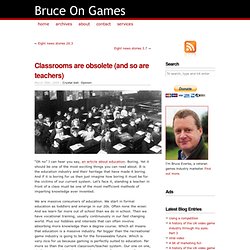
Boring. Yet it should be one of the most exciting things you can read about. It is the education industry and their heritage that have made it boring. And if it is boring for us then just imagine how boring it must be for the victims of our current system. Let’s face it, standing a teacher in front of a class must be one of the most inefficient methods of imparting knowledge ever invented. We are massive consumers of education. I have watched our industry try to get into education for thirty years. Teachers, at best, think that games are chocolate coated broccoli. With proper game based learning it is very simple to keep a track of every student’s progress.
It isn’t just goodbye to classrooms and teachers. But the people who stand to gain most are those with “learning difficulties” who just cannot get all the attention they need with current learning methods. So what are we going to do with all the teachers? Video Games, Social Media & Learning. Education, education, education — Bruce On Games. December 19th, 2007 | Crystal ball There is already an article on here about this.
Quite simply I believe that education will be the biggest area of video gaming. By education I don’t mean the dire low budget software that appeared on the BBC computer, whose progeny have been on the periphery of our industry ever since. No, I mean polished, big budget titles that educate whilst they entertain.
And not just in school.