
Quels modèles d'innovation aujourd'hui ? Le terme “d'innovation”, polysémique s'il en est, tend historiquement à être compris de façon limitée; souvent comme synonyme d’invention ou de recherche et développement, en particulier dans le domaine technologique.
Une telle approche mène à favoriser certains types de soutiens (pôle de compétitivité, projet de R&D, crédits impôt recherche, dispositifs JEI) au détriment d'une vision plus large. La notion d'innovation renvoie pourtant à des réalités très variées. Notons en particulier les changements de perspectives suivants amorcés depuis une quinzaine d'années :- Les finalités de l'innovation tendent à s'élargir ou à se multiplier : innovation sociale, culturelle, projets citoyens ou environnementaux.
Ce constat a deux conséquences directes. D'une part, les objectifs dans ces secteurs dépassent les logiques de compétition ou de croissance. Privatising public space (1) « thenextwave. One of the issues that the Occupy movement has brought into sharp focus is that of city land and its ownership.

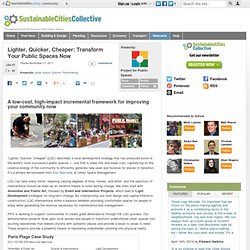
On Wall Street, Zuccotti Park is owned privately but heavily constrained by covenants. Occupy LSX ended up camped on ground partly by St Paul’s Cathedral and partly by the City of London Corporation because Paternoster Square, where the London Stock Exchange is located, is private land. In practice, urban land is increasingly owned or managed by private interests, even when it appears to be public space. Lighter, Quicker, Cheaper: Transform Your Public Spaces Now. A low-cost, high-impact incremental framework for improving your community now “Lighter, Quicker, Cheaper” (LQC) describes a local development strategy that has produced some of the world’s most successful public spaces — one that is lower risk and lower cost, capitalizing on the creative energy of the community to efficiently generate new uses and revenue for places in transition.
Textes des communications. Ville de demain : quelle place pour les personnes âgées ? - Solutions Durables. Imagining the United States Without Shopping Malls. If I were to ask you to list symbols of American consumerism, I bet the words “shopping mall” would come to mind pretty quickly.

And that’s because for the past 5 decades, shopping malls have been a dominant feature of the retail scene in a country that has more retail space than most. In 2009, NPR reported that the U.S. had 20 square feet of retail space per person (almost 7x as much as the country who came in 2nd, Sweden). James Howard Kunstler. A road map for tomorrow's cities by James Howard Kunstler I LOVE THOSE CITIES-of-the-future illustrations from the old pop-culture bin.

In “yesterday’s tomorrow,” they always get things so wonderfully wrong. One of my favorites, from the August 1925 issue of Popular Science Monthly, depicts a heroic cross section of New York’s Park Avenue looking to the south from around 47th Street in the far-off sci-fi future of 1950. “Airport landing fields” are denoted on the roof of a building that has replaced the familiar Grand Central Station tower at the end of the vista.
3D Map of London's Urban Complexity. Q&A with Chiara Camponeschi « Enabling Suburbs. Chiara Camponeschi is author of The Enabling City and works at the intersection of interdisciplinary research, social innovation and urban sustainability. 1.
What do you think are the most difficult challenges, contradictions and opportunities facing suburbs and their communities, or Aspley/your suburb and its community? Suburbs are particularly vulnerable places. Imagining an Elastic City. Planters and urban gardening tools at Kennedy Greenway in central Boston, the site of the Occupy Boston encampment.
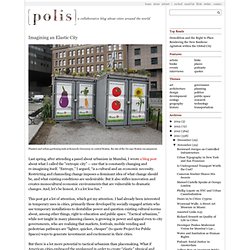
Last spring, after attending a panel about urbanism in Mumbai, I wrote a blog post about what I called the "entropic city" — one that is constantly changing and re-imagining itself. URBAN GAMES 2010/2011 // documents. 40 ans du Grand Lyon en feuilleton » Pourquoi ce feuilleton ? Policies for a Shareable City #10: Shareable Rooftops. UPDATE: We've summarized much of the series this article is part of in a new report, Policies for Shareable Cities: A Sharing Economy Policy Primer for Urban Leaders.
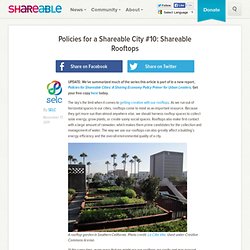
Get your free copy here today. The sky’s the limit when it comes to getting creative with our rooftops. As we run out of horizontal spaces in our cities, rooftops come to mind as an important resource. Because they get more sun than almost anywhere else, we should harness rooftop spaces to collect solar energy, grow plants, or create sunny social spaces.
Reinterpreting Green Space in cities. This post is also available in: Chinese (Traditional) ‘A product of the creative encounter between the man-made and the natural, between order and disorder, the garden can offer productive metaphors for the interactions between human life and time, care, thought or space.’
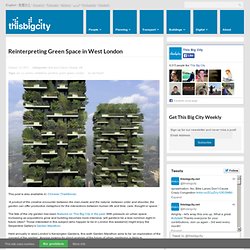
The fate of the city garden has been featured on This Big City in the past. With pressure on urban space increasing as populations grow and building becomes more intensive, will gardens be a less common sight in future cities? Thai Flood Hacks. LE GOUT DES VILLES IMAGINAIRES. Le goût des villes imaginaires Textes choisis et présentés par Jean-Noël MouretEd Mercure de France, 2011 Dans le vaste atlas des villes imaginaires, où commence le rêve, où s'arrête la réalité ?

Grand Theft Urbanism. I received the link to this video from Alain Renk. Alain is from UFO—Urban Fabric Organisation. The video showcases UFO’s Ville sans Limite (Unlimited Cities) initiative. Research into cities of the future to be boosted with new London centre. By Laura Gallagher Thursday 10 November 2011 London is becoming a global leader in future cities research, after Imperial College London, Cisco and UCL today entered into a three year initial agreement to create a Future Cities Centre in the capital.
See also: Related news stories: Temporary uses can enliven city neighborhoods.