
As Welfare State Collapses, Greeks Suffer and Fear Future. Eirini Vourloumis for The New York Times Boxes of papers in the tax office in the Pireaus district of Athens.

The Greek government is raising taxes and slashing pensions and salaries for state workers. “I’m not going to pay it,” Ms. Firigou, 50, said matter-of-factly, as she lighted a cigarette and checked her ringing cellphone to avoid calls from her bank about late payments on a loan. “I can’t afford to pay it. While banks and European leaders hold abstract talks in foreign capitals about the impact of a potential Greek default on the euro and the world economy, something frighteningly concrete is under way in : the dismantling of a middle-class welfare state in real time — with nothing to replace it.
Since 2010, the government has raised taxes and slashed pensions and state salaries across the board, in an effort to rein in the bloated public sector that today employs one in five Greeks. A clerk in her local town hall, Ms. Greece under pressure as finance ministers put brakes on bailout payment. European finance ministers on Friday heaped pressure on the Greek government to accelerate its privatisation programme and implement deeper spending cuts, after they told Athens a crucial €8bn (£6.9bn) bailout payment would be delayed until next month. Luxembourg prime minister Jean-Claude Juncker, who chaired a meeting of the eurogroup of single currency finance ministers in Poland on Friday, said officials recognised the renewed efforts by Greece to meet its fiscal targets, but a decision on releasing the next tranche of cash would not be taken until October.
The move was met with incredulity by Greek officials. They have already warned they will be out of money by mid-October and are reported to be making contingency plans to lay off public sector workers. The US treasury secretary, Tim Geithner, who flew to Poland on Friday to emphasise Washington's fears of a second financial meltdown, urged eurozone countries to expand their bailout fund to better tackle the debt crisis. Greek despair over further cuts sees suicide and crime rates on the rise.
It is 11pm.
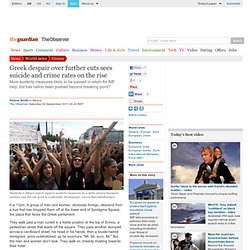
A group of men and women, obviously foreign, descend from a bus that has dropped them off at the lower end of Syntagma Square, the plaza that faces the Greek parliament. They walk past a man curled in a foetal position at the top of Ermou, a pedestrian street that leads off the square. They pass another slumped across a cardboard sheet, his head in his hands, then a tousle-haired immigrant, arms outstretched, as he murmurs: "Mr, Mr, euro, Mr.
" But the men and women don't look. They walk on cheerily chatting towards their hotel. Greeks feel drip-drip torture of austerity. Keiser Report: The Greek Depression (E190) Protest sit-in blocks Greece bailout meeting - Europe. Greece due to unveil plan to sack state workers. Hit by crisis, Greeks turn to barter networks. Greece Approves $8.8 Billion in Austerity. The Greek government said it passed a new budget backed by its international creditors, including larger deficits than previously forecast, as the country moves closer to securing an 8 billion-euro ($10.7 billion) aid payout needed to avoid default.
Prime Minister George Papandreou’s Cabinet also passed 6.6 billion euros of austerity measures last night to cut the 2012 deficit to 6.8 percent of gross domestic product, missing the 6.5 percent goal previously set with the European Union, International Monetary Fund and European Central Bank, known as the troika. Pain of debt crisis felt on Greek streets - Europe. Greece paralyzed by 24-hour strike by civil servants. Updated 2011-10-05 1:57 PM Police detain a demonstrator during a protest rally marking the 24-hour general strike today in Athens, Greece.
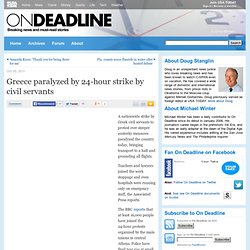
By Louisa Gouliamaki, AFP/Getty Images A nationwide strike by Greek civil servants to protest ever steeper austerity measures paralyzed the country today, bringing transport to a halt and grounding all flights. Teachers and lawyers joined the work stoppage and even hospitals were running only on emergency staff, the Associated Press reports. World financial crises visualised: how does Greece's debt restructuring compare? Meanwhile Greece Just Bought 400 Tanks From The US. General strike brings Greece to a standstill as public sector closes down. Merkel wins crucial vote on Greek bailout - Business. German Chancellor Angela Merkel has won a major vote in the Bundestag after deputies approved new powers for the European Union's bailout fund.

The vote in the lower house on expanding the $599bn bailout fund had been seen as a crucial test of Merkel's authority amid fears of a major backbench rebellion. Among the 611 deputies present, 523 approved the measure, 85 voted against it and three abstained. Only 15 deputies from her centre-right coalition voted against the measure or abstained after threats of a major backbench rebellion which would have delivered a stinging blow to her political authority. Traders and European partners had been on tenterhooks before the vote as Germany, the eurozone paymaster, became the 11th country among the 17 using the euro to agree to boost the scope and size of the fund, called the EFSF. Most European and US stock markets rose on Thursday in response to the Bundestag vote.
Greece’s Urgency Challenges European Union Efforts.