
Spiral Island - A Bottle Island that Floats. Then build your own island.

Richie Sowa did. He spent 2 1/2 years building his island off of Mexico's coastline. He built it using 250,000 spiral bottles, inserted into bags, and then tied with nets. He collected the bottles over the months, by picking them up from the beaches of Cancun. He also had people that would save them, and give them to him, as well. Welcome To Urban Farming! Urban agriculture. Urban agriculture is the practice of cultivating, processing, and distributing food in or around a village, town, or city.[1] Urban agriculture can also involve animal husbandry, aquaculture, agroforestry, Urban beekeeping, and horticulture.
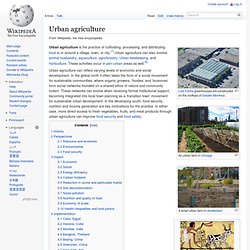
These activities occur in peri-urban areas as well.[2] Urban agriculture can reflect varying levels of economic and social development. In the global north it often takes the form of a social movement for sustainable communities, where organic growers, ‘foodies’ and ‘locavores’ form social networks founded on a shared ethos of nature and community holism. These networks can evolve when receiving formal institutional support, becoming integrated into local town planning as a ‘transition town’ movement for sustainable urban development.
In the developing south, food security, nutrition and income generation are key motivations for the practice. History[edit] Perspectives[edit] Resource and economic[edit] Environmental[edit] Food security[edit] Impact[edit] Inspiring Urban Farm Grows an Astonishing Three Tons of Produce a Year on a Mere 1/10 of an Acre. Carolanne Wright Contributing Writer for Wake Up World With food prices steadily rising over the last several years, by as much as five percent, families are scaling back and going without many staples just to put a meal on the table.

Or worse, resorting to ‘bargains’ like fast food specials, subsidized SNAP junk food or just plain instant noodles to fill a hungry belly. We have reached the point where self-sufficiency is not a luxury any longer, it’s a real necessity. In response, many are carving out a small homestead niche, even in the middle of lively cities. It isn’t much of a stretch to see our food dollars are shrinking. The tale begins in the mid-1980s when Jules Dervaes sold his property in rural Florida to head west and purchase a ramshackle fixer-upper in a low income Southern California neighborhood.
Garden - Growing 99 percent of produce - Saving seeds - Companion planting - Intensive growing methods - Polyculture/intercropping - Composting Food - Canning and drying - 12 solar panels.