
The Political Consequences of Mr. Morsi. The week, before demonstrations planned for 30 June demanding President Morsi step down and new elections be held, has been one of unsettling violence.

There is an increasing sense of foreboding that the political situation is spinning out of control. It is clearer to many what Egypt is not, (Turkey, Brazil, Tunisia, Eastern Europe) rather than what it is. With millions of Egyptians taking to the streets on 30 June, Egypt has entered into a new period of revolutionary upheaval. A Year In Office: Morsi’s Economic Mistakes. “I have made many mistakes,” conceded Egypt’s President Mohammed Morsi in a major speech last week after just one year in office.
While not elaborating on what exactly went wrong, Morsi will today be haunted by his mismanagement as thousands take part in anti-government demonstrations across the country. Rebel Economy is glad to shed light on the economic disasters of the last year: 1) The Failure of the Renaissance Project Even from the start, the president’s “economic plan” was someone else’s plan – a manifesto created by the Muslim Brotherhood’s first choice for president, Khairat el-Shater, until he was disqualified. Ambitiously called the Renaissance Project, or Al Nahda in Arabic, the 20-year plan trumpeted an Islamist roadmap for Egypt after the revolution in 2011.
The Project envisioned an ambitious transformation of Egypt’s economy that was expected to lead to a gross domestic product of 6.5% or 7% in five years, though how this growth rate would be reached was unclear. Conclusion. Can Morsi Survive? The Morsi presidency - analysis. Unpacking Anti-Muslim Brotherhood Discourse. Noam Chomsky’s Media Control: The Spectacular Achievements of Propaganda argues that effectively crafted and controlled media messages can turn otherwise rational people into “hysterical” warmongers.
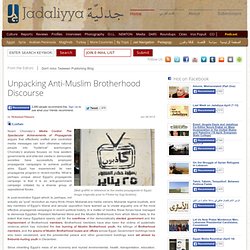
Chomsky’s analysis focuses on how western governments and elite-led media in democratic societies have successfully employed propaganda campaigns to achieve political aims. Egypt has experienced its own propaganda program in recent months. What is perhaps unique about Egypt’s propaganda campaign is that it is an anti-government campaign initiated by a diverse group of oppositional forces. In post-revolution Egypt–which is, perhaps, not actually as “post” revolution as many think–Hosni Mubarak-era media owners, Mubarak regime loyalists, and key members of Egypt’s liberal and secular opposition have teamed up to create arguably one of the most effective propaganda campaigns in recent political history. Revolution as Gambling: Egypt Under the Muslim Brotherhood - events2013 - Events - Middle East Centre.
The Brotherhood and Egypt's Economy.... The Brotherhood and the 2011 presidential elections. The Freedom and Justice Party - resrouces. The Brotherhood in international politics. The Muslim Brotherhood - reading. Muslim Brotherhood - curators.. Political Islam in the Middle East. The Egyptian Muslim Brotherhood - key figures. How the Muslim Brotherhood's choices will shape Egypt's future. Tareq al-Bishry, a prominent judge and great historian from whose books we have learned Egypt’s modern history, also subscribes, at least in theory, to political Islam.

Bishry must be aware that whenever a revolution succeeds in bringing down a regime, the constitution of that fallen regime also falls. The revolutionaries are then required to put together a new constitution that achieves their goals. As a historian, Bishry must be fully aware of this, yet, instead of advocating that a new constitution be drafted following the ouster of Mubarak, he accepted the ruling Supreme Council of the Armed Forces’ offer to head a panel charged with introducing limited changes to the 1971 constitution. The problem with Egypt's Muslim Brotherhood is not sharia. Secularism is not my cause and sharia is not my fear but I am one of those Egyptians who are critical of the Muslim Brotherhood movement – one who made a point of not voting for the Brotherhood's Freedom and Justice party in the recent elections.
My cause is Egypt, the revolution, and seeing my country become a true democracy. My fear is the prolongation of military rule, of transformation to a system that gives the military special status above civil institutions, or one that grants the army and its budget immunity against parliamentary accountability. The Brotherhood's priorities are different from mine, and their objectives have occasionally conflicted with those of the revolutionaries. There were striking examples of that in November and December. Stability is the antithesis of revolution, and Egypt's revolution has not ended. The interior ministry, which has a history of using torture and brutality against citizens, has not been restructured. The Brothers and the Interior Ministry. An interesting tidbit from the trial of Habib al-Adly, Mubarak's interior minister, from Ahram: Essam El-Batawi, defence lawyer for former interior minister Habib El-Adly, continued laying out his case for his client’s innocence on Tuesday, claiming that Egypt’s Muslim Brotherhood (MB) had planned in advance to participate in last year’s 28 January “Friday of Rage” demonstrations in Cairo’s Tahrir Square in coordination with the interior ministry, with the understanding that protests would remain peaceful in nature.According to El-Batawi, meetings were held between Brotherhood members and representatives of the State Security apparatus in the run-up to 28 January.

This is entirely plausible and consistent with everything I've known about the Brothers over the last decade. Senior leaders were in constant contact with their State Security handlers. Is this damning for the MB? Perhaps. Brothers and soldiers: A weakened security apparatus is implicated in political play. An Egyptian is lying naked on the ground while policemen are kicking him.

Another is lying dead in a hospital with traces of torture on his body three days after he was kidnapped by security forces. Dozens of others are killed in clashes with the police throughout last week’s wave of violence. This is January 2013. Two years have passed since the 25 January revolution, which primarily set out to overturn widely seen violations by the police apparatus. On the commemoration of this historic event, the police practices that produced so much wrath are seen reproduced.
But, two years following the revolution, Egypt Independent has found out, the security apparatus is not as confident in its practices as before.