
Creative Education SIMMERING POT 2. Other Creative Trees. Everything Is A Remix. Manipulation of The People - Rudiments of Propaganda. Despite living in "the free world", there are very few free men and women walking around in our democracies.

Very few indeed. This is because some men and women have a human failing that drives them to want to manipulate others for the sake of power. That manipulation has enslaved humanity throughout most of its history, and still presents the most ominous threat to democracy. Following is an outline to that manipulation, and what we can do about it. W E THINK WE LIVE in a democracy, which is the type of society in which ultimate power lies with the people.
The rate and density of information flow has been rising exponentially since the end of the Second World War. With control over the West's mass media falling into the hands of a small group of multinationals (only 5 control just about all the US media), the potential for information flow to be spun by the interests of big business (and governments, which have a symbiotic relationship with big business) has never been greater. CASINO EN LIGNE FRANCOPHONE + DE 320 JEUX DE CASINO MACHINES A SOUS ET POKER. Universcale. Bestiario. CASINO EN LIGNE FRANCOPHONE + DE 320 JEUX DE CASINO MACHINES A SOUS ET POKER. Homepage. Why Are Finland's Schools Successful? It was the end of term at Kirkkojarvi Comprehensive School in Espoo, a sprawling suburb west of Helsinki, when Kari Louhivuori, a veteran teacher and the school’s principal, decided to try something extreme—by Finnish standards.
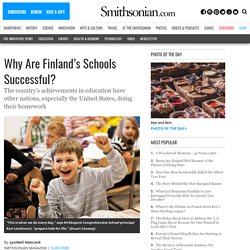
One of his sixth-grade students, a Kosovo-Albanian boy, had drifted far off the learning grid, resisting his teacher’s best efforts. The school’s team of special educators—including a social worker, a nurse and a psychologist—convinced Louhivuori that laziness was not to blame. So he decided to hold the boy back a year, a measure so rare in Finland it’s practically obsolete. Finland has vastly improved in reading, math and science literacy over the past decade in large part because its teachers are trusted to do whatever it takes to turn young lives around. This 13-year-old, Besart Kabashi, received something akin to royal tutoring.
Years later, a 20-year-old Besart showed up at Kirkkojarvi’s Christmas party with a bottle of Cognac and a big grin. Micrositio iPad: Recursos Educativos para Tu iPad. Trevor Eissler "Montessori Madness!" - 321 FastDraw. YOUmedia - Youth-powered 21st century learning. U/MASS Critical and Creative-Graduate Program, U. Massachusetts Boston. Stanford Opens Seven New Online Courses for Enrollment (Free) School of the Future: Unschooling Education - Education. What do you want to learn?
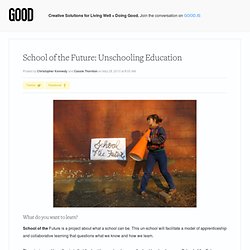
School of the Future is a project about what a school can be. This un-school will facilitate a model of apprenticeship and collaborative learning that questions what we know and how we learn. The mission and hypothesis is that the best learner-teachers are the best teacher-learners. School of the Future invites adventurous teachers and learners to propose classes, workshops, apprenticeships, installations, or moments that add to our active research about how to make a better education. In the process of exploring the possibilities of school, we aim to become a body of unschooled and educated teaching students. School of the Future is an ongoing experiment that can happen anywhere, at anytime.
From solar-powered lighting to a giant scrabble board, Tyvek mountains and experimental food sculptures, the School of the Future is an invitation to experiment and analyze learning through the arts. Free Online Course Materials. MIT Launches Free Interactive Online Learning Platform - Education. Ten years ago, when the Massachusetts Institute of Technology created its OpenCourseWare project, giving free access to college course materials was a revolutionary concept.
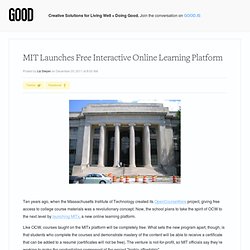
Now, the school plans to take the spirit of OCW to the next level by launching MITx, a new online learning platform. Like OCW, courses taught on the MITx platform will be completely free. What sets the new program apart, though, is that students who complete the courses and demonstrate mastery of the content will be able to receive a certificate that can be added to a resumé (certificates will not be free). The venture is not-for-profit, so MIT officials say they’re working to make the credentialing component of the project "highly affordable". The head of the project, provost L. An experimental prototype version of MITx will launch sometime in spring 2012 with a few classes, and the project will grow over time.
Photo via (cc) Flickr user vobios.