
How to Study with Mind Maps. How to Study with Mind Maps: The Concise Learning Method is a condensed version of Concise Learning: Learn More & Score Higher in Less Time with Less Effort.
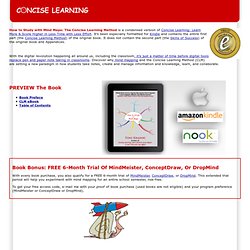
It’s been especially formatted for Kindle and contains the entire first part (the Concise Learning Method) of the original book. It does not contain the second part (the Skills of Success) of the original book and Appendices. With the digital revolution happening all around us, including the classroom, it’s just a matter of time before digital tools replace pen and paper note taking in classrooms. Discover why mind mapping and the Concise Learning Method (CLM) are setting a new paradigm in how students take notes, create and manage information and knowledge, learn, and collaborate. With every book purchase, you also qualify for a FREE 6-month trial of MindMeister, ConceptDraw, or DropMind. Don’t be left behind by your current ways.
Concise Learning. A wise man once said: "The definition of insanity is doing the same thing over and over again and expecting different results.
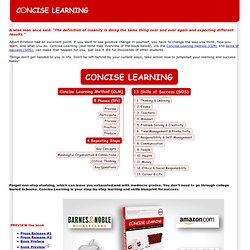
" Albert Einstein had an excellent point. If you want to see positive change in yourself, you have to change the way you think, how you learn, and what you do. Concise Learning (see mind map overview of the book below), via the Concise Leaning method (CLM) and skills of success (SOS), can make that happen for you, just like it did for thousands of other students. Things don’t get handed to you in life. Don't be left behind by your current ways; take action now to jumpstart your learning and success today! Forget non-stop studying, which can leave you exhausted and with mediocre grades. There's a new chapter that goes with this book: Lifelong Learning with CLM. With every book purchase, you also qualify for a FREE 6-month trial of MindMeister, ConceptDraw, or DropMind. What you should be asking is, “Can I afford NOT to buy this book?
CL Community. Website. Blog. Final Argument: Great whiteboard and presentation iPad app Final Argument ( captured my attention because of its mind mapped, non-linear layout of slides.
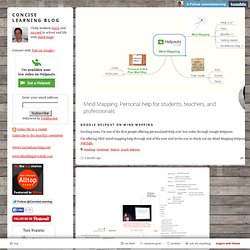
Features (see screenshot): 1. There’s a separation of presenter’s view from the audience’s view. As a presenter, you see both screens which helps you with transition between slides but your audience sees only the slides in audience’s view. 2. 3. 4. Facebook. Google Profile. Visual Mapping in Education group. Google knol. Visual Practitioners. I’m the author of Concise Learning: Learn More & Score Higher in Less Time with Less Effort, a student success coach, and a mind mapping expert.
Concise Learning helps students learn how to learn and be successful. What began as a young professor’s desire to help his students transform the quality of their learning and skills has grown into my lifelong mission to inspire and teach all students how to learn and be successful. As a former professor of chemistry with nearly a decade of college-level teaching experience at both two-year and four-year institutions, including four years at The George Washington University, I’ve seen first-hand what works best with students.
I’ve advised thousands of students on how to become more effective and efficient learners, helping them achieve success in school and in life. I’ve developed the Concise Learning method (CLM) – a visual, flexible, and systematic method to meaningful learning using mind maps. Biggerplate. There's a map for that. BW Business Exchange. Twitter. Skype. YouTube. TED. StumbleUpon. You Are What You Read. GOOD. Amazon Top 10 Book Lists. Shelfari. Open Innovation Portal. Ednebula - The Educator's Network. ASCD Edge. Edutopia. International Edubloggers Directory. Triiibes. Sign In to Triiibes This network is closed to new members for the foreseeable future.
If you were advised that we'd be opening it one day, it seems as though we won't... the triiibe voted to keep it closed for now. I'm sorry. If you have an invitation, click the link in the email to join. Here's the good news: there's a ton of FREE stuff at Read the ebook, check out the links and connect! About Triiibes For people who want to lead a tribe and make something happen. DocStoc. Toni Krasnic About Me Stats Docs: 2 Views: 250.
SlideShare. EducoPark. Betterfly. MentorsConnect. ProfNet. Classroom 2.0. Future of Education. ISTE Community. LearnCentral. Students 2.0. Educator's PLN. Technology Integration in Education (@ning)