
How to implement RESTful authentication - Synopse - blog.synopse.info (HTTP) How to handle authentication in a RESTful Client-Server architecture is a matter of debate.
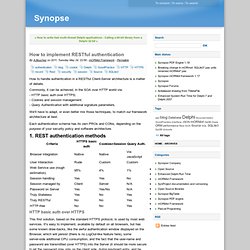
Commonly, it can be achieved, in the SOA over HTTP world via: - HTTP basic auth over HTTPS; - Cookies and session management; - Query Authentication with additional signature parameters. We'll have to adapt, or even better mix those techniques, to match our framework architecture at best. Each authentication scheme has its own PROs and CONs, depending on the purpose of your security policy and software architecture. 1. REST authentication methods HTTP basic auth over HTTPS This first solution, based on the standard HTTPS protocol, is used by most web services. The supplied TSQLite3HttpClientWinHTTP and TSQLite3HttpClientWinINet clients classes are able to connect using HTTPS, and the THttpApiServer server class can send compatible content. Session via Cookies To be honest, a session managed on the Server is not truly Stateless. Query Authentication It was defined as such in this article: GET /object? Stuff & Nonsense - stuffandnonsense.co.uk (HTTP)
How do you answer the Internet Explorer 6 question?
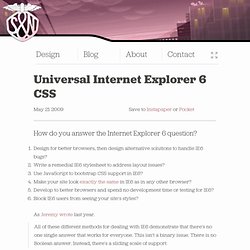
Design for better browsers, then design alternative solutions to handle IE6 bugs? Write a remedial IE6 stylesheet to address layout issues? Use JavaScript to bootstrap CSS support in IE6? Make your site look exactly the same in IE6 as in any other browser? Develop to better browsers and spend no development time or testing for IE6? As Jeremy wrote last year. All of these different methods for dealing with IE6 demonstrate that there's no one single answer that works for everyone. Design for better browsers, then design alternative solutions to handle IE6 bugsI've often written that designers shouldn't be limited by lowest common denominator browser capabilities. Are these the only options? No. Universal Internet Explorer 6 CSS When I asked myself why people visit my sites, and the ones that I make for other people, the answer was always “for the content”.
Universal-ie6-css on Google Code Update log: 0.2. Ie7-js - A JavaScript library to make MSIE behave like a standards-compliant browser. - Google Project Hosting - code.google.com (HTTP) IE7.js is a JavaScript library to make Microsoft Internet Explorer behave like a standards-compliant browser.
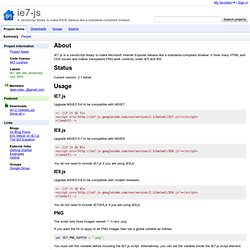
It fixes many HTML and CSS issues and makes transparent PNG work correctly under IE5 and IE6. Current version: 2.1 beta4. IE7.js Upgrade MSIE5.5-6 to be compatible with MSIE7. gRaphaël—Charting JavaScript Library. Raphaël Reference. Processing.js. JsFiddle - Online Editor for the Web. Google Web Toolkit. GWT is a development toolkit for building and optimizing complex browser-based applications.

Its goal is to enable productive development of high-performance web applications without the developer having to be an expert in browser quirks, XMLHttpRequest, and JavaScript. GWT is used by many products at Google, including AdWords, AdSense, Flights, Hotel Finder, Offers, Wallet, Blogger. It’s open source, completely free, and used by thousands of developers around the world. What’s New in GWT 2.8.0 What’s inside the toolbox? RGraph: HTML5 canvas graph library based on the HTML5 canvas tag.
CSS Properties.