
A Reporter's Guide to the Autism Speaks Debacle. Autism may make brains of women but not men more male - health - 13 August 2013. Autism may shape the brains of women differently to those of men.

The condition seems to cause female, but not male, brains to look more masculine, suggesting that one controversial view of autism – as an extreme version of the male brain – may need rethinking. Simon Baron-Cohen at the Autism Research Centre in Cambridge, UK, has previously found that men tend to be better at systematising tasks and females better at ones involving empathising. As people with autism tend to be good systematisers and below-average empathisers, he has argued that autism may be an extreme version of the male brain, or EMB.
However, the theory is contentious. "The jury is still out," says autism researcher Uta Frith of University College London. Sensory integration therapy ineffective for treatment of autism, study finds - Los Angeles LA. Parents of children with autism are faced with many options when it comes to therapy and education for their children, from applied behavior analysis (ABA) to floortime.

A new study out of the University of Texas at Austin has found that one form of therapy, sensory integration therapy, is ineffective for the treatment of autism. Many children on the autism spectrum experience sensitivities towards sensory stimuli such as sounds, light and touch. Those who practice sensory integration therapy seek to offer children small amounts of sensory input with the goal of improving how their nervous system reacts to certain stimuli. This is accomplished through objects such as weighted blankets, weighted vests and swings. The researchers evaluated 25 studies on sensory integration therapy and found that there was no scientific evidence that symptoms of autism were improved.
Autism Awareness: I see you everywhere - OC Moms. Autism awareness: I see you everywhere I know what the numbers say. 1 in 88.
Some feel panic. Some feel insulted that there's panic. Some don't feel nearly enough. Children with Asperger's Syndrome: Characteristics/Learning Styles and Intervention Strategies pg 2. Language Comprehension/Auditory Processing Difficulties Characteristics: Children with Asperger's Syndrome generally interpret auditory information literally and concretely.
They can have difficulty understanding figurative language, jokes/riddles, multiple meaning words, teasing and implied meanings. Example 1: A child with Asperger's Syndrome was participating in a local basketball clinic. He was playing very well, and the coach made the comment, "Wow! Your mom must have put gas in your shoes this morning". It is also important to note that delays in processing information auditorilly may be present in children with Asperger's Syndrome.
Language Comprehension/Auditory Processing - Intervention Strategies: Auditory information/prompting should be kept to a minimum, as it can be too overwhelming for some children. Sensory Processing Difficulties. Children with Asperger's Syndrome: Characteristics/Learning Styles and Intervention Strategies pg 1. By Susan Stokes Autism Consultant If you reprint or use this article, or parts of it, please include the following citation:"Written by Susan Stokes under a contract with CESA 7 and funded by a discretionary grant from the Wisconsin Department of Public Instruction.
Lazy Kid or Executive Dysfunction? By: Tracy Landon and Linda Oggel (2002) Do you have a student who seems incredibly lazy?
Intentionally forgetful? Absolutely unmotivated? Deliberately late? Do you feel like a broken record? One of the least studied and most frequently overlooked contributors to academic and behavioral problems is a problem in the frontal lobes of the brain known as executive dysfunction (Parker, 2001). If you believe your student has executive dysfunction (also called executive function deficits—called “executive” because the tasks are often the responsibilities of a company executive), consider helping the student to organize himself. Managing time. Homework. Executive dysfunction. In psychology and neuroscience, executive dysfunction, or executive function deficit is a disruption to the efficacy of the executive functions, which is a group of cognitive processes that regulate, control, and manage other cognitive processes.[1] Executive dysfunction can refer to both neurocognitive deficits and behavioural symptoms.
It is implicated in numerous psychopathologies and mental disorders, as well as short-term and long-term changes in non-clinical executive control. Executive dysfunction is not the same as dysexecutive syndrome, a term coined by Alan Baddeley to describe a common pattern of dysfunction in executive functions, such as deficiencies in planning, abstract thinking, flexibility and behavioural control.[2][3] This group of symptoms, usually resulting from brain damage, tend to occur together.[4] However, the existence of this syndrome is controversial.[5] Overview[edit] Etiology[edit] Neurophysiology[edit] Genetics[edit]
Asperger syndrome: the triad of impairments. What is the triad of impairments and how can parents work with schools to help overcome them?
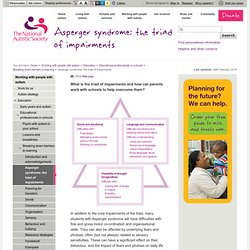
In addition to the core impairments of the triad, many students with Asperger syndrome will have difficulties with fine and gross motor co-ordination and organisational skills. They can also be affected by underlying fears and phobias, often (but not always) related to sensory sensitivities. These can have a significant effect on their behaviour, and the impact of fears and phobias on daily life should not be underestimated. Our experience shows that transition is most successful where there is good communication between parents and school. Parents usually have experience of successful strategies that have helped their children in the past.
Theory of mind. Definition[edit] Theory of mind is a theory insofar as the mind is not directly observable.[1] The presumption that others have a mind is termed a theory of mind because each human can only intuit the existence of his/her own mind through introspection, and no one has direct access to the mind of another.
Empathy, Mindblindness, and Theory of Mind. In a 2001 research paper , Simon Baron-Cohen describes Theory of Mind as "...being able to infer the full range of mental states (beliefs, desires, intentions, imagination, emotions, etc.) that cause action.
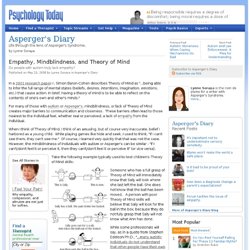
In brief, having a theory of mind is to be able to reflect on the contents of one's own and other's minds. " For many of those with autism or Asperger's , mindblindness, or lack of Theory of Mind creates major barriers to communication and closeness. These barriers often lead to those nearest to the individual feel, whether real or perceived, a lack of empathy from the individual. When I think of Theory of Mind, I think of an amusing, but of course very inaccurate, belief I harbored as a young child. While playing games like hide and seek, I used to think, "If I can't see them, they can't see me. " Inside and Out: A Few Words about Empathy. By Nicole Nicholson on August 17th, 2011 Got empathy? I do. And from all the testimonies I have read and heard, so do many other individuals on the autism spectrum. Shocking? It might be, if you’ve believed up to this point that Aspies and other folks on the spectrum lack the capacity to empathize with other people – in other words, if you believe that we cannot feel or care about your pain.
Asperger - Selected Content. iGoogle. Teaching Students with Aspergers Syndrome: Tips for Teachers and Parents. Students with asperger's syndrome may experience difficulties with focusing as well as lack of focus. Focus involves attention. Sometimes asperger's students focus all their attention on a particular object or subject; therefore, they fail to focus on what information the instructor is presenting. All their energy is directed toward a particular subject or object. Why? Because that object or subject is not overwhelming to them and they understand it. To overcome this problem, the teacher can try to establish some connection between the object or subject of interest and the area of study. The possibilities for instruction are endless, but it will take some time and creative planning on the part of the teacher.
Sensory issues affect learning for the student with asperger's syndrome. Often aperger's students are distracted by something in the environment that they simply cannot control. Obviously, a teacher does not want disruptions in the classroom. Teaching Aspergers Children: Tips For Teachers. Educators can be great allies in keeping your youngster with Aspergers (AS) or High-Functioning Autism safe and successful in school, but you'll need to make sure they have all the knowledge they need to help.
Use the suggestions below to create an information packet to bring educators up to speed... The Five Main Things Educators Need to Know— 1. What is Asperger syndrome? Here we explain more about Asperger syndrome - a form of autism - including the three main difficulties that people with Asperger syndrome share, how many people have the condition, and what may cause it. As soon as we meet a person we make judgements about them. Aspergers Syndrome Foundation. Guidelines for teaching students with Asperger syndrome in further education colleges. As well as behaviour, the areas of impairment will affect the thought processes that govern behavioural responses to the environment and responses to the demands made by people, and situations arising within this space.