
Lewd graffiti from ancient Pompeii. 1,600-Year-Old Goblet Shows that the Romans Used Nanotechnology. The Lycurgus Cup, as it is known due to its depiction of a scene involving King Lycurgus of Thrace, is a 1,600-year-old jade green Roman chalice that changes colour depending on the direction of the light upon it.
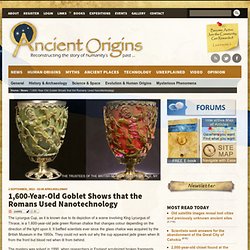
It baffled scientists ever since the glass chalice was acquired by the British Museum in the 1950s. They could not work out why the cup appeared jade green when lit from the front but blood red when lit from behind. The mystery was solved in 1990, when researchers in England scrutinized broken fragments under a microscope and discovered that the Roman artisans were nanotechnology pioneers: They had impregnated the glass with particles of silver and gold, ground down until they were as small as 50 nanometres in diameter, less than one-thousandth the size of a grain of table salt.
The work was so precise that there is no way that the resulting effect was an accident. This is not the first time that Roman technology has exceeded that of our modern day. By April Holloway. 70 metal books found in Jordan cave could change our view of Biblical history. By Fiona Macrae Updated: 19:36 GMT, 30 March 2011 For scholars of faith and history, it is a treasure trove too precious for price.

This ancient collection of 70 tiny books, their lead pages bound with wire, could unlock some of the secrets of the earliest days of Christianity. Academics are divided as to their authenticity but say that if verified, they could prove as pivotal as the discovery of the Dead Sea Scrolls in 1947. Lines of inquiry: The metal tablets could change our understanding of the Bible. French Archaeologists Discover Beautifully Preserved Deformed Skull. 02629178. Makthar, Tunisia - مكثر، تونس. (13) Estelas de Guerrero del Sudoeste. (3) Facebook. 2,000-year-old ritual bath found in Jerusalem. Archaeologists in Jerusalem say they've found a 2,000-year-old ritual bath with a sophisticated system to keep water pure, Israel's Antiquities Authority (IAA) announced.
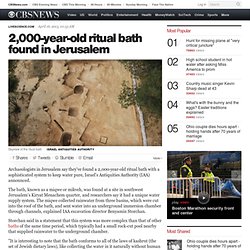
The bath, known as a miqwe or mikveh, was found at a site in southwest Jerusalem's Kiryat Menachem quarter, and researchers say it had a unique water supply system. La cueva de La Pileta. 655Fall2012..pdf. Palmyra. Palmyra /ˌpælˈmaɪərə/, (Aramaic: ܬܕܡܘܪܬܐ; Arabic: تدمر; Hebrew: תַּדְמוֹר; Ancient Greek: Παλμύρα), was an ancient Semitic city, located in Homs Governorate, Syria.
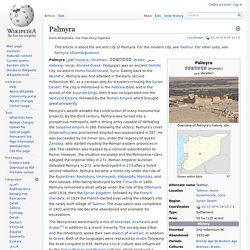
Dating back to the Neolithic, Palmyra was first attested in the early second millennium BC, as a caravan stop for travelers crossing the Syrian Desert. The city is mentioned in the Hebrew Bible and in the annals of the Assyrian kings, then it was incorporated into the Seleucid Empire, followed by the Roman Empire which brought great prosperity. The Palmyrenes were mainly a mix of Amorites, Arameans and Arabs,[1] in addition to a Jewish minority.
Heracleion in context conference - School of Archaeology - University of Oxford. Upis, Goddess of Lydia, also called Artemis Ephesia. Domus de Janas. Domus de Janas (Sardinian: "House of the Fairies" or of the "Witches") are a type of pre-historic chamber tombs found in Sardinia.
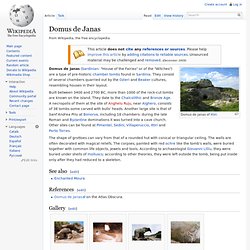
They consist of several chambers quarried out by the Ozieri and Beaker cultures, resembling houses in their layout. Built between 3400 and 2700 BC, more than 1000 of the rock-cut tombs are known on the island. They date to the Chalcolithic and Bronze Age. A necropolis of them at the site of Anghelu Ruju, near Alghero, consists of 38 tombs some carved with bulls' heads. Another large site is that of Sant'Andrea Priu at Bonorva, including 18 chambers: during the late Roman and Byzantine dominations it was turned into a cave church. Pictish written language discovered in Scotland. A new language dating back to the Scottish Iron Age has been identified on carved stones.
These inscriptions are believed to belong to the early Pict society living from ca 300 to 843 AD, in modern-day eastern and northern Scotland. The Picts, meaning “the Painted Ones”, were named by the Roman Eumenius in 297 AD and are renowned for having repeatedly repelled invasions from both Romans and Angles, creating a clear North-South division of the British Isles.
Celtic tribes around Ireland, Wales and Scotland are known for their use of stylised stones as signs of ownership and to indicate their names. In the past, some two dozen Pictish Ogham inscriptions had been found in the north and north-west of Scotland. Oghams, also called Primitive Irish, compose an Early Medieval lexigraphic alphabet and the earliest inscriptions discovered date back to the 4th century AD. Indeed, in order to identify the languages, the three professors applied a mathematical method called Shannon Entropy. MATRONALIA: Festival of Wives and Mothers. Rujm el-Hiri, Golan Heights - Ancient Archaeoastronomy. Sixteen kilometers east of the Sea of Galilee in the western part of the historic Bashan plain of the Golan Heights (a contested area claimed by both Syria and Israel) are the ruins of a most unusual structure, which scholars believe was built at least in part for archaeoastronomical purposes.

Located at 515 meters above sea level, Rujm el-Hiri consists of a central cairn with a set of concentric rings encircling it. Built during the late Chalcolithic or Early Bronze Age about 5000 years ago, Rujm el-Hiri (also called Rogem Hiri or Gilgal Rephaim) is made of an estimated 40,000 tons of uncut black volcanic basalt field stones piled and wedged into between five and nine concentric rings (depending on how you count them), with heights reaching to 1 to 2.5 meters (3-8 feet) high. Untitled Document. Capital of Judah I (930-722) First Temple Period: Jerusalem as the Capital of Judahite Kingdom (930-722) From the death of King Solomon (c.930) until its destruction by the Neobabylonians under Nebuchadnezzar (586), Jerusalem functions as the capital of the kingdom of Judah.
From c.930 until 722, its greatest antagonist is the kingdom of Israel which breaks away from the royal house of David without establishing a lasting dynasty of its own. Of the two kingdoms, Israel is the stronger and wealthier one. Eilat Mazar. Un article de Wikipédia, l'encyclopédie libre.
Pour les articles homonymes, voir Mazar. Eilat Mazar est une archéologue israélienne, née le (57 ans), spécialiste d'archéologie biblique et phénicienne. Elle a travaillé sur les excavations du Temple de Jérusalem, ainsi que sur celles d'Achzib et de Bethléem. Elle est la petite-fille de l'archéologue Benjamin Mazar, professeur d'archéologie à l'Université hébraïque de Jérusalem et pionnier des recherches archéologiques en Israël. Amazing Archaeological Discoveries Recently Made in Jerusalem. Ruins of Perperikon, ancient city of the Thracians. Today’s image of the ancient city of Perperikon comes from EarthSky Facebook friend Zlatan Merakov.
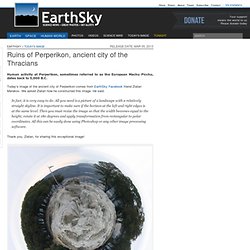
We asked Zlatan how he constructed this image. He said: In fact, it is very easy to do. (49) Photos du journal. (49) Photos du journal. Mysterious Structure Discovered Beneath Sea of Galilee. A giant "monumental" stone structure discovered beneath the waters of the Sea of Galilee in Israel has archaeologists puzzled as to its purpose and even how long ago it was built.
The mysterious structure is cone shaped, made of "unhewn basalt cobbles and boulders," and weighs an estimated 60,000 tons the researchers said. That makes it heavier than most modern-day warships. Rising nearly 32 feet (10 meters) high, it has a diameter of about 230 feet (70 meters). To put that in perspective, the outer stone circle of Stonehenge has a diameter just half that with its tallest stones not reaching that height. Disque de Phaistos. Un article de Wikipédia, l'encyclopédie libre. faces B et A du Disque de Phaistos Le disque de Phaistos ou disque de Phaestos est un disque d'argile cuite découvert en 1908 par l'archéologue italien Luigi Pernier sur le site archéologique du palais minoen de Phaistos, en Crète. Il pourrait dater du milieu ou de la fin de l'âge du bronze minoen (IIe millénaire). Son diamètre est d'environ seize centimètres et il est couvert, sur ses deux faces, de hiéroglyphes imprimés à l'aide de poinçons.
En tout, ce sont 241 signes, dont 45 différents qui recouvrent le disque, en formant une spirale partant de l'extérieur vers le centre de l'objet. De nombreuses théories entourent ce disque, quant à sa provenance, son utilisation ou sa signification. Bien que l'authenticité du disque soit généralement admise, certains chercheurs avancent l'hypothèse qu'il puisse s'agir d'un faux. Le disque original est exposé au musée archéologique d'Héraklion. Présentation[modifier | modifier le code]