
Tips for Sharpening Your Images the Right Way. The following two tabs change content below.

Photographer who loves challenging and experimental photography and is not afraid to share the knowledge about it.
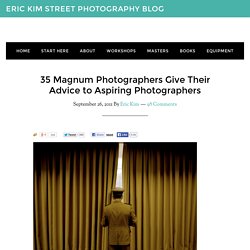
35 Magnum Photographers Give Their Advice to Aspiring Photographers. (Above image copyrighted by Alex Majoli) Bill Reeves, a passionate photographer who is fortunate enough to have Magnum photographers Eli Reed and Paolo Pellegrin as his mentors, told me about a blog post that Magnum had a while back regarding advice to young photographers.
It was put together by Alec Soth, who has done a series of fascinating projects such as his most popular, “Sleeping by the Missisippi” which was done on a 8×10 view camera. An interesting excerpt that Bill put together about Alec is below: Photography. Advanced Photography Tips. List of classical music composers by era. List of classical music composers by era From Wikipedia, the free encyclopedia Jump to: navigation, search.

Magic. Articles. Digital Photography Tutorials. Learn how to take and edit digital photographs using visual tutorials that emphasize concept over procedure, independent of specific digital camera or lens.

This is a complete listing of all tutorials on this site; click the drop-down links in the top menu to see particular topics. Manual Focusing with AF Camera Systems. Cinematography Cinematography lenses from ZEISS have helped to create distinctive images in many famous movies, e.g.

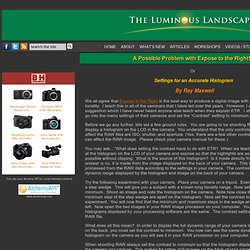
Settings for an Accurate Histogram. Or By Ray Maxwell We all agree that Expose to the Right is the best way to produce a digital image with a maximum of smooth tonality.
The understated utility of smaller pixels. Most statements about megapixels understate their usefulness.

For example, it is often stated that when you're only printing an 8x12, it's impossible to tell the difference between an 8 MP camera and a 15 MP camera. But in many common circumstances, the difference is striking. Hyperfocal Distance. The concept of hyperfocal distance is easy to understand: focus a lens at the hyperfocal distance and everything in the photograph from some near distance to infinity will be sharp.
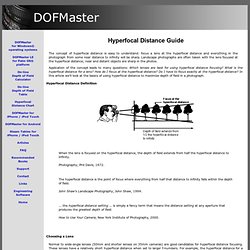
Landscape photographs are often taken with the lens focused at the hyperfocal distance; near and distant objects are sharp in the photos. Understanding Back light, Rim Light & Silhouette In Music Photography. Home. Zone System. Complete Self-Instructing Library Of Practical Photography Vol 1-5. Back in the 70's of the last century - not so many years ago, after all - photography was in its infancy and but little practiced by the general public.
The few professionals who made it their regular business prepared most of their own materials, plates, papers, etc., and the results were frequently very uncertain, as they depended largely upon local conditions, and on the skill and knowledge of the operator. Photography as applied today to the arts and sciences was unheard of. Now, there is hardly a science, industry, or enterprise of any account undertaken that photography, in some form or other, does not enter into. Understanding Depth of Field in Photography. Depth of field refers to the range of distance that appears acceptably sharp.

It varies depending on camera type, aperture and focusing distance, although print size and viewing distance can also influence our perception of depth of field. This tutorial is designed to give a better intuitive and technical understanding for photography, and provides a depth of field calculator to show how it varies with your camera settings. Reducing Camera Shake with Hand-Held Photos. We've all likely encountered this problem many times: blurry photos due to camera shake with hand-held shots.
It's especially prevalent for those of us who are unfortunate enough to have unsteady hands. While it cannot be eliminated entirely, fortunately there's a number of steps you can take to greatly reduce its impact — and hopefully prevent it from becoming visible in the first place. Blurry Photo from Camera Shake Photo Without Camera Shake Photo from the base of the Eiffel Tower at night - Paris, France. Camera shake is visible whenever your shutter speed is slow compared to the speed of unintended camera motion. Methods for increasing the shutter speed (shorter exposure time)Methods for reducing camera motion.
Beauty and Fashion Photographer. Editing your digital images without the mystery. Welcome to Ars Workshops, and thank you for paying at the door. Beauty and Fashion Photographer. Lenses and perspective, or distortion on a face for beauty. Q. Why do you use long lenses and what's the advantage or disadvantage for it? A. Harold Davis Webcasts and Video. Sunflowers #5, photo by Harold Davis. View this image larger. The Luminous Landscape. Celebrating Our 15th Year. Complete Digital Photography. Creative Sharpening, Part I - Digital Photo Pro. Tuesday, April 12, 2011 By John Paul Caponigro Final Sharpened Image The vast majority of photographic images benefit from sharpening. Double Exposure Photography: 50+ Examples and Tutorials. Double Exposure, or Multiple Exposure, is a photographic technique that combines 2 different images into a single image.
The technique has been practiced for several years, and it became particularly famous recently, due to the fact that graphic editor like Photoshop can help to create the identical effect. (Image Source: Elena iPhoneography) With double exposure technique, you can create certain effect like ghost image, mirror image, or simply merging a bright moon into the dark, lonely sky. Understanding & Using Ansel Adam’s Zone System.