
background preloader

Imitators

Facebook Twitter

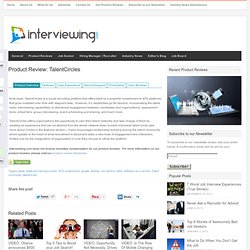
Product Review: TalentCircles - Interviewing.com. Product Overview At its base, TalentCircles is a social recruiting platform that offers itself as a powerful complement to ATS platforms that grow outdated over time with stagnant data. However, it’s capabilities go far beyond, incorporating the latest video interviewing capabilities, bi-directional engagement between candidates and organizations, assessment tools, virtual fairs, group interviewing, event scheduling and sharing, and much more. TalentCircles offers organizations the opportunity to own their talent networks and take charge of them by creating an experience that can be tailored from the whole network down to each individual talent circle (see more about Circles in the features section.) It also encourages relationship building among the talent community which speaks to the heart of what recruitment is about and adds a new level of engagement and interaction, limited only be the imagination of organization in how they choose to utilize the platform.
User Experience Price/Value. Find Top Tech Talent Whether They're Looking Or Not. How Entelo uses data to make your résumé passé. For many workers, landing a new job means crafting a great résumé that highlighted your experience, strengths and penchant for hyperbole. For tech-industry employees, though, résumés might be headed for the dustbin of history. The act of actually getting their hands dirty looking for a job might be going there, too. One company that wants to speed the evolution of job-searching is a startup called Entelo, which launched on Wednesday and has raised an undisclosed amount of funding from Battery Ventures and Menlo Ventures.
Entelo aggregates public data from a variety of online sources that might do a better job of displaying high-tech skills than a resume ever could — Github, StackOverflow, Quora and LinkedIn among them — and creates profiles of potential candidates. After six months in private beta, Founder and CEO Jon Bischke told me, the company has created more than 300 million profiles and has more than 40 paying customers, including Box.net, LookOut, Kontagent and LevelUp. Entelo Launches To Help Businesses Recruit The Best Candidates, Even If They’re Not Looking. Part of the reason that services like Coursera, EdX, Udacity, Codecademy and Treehouse are so exciting is that they hint at a future when quality education will be accessible to the masses and be affordable. Collectively, they represent a change in the model as a whole, even if we have no idea what that change will mean two years from now — 10 years from now. Uncertainty aside, what we do know is that digital learning platforms today are making it easier to access information, to gain skills, to train for jobs and tests and to acquire knowledge in context and in personalized, engaging ways.

Much to the delight of Peter Thiel, as it becomes easier to learn the things we need to learn, measure progress, and acquire the skills we need to enter the workforce through digital channels — independent of the traditional educational system — the system itself is devalued. So, Bischke set out to develop a solution. It’s a long road, but the endgame holds a lot of value. More on Entelo here. Honestly.com Becomes A Talent Search Engine, Renames Itself TalentBin. Honestly.com, a startup that allowed professionals to submit anonymous reviews of their coworkers, has been pretty quiet for the past couple of years. Turns out that’s because the company has been busy reinventing itself. Today it’s unveiling a new product and a new name — TalentBin.
Co-founder Peter Kazanjy says TalentBin addresses one of the big problems with Honestly, namely the lack of content. Rather than relying on users to create all the reviews, TalentBin looks at the content that already exists on the Web — specifically, people’s activity on a variety of social networking sites. Kazanjy calls that activity your “professional exhaust,” and argues that it contains lots of relevant information about your professional interests and accomplishments.

So TalentBin aggregates a person’s activity across sites like Facebook, Twitter, Google Plus, Meetup, Quora, Github, Sourceforge, and Bitbucket, then uses that data to create a searchable profile for recruiters. Science Shows Dating Websites Aren’t Better At Finding You Love. I was really hoping this article would have ended differently. But after spending countless hours scanning tiny pixelated squares of people who were supposed to represent my mathematically determined soul mate, I found that online dating websites are modern-day versions of snake oil.

I ended up back at bachelorhood after a long and expensive trek through computer-aided love services; I decided to look for love on the Internet mainly to test the hypothesis behind a blistering 50-page critique of hyped up promise of dating websites. “The heavy emphasis on profile browsing at most dating sites has considerable downsides, and there is little reason to believe that current compatibility algorithms are especially effective,” explained the team behind an article published in Psychological Science in the Public Interest. I hoped they were wrong. Impossible Claims From Algorithms So what does predict success? A Weird Psychological State Of Choosing Normally I enjoy dates. It’s All A Numbers Game. With $1.5M From Adecco, Path.To Wants To Be The EHarmony For Jobs In Silicon Valley And Beyond. The job-hunting market today is getting a little more social: Path.to, a kind of About.me-meets-LinkedIn service that lets people create image-filled, sleek professional profiles for themselves online, is today relaunching itself as a network to connect those professionals with job openings.

And taking a pro-tip from the matchmaking site eHarmony, Path.to has developed an algorithm to create “compatibility” scores between job seekers and job vacancies using data from social media sites as part of the mix. It says it is the first online job service to offer this feature. It is also today announcing a $1.5 million round of strategic funding from HR giant Adecco to help it along the way. Started in August 2011 by Cliqset founder Darren Bounds, Path.to went dark in March in preparation for this newest version of itself. The first wave of jobs features openings from more than 100 companies, including Eventbrite, Evernote, Lytro and Uber. Start-Up Bright Uses Technology to Improve Job-Seeking Process. For five long and very strange years, death haunted tiny Dryden, NY, a town near the Finger Lakes where a plague of car accidents, suicides, and even grisly murders involving two popular cheerleaders just kept mounting up. At the end of Fargo, Frances McDormand’s police chief, Marge Gunderson, captures the psycho played by Peter Stormare.

He’s in the backseat of her police cruiser and she talks to him as she drives. We see that she cannot fathom the evil she’s just seen. “And here ya are,” she says, “and it’s a beautiful day. Well, I just don’t understand it.” It’s as true a piece of acting as you’ll find—Marge really doesn’t comprehend a certain kind of human darkness. I am not surprised by violence or horror but still sometimes find myself struck, not unlike Marge, in a kind of a daze, unable to wrap my head around it. Why do horrible things happen? In the meantime, dig into “The Cheerleaders.” The Cheerleaders by E. Welcome to Dryden. In the summer of ’96, many bonfires are built. Digital Staffing: The Future of Recruitment-by-Algorithm - Tomas Chamorro-Premuzic. By Tomas Chamorro-Premuzic | 9:00 AM October 26, 2012 Americans are now spending more time on social networking sites than on all other sites combined.
Facebook alone has more than 1 billion users — that’s 15% of the world’s population and almost 50% of internet users, and they spend an average 15 minutes a day on the site. And that’s just one site; imagine if you added in Twitter, LinkedIn, Google+, Weibo, Renren, Orkut, and on down the list. As a consequence of spending so much time online, we now leave traces of our personality everywhere. First, the web makes recruiting easier for employers and would-be employees. Second, the web makes recruiting less biased and less clubby. Third, web analytics can help recruiters become more efficient. The big implication is that you need to invest a considerable amount of time managing your digital reputation. We will soon witness the proliferation of machine learning systems that automatically match candidates to specific jobs and organizations.

New Sites Promise More 'Scientific' Method To Job Hunting. LinkedIn's Algorithm Taps Talent Graph, But Still Needs Human Touch. Imagine if your prospects for beating the 9.1% unemployment rate depended not on a meticulously crafted cover letter and résumé, but on a complicated algorithm that helped companies determine the best matches for open jobs. Such a Brave New World-like future is rapidly becoming a reality--but don't fear just yet. Your career will still very much rely on strong credentials, networking, and a good pinch of serendipity.

(For now, at least.) Over the last year, LinkedIn has rolled out a set of new premium tools to its 100 million users. And they've worked. "We're starting to see recruiters do queries where they literally put, 'I want someone who has worked at one of these twenty companies and a startup, and gone to one of these twenty schools,'" Nash says.

Two tools in particular are helping businesses find talent: Skills and Similar Profiles. "With Skills, you're never going to see a score," Nash clarifies. But as bountiful as LinkedIn's data is, it's not the be-all end-all. Labels.io shuns outdated resumes for its job matching algorithm. Anybody who has had to sift through hundreds of resumes at a time or placed a job advert that’s gone unfilled for months will know that the recruitment process isn’t always as efficient as it could be. It’s not surprising then that many startups have tried to bring recruitment kicking and screaming into the Internet age – from various job sites to the professional social networking giant LinkedIn. However, Labels.io, which launches out of Beta today, thinks that most of these efforts still place too much emphasis on the traditional resume, a format that is outdated with its tendency to list countless “key accomplishments” and one that encourages “dull corporate speak”, says founder Octavian Popescu.
Instead, professionals are defined by three simple criteria: previous employers, skills and personality, he says, which is precisely the format that Labels.io standardises on. Find Teams of Developers and Designers With GroupTalent [EXCLUSIVE] This startup just raised $1M for an algorithm to help employers fill engineering jobs. Everywhere you go in the tech industry these days companies are struggling to find smart engineers, designers and developers.
Enter Group Talent. This Seattle/San Fran/NYC startup, which just scored $1 million in seed funding, has developed a matching engine that’s designed to pinpoint the perfect fit for your engineering jobs. Since Valentine’s Day is in the air, think about it like eHarmony for employees and employers. The company competes again TalentBin and Gild. “By really focusing on what the talent wants, we’re creating an entirely new category of on-demand staffing for highly-technical and strategically critical roles,” said GroupTalent CEO Manny Medina, a former manager in Microsoft’s Windows Phone division. Launched in December 2011, GroupTalent is a graduate of the TechStars Seattle program. I asked Andrew Kinzer of GroupTalent what makes them different than the competition, and here’s what he had to say: Here’s a closer look at the service. TinyProj Shuts Down, Users Sent To TechStars Grad GroupTalent Instead.

TinyProj , a project marketplace started by Forrst founder Kyle Bragger is shutting down. All 8,300 of the service’s registered developers and designers who used the site to find project-based work will now be transitioned over to GroupTalent , a recent TechStars grad. Both companies have been building online marketplaces for project-based work since October 2011.

With GroupTalent , the goal has been to help match companies with quality talent by curating the level of applicants accepted. Only 20% of all applicants get in, as determined by a filtering process done through manual review in combination with algorithms that rank the applicants based on open source contributions. According to GroupTalent CEO Manuel Medina, his site serves the growing needs of startup founders to earn additional income while their own sites get off the ground. “The majority of our talent base are teams from startups who are bootstrapping,” he says. . → Learn more. Path.To : Fall in love with your next job.