
Top 10 Most Dangerous Plants in the World. 1. Most likely to eat a rat Giant Pitcher Plant: Nepenthes attenboroughii Discovered more than 5000 feet above sea level on Mount Victoria in the Philippines, the giant, carnivorous pitcher plant secretes a nectar-like substance to lure unsuspecting prey into a pool of enzymes and acid. A series of sticky, downward ribs makes it nearly impossible for trapped prey to escape. The plant's 30-centimeter diameter is large enough to trap unlucky rodents, but insects are its most common meal. 2.
Castor Bean Plant: Ricinus communis Castor-bean plants can be purchased at just about any garden center, despite containing the deadly poison ricin. 3. Western Water Hemlock: Cicuta douglasii Deemed the most "violently toxic plant that grows in North America" by the USDA, the water hemlock contains the toxin cicutoxin, which wreaks havoc on the central nervous system, causing grand mal seizures--which include loss of consciousness and violent muscle contractions--and eventually death, if ingested. 4. 5.
Don't Stand Under the Cannonball Tree. It is the case with a number of plants that they are given popular names which reflect how they look or what they do.
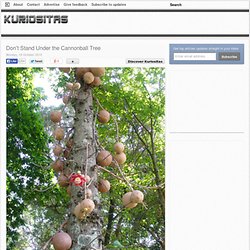
So it is with the Cannonball Tree whose fruit is so large that they look like cannonballs. Not only that, when they fall to the ground a large noise is created similar to... you guessed it. The fruit will of course fall when it is good and ready. So you will not find a Cannonball Tree near a public pathway or a road. One of these fruit, weighing in at several pounds and often up to ten inches in diameter could kill you. The tree (scientific name Couroupita guianensis is native to the south of the Caribbean and to the northern parts of South America. This evergreen tree is something of a curiosity to say the least not least because its large brown fruit – its cannonballs – seem to be growing from the trunk of the tree. The oddities do not stop there.
Take a look at the flower above. An odd tree, for sure. You may also like: Valencia: Astonishing City of Arts and Sciences. Sequoia, Redwood - The Ancient Giants. Sequoia, Redwood: Giant Sequoia trees Giant Sequoia trees, Mariposa Grove, Yosemite National Park, California We published this article back on Sep. 20, 2010 but we love Sequoia so much we decided to re-publish it.
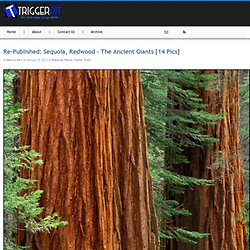
Hope you enjoy. California’s enormous giant sequoia is the world’s most massive tree and one of the oldest. These trees can grow to more than 250 feet tall (or 76 meters which is about as tall as a 25-story building), with a diameter at breast-height up to 30 feet (about 9 meters). Sequoia National Park’s General Sherman Tree is about 52,500 cubic feet (1,478 cubic meters), which is roughly equivalent to 21,800 150-pound (68 kg) humans! Giant sequoias can live to be 3,000 years old; the oldest recorded specimen exceeded 3,500 years. Sequoia, Redwood: Sequoias in the fog Sequoias in the fog at King’s Canyon National Park. Sequoia, Redwood: Moro Rock Moro Rock is a the vista view point in Sequoia National Park, California, USA.
Sequoia, Redwood: Giant Sequoias Giant Sequoias.