
Sphere of influence. In the field of international relations, a sphere of influence (SOI) is a spatial region or concept division over which a state or organization has a level of cultural, economic, military, or political exclusivity, accommodating to the interests of powers outside the sphere is the state that controls it.

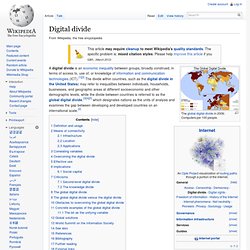
While there may be a formal alliance or other treaty obligations between the influence and influencer, such formal arrangements are not necessary and the influence can often be more of an example of soft power. Similarly, a formal alliance does not necessarily mean that one country lies within another's sphere of influence. High levels of exclusivity have historically been associated with higher levels of conflict. In more extreme cases, a country within the "sphere of influence" of another may become a subsidiary of that state and serve in effect as a satellite state or de facto colony. Digital divide. A digital divide is an economic inequality between groups, broadly construed, in terms of access to, use of, or knowledge of information and communication technologies (ICT).[1][2] The divide within countries, such as the digital divide in the United States) may refer to inequalities between individuals, households, businesses, and geographic areas at different socioeconomic and other demographic levels, while the divide between countries is referred to as the global digital divide,[3][4][5] which designates nations as the units of analysis and examines the gap between developing and developed countries on an international scale.[2] Definition and usage[edit] The term Digital divide is used to describe a gap between those who have ready access to information and communication technology and the skills to make use of those technology and those who do not have the access or skills to use those same technologies within a geographic area, society or community.
Means of connectivity[edit] Power (philosophy) In social science and politics, power is the ability to influence or control the behavior of people.
The term authority is often used for power perceived as legitimate by the social structure. Power can be seen as evil or unjust, but the exercise of power is accepted as endemic to humans as social beings. In the corporate environment, power is often expressed as upward or downward. With downward power, a company's superior influences subordinates. When a company exerts upward power, it is the subordinates who influence the decisions of the leader (Greiner & Schein, 1988).