
A Robotic Worm Is Your Only Device In This Incredibly Strange Vision of the Future.
Samsung Announces Plans To Replace Human Factory Workers With Robots By 2018. Robots Inspired By Animals. Botched Robotic Surgeries Have Been Linked to 144 Patient Deaths. 9 Misconceptions About Drones That Engineers Wish You'd Shut Up About. Watch The ATRIAS Bipedal Robot Take A Stroll In The Park. Watch This Bipedal Robot Get Hammered With Dodgeballs. Robots. ATLAS, The Pentagon's Humanoid Robot, Just Got A Major Upgrade.
A Worm's Mind In A Lego Body. Youtube. A Self-Repairing Space Robot on the International Space Station. Captured: The Acrobatics of a Fruit Fly in Flight. At breakneck speed, a fruit fly veers off course and rolls into a precise bank.
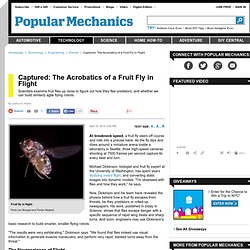
As the fly dips and dives around a miniature arena inside a laboratory in Seattle, three high-speed cameras shooting at 7500 frames per second capture its every twist and turn. Michael Dickinson, biologist and fruit fly expert at the University of Washington, has spent years studying insect flight, and converting static images into dynamic models. Sandia Robotic Hand. Scientists just created some of the most powerful muscles in existence. The military has developed a robotic convoy that doesn't need humans. Robot Soldiers Are Coming! UN: Hold International Talks on ‘Killer Robots’ (New York) – All governments should support international talks to address the threat posed by fully autonomous robotic weapons, Human Rights Watch said today. Human Rights Watch and the Harvard Law School International Human Rights Clinic on October 21, 2013, issued a question-and-answer document about the legal problems posed by these weapons.
Representatives from the Campaign to Stop Killer Robots, including Human Rights Watch, will present their concerns about fully autonomous weapons at a United Nations event in New York on October 21. “Urgent international action is needed or killer robots may evolve from a science fiction nightmare to a deadly reality,” said Steve Goose, arms director at Human Rights Watch. “The US and every other country should support holding international talks aimed at ensuring that humans will retain control over decisions to target and use force against other humans.”
The "bizarre experiment" that became a flying jellyfish robot. I don't see any advantage that this design could have over a copter and I bet it consumes more energy to fly than a copter of the same size/weight, because it doesn't exploit the lift that aerodynamics grant a wing.
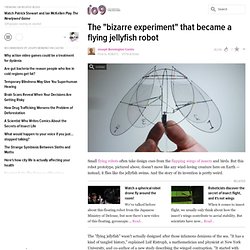
Am I missing something? A helicopter would require extra weight for counter-rotation, either through a second main rotor or an anti-torque rotor. Not to mention, flapping devices have the ability to be highly simplified with linear actuators like electrostrictive polymers, whereas devices that depend on rotation tend to require more complexity, especially for control transmission, i.e. the swashplate assembly. The 6 Most Horrifying Robotic Animals That Actually Exist. Human beings have been building robots for a few millennia.

But no matter how useful our automata, or how sleek and efficient our killing machines grow, we know we'll always be second best. Nature has been building high-end meat-bots for millions of years, after all. Well, we're tired of coming in second. They say that imitation is the sincerest form of flattery, so Mother Nature, consider these bizarre and terrifying abominations a compliment ... This Jumble of Tent Poles Could Be NASA's Next Titan-exploring Robot. Meet the eight astounding finalists of DARPA's Robotics Challenge. Google Buys Boston Dynamics in Sensational Eighth Robotics Acquisition. Google just acquired Boston Dynamics.

It’s the eighth robotics company the California tech titan has purchased in six months and, by far, the most significant. For two decades, Boston Dynamics has produced some of the world’s most advanced robots. Neil Jacobstein, co-chair of the Artificial Intelligence and Robotics Track at Singularity University, told Singularity Hub, “This is a watershed event. A very big deal. Google is buying up high potential robotics companies. Robots can now collaborate over their very own Internet. If Robots are able to access all the data found in databases around the world (including the internet) then either there will require a massive reworking of databases or the Robots will have hours upon hours of time rummaging through useless information with incredibly complex queries.

The world's databases would all need to be similarly constructed, and every single one available will have to be reformatted to BCNF or 4NF, which would take years! Old databases would most likely need to be entirely re-designed. Splendid idea, but not practical for Robots to efficiently access information from the internet, at least not soon.
General Electric Expands Internet of Things to More Industrial Equipment. The Internet of Things — a network that connects devices, from sneakers to massive industrial oil- and gas-drilling equipment, and runs the information they provide through big data-analyzing software — has been over-promised and under-delivered.

Yet tech companies are still lumbering toward such a network. General Electric recently took a big step, more than doubling the vertically-specialized hardware/software packages it offers to connect machines and interpret their data. The company hopes to make its mark by significantly reducing the amount of “unplanned downtime” that industrial equipment undergoes, thereby bringing about economic benefits. Targeting industries including oil and gas, wind power, airlines, railroads and health care, the company figures that even if it drives its clients’ costs down by 1 percent, the effects will be more than enough to offset the cost of its products and probably enough for the companies to pass some savings on to consumers.
Robots to get their own internet. 9 February 2011Last updated at 10:54 By Mark Ward Technology correspondent, BBC News RoboEarth could help robots get to work in novel environments much more quickly Robots could soon have an equivalent of the internet and Wikipedia.
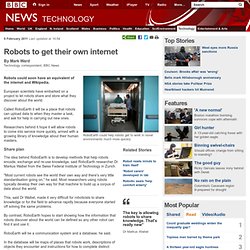
European scientists have embarked on a project to let robots share and store what they discover about the world. A Swarm of Nano Quadrotors. Robot Quadrotors Perform James Bond Theme. Gramazio & Kohler, Architects ETH SIA BSA. Flight Assembled Architecture, 2011-2012FRAC Centre Orléans Flight Assembled Architecture is the first architectural installation assembled by flying robots, free from the touch of human hands.

The installation is an expression of a rigorous architectural design by Gramazio & Kohler and a visionary robotic system by Raffaello D’Andrea. Flight Assembled Architecture consists of over 1.500 modules which are placed by a multitude of quadrotor helicopters, collaborating according to mathematical algorithms that translate digital design data to the behavior of the flying machines. In this way, the flying vehicles, together, extend themselves as “living” architectural machines and complete the composition from their dynamic formation of movement and building performance. Scientists explore the ocean floor with half-crab-half-car behemoth. RoboJelly, The Unmanned Underwater Vehicle That Uses Water For Fuel. A researcher watches RoboJelly, an unmanned underwater vehicle that swims like a jellyfish and uses hydrogen from water as fuel.

These are the kinds of jellyfish you don’t need to be afraid of. They look and swim like jellyfish, but they’re actually water-dwelling fuel cells attached to an artificial muscle, and they might just be the answer to a powerful and cheap way to monitor the world’s oceans. RoboJelly is the creation of associate professor Shashank Priya and his team at Virginia Tech’s College of Engineering. Watch this robotic worm assemble itself. Oh, and it was 3D printed. Wouldn't unleashing a whole lot of mine detontating worms (like actual worms) be a lot faster.
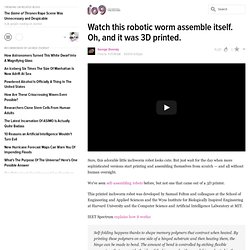
They grow on poop so the whole self assembly is going to be far cheaper and faster than waiting a few months to print enough. It would be pretty cool if we just had mind detonating worm dung piles far cheaper and self sustaining. Modular robot reassembles when kicked apart. This off-road robot could help revolutionize the exploration of other planets. Researchers create robot exoskeleton that is controlled by a moth running on a trackball. PETMAN. Sand Flea Jumping Robot. BigDog Evolution. New Video Of Army’s Alpha Dog Robot: “This Thing Is Awesome” No need to wait up. The speedier Alpha Dog now trots over flat terrain at 7 mph. For the last decade now Boston Dynamics has continuously provided some of the best two- and four-legged walking robots on the planet, and they’re continuing this trend with their latest version of Alpha Dog. Most articles about Alpha Dog go kind of like, “Impressive, but man, really loud.” Pentagon invests $10M to make this scary robot silent and bulletproof.
A diagonal two beat gait, in quadrupeds, is called an amble. It's the most efficient gait for distance. Boston Dynamics - Petman Robot Chemical Warfare Suit Testing [1080p] Robotic Hand Designed to Disarm Bombs. iRobot yields impressive results for DARPA's ARM program. DARPA's ARM program hand is flexible enough to pick up a basketball...
Image Gallery (10 images) Back when DARPA first announced its Autonomous Robotic Manipulation (ARM) program in 2010, the average cost of a military-grade robot hand was around US$50,000. Robotic grippers based on granular jamming. Sandia Hand. Japanese Researchers Continue Quest To Build Life-Like Humanoid Robots. Meet the Amazing Robots That Will Compete in the DARPA Robotics Challenge. Wow. I mean, seriously, wow.