
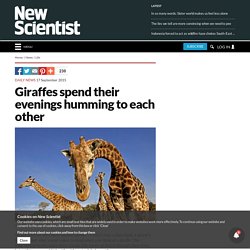
Indestructible Water Bears Have a Genome That Is Seriously Weird. Scientists Analyzed Spiderweb DNA, and the Results Are Super Creepy. The Way That Mushrooms Bring the Rain Will Astound You. How Is That Not Killing You? Report: DNA Markers Accurately Predict Male Homosexuality, At Least in This Small Study. One of Alan Turing's Predictions Came True in the Weirdest Way Possible. Why Some Boys in the Dominican Republic Don't Grow Penises Until Puberty. Giraffes spend their evenings humming to each other. Martin Harvey/Alamy Stock Photo.
AskScience AMA Series: We're scientists on a NOAA mission to explore the deep, unseen waters off Hawaii. Ask Us Anything! : askscience. Why Solving Murders Is Going to Get a Lot Harder. Big Whales Have Nerves Like Bungee Cords. Do "Eyespots" On Butterflies Really Mimic Eyes? How The "Horror Frog" Proves It Wants To Live Way More Than You Do. Under water spider. The Ancient Secrets of a "Bleeding" Glacier Are Finally Being Revealed. Field Cameras Catch Deer Eating Birds—Wait, Why Do Deer Eat Birds?
Why Everything You Know About Wolf Packs Is Wrong. Kinja is in read-only mode.
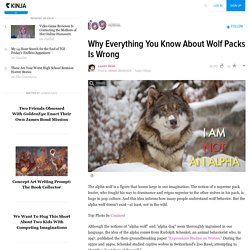
We are working to restore service. Yes. I remember reading about the wild wolves being family pack based. It doesn't mean that there isn't "dominance", a pack mom or dad isn't going to put up with crap from a pup, but... the pup isn't likely to talk back to mom and dad, and everyone loves grandma and grandpa... Hermit Crabs Line Themselves Up From Biggest To Smallest To Swap Shells.
New evidence that plants get their energy using quantum entanglement. The fact that biological systems can exploit quantum effects is quite astounding.
No it is not, not even remotely.There is literally no possible way that photosynthesis could take place without involving quantum physics. This particular exploit is really neat, of course, but far too much as been made of how mystical or ungraspable quantum physics is. Basic chemistry is defined by quantum physics. Every interaction of two particles or two molecules is the result of the laws of quantum physics. Meet The Scariest Inhabitant Of The Great Pacific Garbage Patch. Butterflies Remember What They Learned as Caterpillars. When a caterpillar turns into a butterfly, the transformation is so radical that it’s hard to believe they belong to the same species.
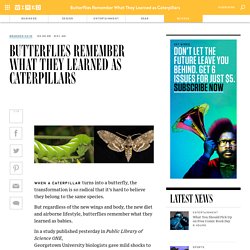
But regardless of the new wings and body, the new diet and airborne lifestyle, butterflies remember what they learned as babies. In a study published yesterday in Public Library of Science ONE, Georgetown University biologists gave mild shocks to tobacco hornworm caterpillars while exposing the caterpillars to particular odors. Humans' Sense of Smell is Far More Precise Than We Thought. I love that this study happened.
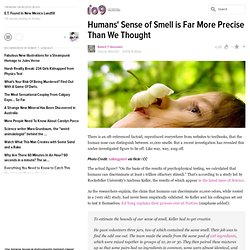
Hella fascinating. Just want to point out, since scientists are Debbie Downers, one of the major limitations is the fact that it's a cohort of 26 people. Admittedly, it's a very diverse cohort: Data from 26 subjects [17 female; median age 30 (range of 20 to 48); 14 Caucasian, 5 African-American, 5 Asian, 2 Other; 4 Hispanic] are included in the analysis presented here. Scientists Reveal How Microbe 'Eats' Electricity. Some microbes, simple as they may be, have an ability to gather energy from extreme sources like sulfur, formic acid, minerals, and... electricity?
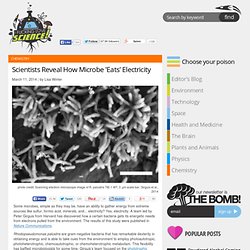
Yes, electricity. A team led by Peter Girguis from Harvard has discovered how a certain bacteria gets its energetic needs from electrons pulled from the environment. Watch an artificial virus fighting to infect a cell. Dogs align their bodies along a North-South axis when they poop. Pacific Leaping Blenny: Study Sheds More Light on Life of Legless, Land-Dwelling Fish.
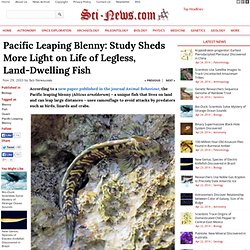
According to a new paper published in the journal Animal Behaviour, the Pacific leaping blenny (Alticus arnoldorum) – a unique fish that lives on land and can leap large distances – uses camouflage to avoid attacks by predators such as birds, lizards and crabs.
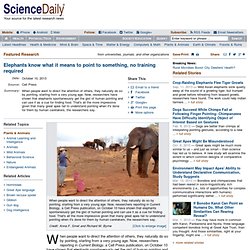
Small animals perceive the world in slow-motion. Www.nuffieldbioethics.org/sites/default/files/The ethics of research involving animals - summary & recs only.pdf. Elephants know what it means to point to something, no training required. When people want to direct the attention of others, they naturally do so by pointing, starting from a very young age.
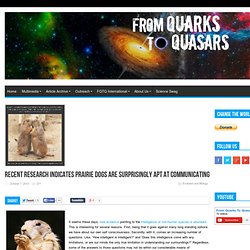
Recent Research Indicates Prairie dogs Are Surprisingly Apt at Communicating. It seems these days, new evidence pointing to the intelligence of non-human species is abundant.
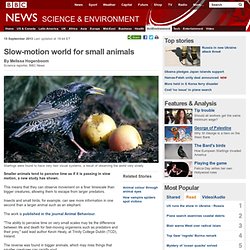
This is interesting for several reasons. Slow-motion world for small animals. 15 September 2013Last updated at 19:44 ET By Melissa Hogenboom Science reporter, BBC News.
The First Gear Discovered in Nature. With two diminutive legs locked into a leap-ready position, the tiny jumper bends its body taut like an archer drawing a bow. At the top of its legs, a minuscule pair of gears engage—their strange, shark-fin teeth interlocking cleanly like a zipper. Lowest temperature for life discovered.
The study, published in PLoS One, reveals that below -20 °C, single-celled organisms dehydrate, sending them into a vitrified – glass-like – state during which they are unable to complete their life cycle. The researchers propose that, since the organisms cannot reproduce below this temperature, -20 °C is the lowest temperature limit for life on Earth. Scientists placed single-celled organisms in a watery medium, and lowered the temperature. Facebook. BBC Nature - Diving bell spiders use bubble webs 'like gills' 9 June 2011Last updated at 05:41 By Ella Davies Reporter, BBC Nature Dinner time in the diving bell Diving bell spiders only need to come up for air once a day, according to researchers.
The spiders are named for their sub-aqua webs which they fill with air in order to breathe underwater. Scientists studying the European arachnids measured oxygen levels inside and around an air bubble web. They found that the bubble acted like a gill, extracting dissolved oxygen from the water and dispersing carbon dioxide. The study is published in the Journal of Experimental Biology. Argyroneta aquatica live in ponds, pools and slow-moving streams across Europe and northern Asia. Sunbathing keeps you healthy... if you're a bug. The necessary junk: new functions for transposable elements. Abstract Transposable elements have been shaping the genome throughout evolution, contributing to the creation of new genes and sophisticated regulatory network systems.
Why Koalas Have Human Fingerprints. Epigenetics: Feast, Famine, and Fatness. Increasingly, evidence shows that our children and even grandchildren can inherit non-genetic elements — stuff that’s not our DNA, but rather changes in the way our DNA can be expressed. InnerHi. Scientists snap a picture of DNA’s double helix for the very first time. DNA directly photographed for first time - Technology & science - Science - LiveScience. Researchers produce first complete computer model of an organism. July 19, 2012 A mammoth effort has produced a complete computational model of the bacterium Mycoplasma genitalium, opening the door for biological computer-aided design.
Facebook. Facebook. Quantum states last longer in birds' eyes - life - 20 January 2011. Robins can literally see magnetic fields, but only if their vision is sharp. Some birds can sense the Earth’s magnetic field and orientate themselves with the ease of a compass needle. The Science of Sperm Collecting. Human Chimeras: These Fused Fraternal Twins Can Confuse DNA Tests.