
SXSW 2011: The internet is over. If my grandchildren ever ask me where I was when I realised the internet was over – they won't, of course, because they'll be too busy playing with the teleportation console – I'll be able to be quite specific: I was in a Mexican restaurant opposite a cemetery in Austin, Texas, halfway through eating a taco.
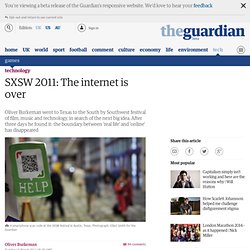
It was the end of day two of South by Southwest Interactive, the world's highest-profile gathering of geeks and the venture capitalists who love them, and I'd been pursuing a policy of asking those I met, perhaps a little too aggressively, what it was exactly that they did. What is "user experience", really? What the hell is "the gamification of healthcare"?
Or "geofencing"? Or "design thinking"? The content strategist across the table took a sip of his orange-coloured cocktail. This, for outsiders, is the fundamental obstacle to understanding where technology culture is heading: increasingly, it's about everything. Web 3.0 The game layer The dictator's dilemma Biomimicry comes of age.
The Hierarchy Of Digital Distractions. Panorama. What’s the Next Big Trend in Social Media Marketing? « Mobile News Authority. If there is anything that can be observed about human behavior by examining social media, it’s that people are basically restless.
They’re always looking for something new to read, watch, see and interact with. The seemingly impenetrable social media experiences of a few years ago; MySpace for example, is a prime example of how fickle our love affairs can diminish with all things social. So it’s only natural to wonder: When do we begin to tire of our current online social sites, where will we turn next? Obviously, the big kid on the social media block these days is Facebook.
Its 600 million users collectively spent more than 49 billion minutes on the social networking site in 2010. What’s interesting is that although Facebook is currently the most popular social media site, it only captures about 12.5 percent of the total social network page views. So what’s the next big trend in social media marketing? The next big thing may actually start with a “Q” Who participates ? Twitter territory. Executives & Social Media. The time constraints on today’s executives are more numerous than ever before.
Between the economic downturn, ever-changing industry regulations, fast-moving information and simple day-to-day management tasks, corporate executives are trapped in the virtual jail cell that is today’s business climate. The unintended result of executive “information-imprisonment” is a workplace where they may have little insight into employee morale, culture, and general goings-on during the workday. Blinded by the reflection of their own to-do-lists, executives are turning to consumer social networks to stay connected to the people that execute on daily tasks inside their organizations.
According to The Society for New Communication Research (SFNCR), 92 percent of executives are users of LinkedIn, 51 percent are on Facebook, and 41 percent are on Twitter because these tools are “a great way to keep track of peers and colleagues.” Pourquoi Quora plait-il aux blogueurs ? » Article » OWNI, Digital Journalism. Pourquoi Quora fait-il le buzz ?
Pour Benoit Raphaël, la raison est essentiellement dans le fait que ce nouveau service répond aux attentes des blogueurs. Cela fait plusieurs mois que je cite Quora en exemple sur ce blog. Créé en 2009 par Charlie Cheever et Adam d’Angelo, un ancien de Facebook (photo), Quora reprend le meilleur des réseaux sociaux : Facebook, Twitter et Yahoo Answers, pour proposer une expérience qui, je ne suis pas le seul à en être convaincu, préfigure le visage du blogging du futur. Depuis le mois de décembre, Quora est “hot”. C’est le service dont tout le monde parle dans les milieux techies. Charlie Cheever Explains The Difference Between Quora And Wikipedia. If Social Media were a high school. This post was written by Jenny Urbano, our Social Media Manager.
Here at Demandforce, we love seeing and celebrating your ideas! And more than that, we love to hear from YOU. We want to bridge the gap between us and you, so that’s why we’re offering a once in a lifetime opportunity to win a trip to San Francisco, sightsee in this amazing city, visit Demandforce headquarters and share your ideas with us! 6 winners, and a guest of their choice will be flown out to San Francisco, California on March 12-14th, 2014, where they will stay in Union Square, spend a day at Demandforce, have dinner with the team, and explore the lovely City by the Bay! For contest rules, and how to enter, please visit our post in the Generation Demandforce Community here. Good luck!