
Ken Wilber. A Brief History of Everything: Amazon.ca: Ken Wilber. Integral Institute. Ken Wilber on Seeking Enlightenment. Ken Wilber. Kenneth Earl "Ken" Wilber II (born January 31, 1949, in Oklahoma City, Oklahoma) is an American writer and public speaker.
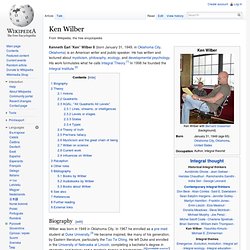
He has written and lectured about mysticism, philosophy, ecology, and developmental psychology. His work formulates what he calls Integral Theory.[1] In 1998 he founded the Integral Institute.[2] Biography[edit] Wilber was born in 1949 in Oklahoma City. In 1967 he enrolled as a pre-med student at Duke University.[3] He became inspired, like many of his generation, by Eastern literature, particularly the Tao Te Ching. In 1973 Wilber completed his first book, The Spectrum of Consciousness,[5] in which he sought to integrate knowledge from disparate fields. In 1982 New Science Library published his anthology The Holographic Paradigm and other Paradoxes[6] a collection of essays and interviews, including one by David Bohm.
In 1983 Wilber married Terry "Treya" Killam who was shortly thereafter diagnosed with breast cancer. Theory[edit] Ray Kurzweil. Ray Kurzweil on how technology will transform us. Singularity Is Near: Amazon.ca: Ray Kurzweil. Kurzweil Technologies, Inc. Raymond Kurzweil. Raymond "Ray" Kurzweil (/ˈkɜrzwaɪl/ KURZ-wyl; born February 12, 1948) is an American author, computer scientist, inventor, futurist, and is a director of engineering at Google.
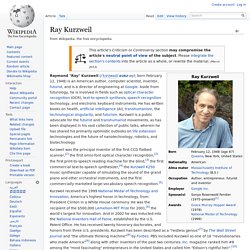
Aside from futurology, he is involved in fields such as optical character recognition (OCR), text-to-speech synthesis, speech recognition technology, and electronic keyboard instruments. He has written books on health, artificial intelligence (AI), transhumanism, the technological singularity, and futurism. Kurzweil is a public advocate for the futurist and transhumanist movements, as has been displayed in his vast collection of public talks, wherein he has shared his primarily optimistic outlooks on life extension technologies and the future of nanotechnology, robotics, and biotechnology. Life, inventions, and business career[edit] Early life[edit] Ray Kurzweil grew up in the New York City borough of Queens.
Kurzweil attended Martin Van Buren High School. Mid-life[edit] Later life[edit] Personal life[edit] Alvin Toffler. Alvin Toffler. Alvin Toffler (born October 4, 1928) is an American writer and futurist, known for his works discussing the digital revolution, communication revolution and technological singularity. He founded Toffler Associates, a management consulting company, and was a visiting scholar at the Russell Sage Foundation, visiting professor at Cornell University, faculty member of the New School for Social Research, a White House correspondent, an editor of Fortune magazine, and a business consultant.[3] Toffler is married to Heidi Toffler, also a writer and futurist. They live in the Bel Air section of Los Angeles, California, just north of Sunset Boulevard. The couple’s only child, Karen Toffler, (1954–2000), died at the age of 46 after more than a decade suffering from Guillain–Barré syndrome.[4][5] Early life and career[edit] Alvin Toffler was born in New York city in 1928.
In the mid-’60s, the Tofflers began work on what would later become Future Shock.[6] His ideas[edit] Critical acclaim[edit] Alvin Toffler. Toffler Associates - Creating the Future. Strategy and Manageme. Alvin Toffler to address 'The Future of digital Media'