
JellyRat: Scientists construct artificial jellyfish from rodent cells. Insects Find Crack In Biotech Corn's Armor : The Salt. Hide captionScientists say the corn rootworm is growing resistant to Bt corn.
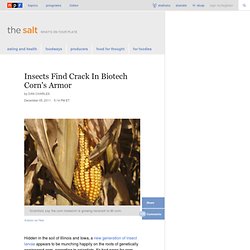
Snbetor via Flickr Hidden in the soil of Illinois and Iowa, a new generation of insect larvae appears to be munching happily on the roots of genetically engineered corn, according to scientists. It's bad news for corn farmers, who paid extra money for this line of corn, counting on the power of its inserted genes to kill those pests. It's also bad news for the biotech company Monsanto, which inserted the larvae-killing gene in the first place. In fact, the gene's apparent failure, as reported in the journal PLoS One, may be the most serious threat to a genetically modified crop in the U.S. since farmers first started growing them 15 years ago. The story of how this happened is long and complicated, but the details are important, so let's start at the beginning.
Almost the entire agricultural biotech industry has been built on just two genetic traits, and our story involves one of them. A Klondike cold rush. Research vessel "Helmer Hanssen", which belongs to the University of Tromsø, on the Arctic Tipping Points expedition in Framstredet, may 2011 (Photo: rudicaeyers.com – BFE/Universitetet i Tromsø) Last summer when the research vessel Helmer Hansen sailed toward the ice packs north of the Svalbard Archipelago, the scientists on board were searching for life that is invisible to the naked eye.

Millions of microorganisms live in every drop of the Arctic seawater. Others are found in the sediments on the sea floor. Even more live inside the guts of fish and other sea creatures. These bacteria harbour knowledge about survival in cold waters – capabilities they’ve inherited through their genes. Frigid gold of the sea Such genetic material is like Klondike for Gro Bjerga and her colleagues. “We call this bio-prospecting,” says Bjerga. Why Monsanto Thought Weeds Would Never Defeat Roundup : The Salt. Hide captionA farmer sprays the weed killer glyphosate across his cornfield in Auburn, Ill.
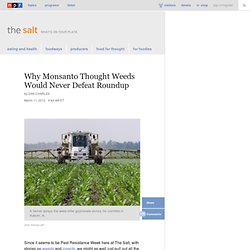
Seth Perlman/AP A farmer sprays the weed killer glyphosate across his cornfield in Auburn, Ill. Since it seems to be Pest Resistance Week here at The Salt, with stories on weeds and insects, we might as well just pull out all the stops. So, next up: Why didn't Monsanto's scientists foresee that weeds would become resistant to glyphosate, the weed-killing chemical in their blockbuster herbicide Roundup?
In 1993, when Monsanto asked the U.S. The company also wrote that several university scientists agreed "that it is highly unlikely that weed resistance to glyphosate will become a problem as a result of the commercialization of glyphosate-tolerant soybeans. " Dow and Monsanto Join Forces to Poison America's Heartland. Scandinavian trees 'survived last Ice Age' Judge Dismisses Organic Farmers' Case Against Monsanto : The Salt. Hide captionFarmer Alan Madison fills a seed hopper with Monsanto hybrid seed corn near Arlington, Illinois, U.S.
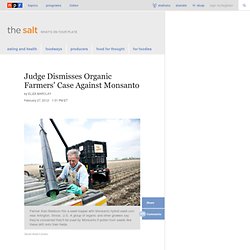
A group of organic and other growers say they're concerned they'll be sued by Monsanto if pollen from seeds like these drift onto their fields. Daniel Acker/Landov Farmer Alan Madison fills a seed hopper with Monsanto hybrid seed corn near Arlington, Illinois, U.S. A group of organic and other growers say they're concerned they'll be sued by Monsanto if pollen from seeds like these drift onto their fields. A New York federal court today dismissed a lawsuit against agribusiness giant Monsanto brought by thousands of certified organic farmers. The Organic Seed Growers and Trade Association and several other growers and organizations do not use Monsanto seeds. Instead, the judge found that plaintiffs' allegations were "unsubstantiated ... given that not one single plaintiff claims to have been so threatened.
" Seattle's First Urban Food Forest Will Be Open To Foragers : The Salt. Hide captionDesigners of a food forest in Seattle want to make blueberry picking a neighborly activity. iStockphoto.com Designers of a food forest in Seattle want to make blueberry picking a neighborly activity.

If you're a regular reader of The Salt, you've probably noticed our interest in foraging. From San Francisco to Maryland, we've met wild food experts, nature guides and chefs passionate about picking foods growing in their backyards. Now, Washington state has jumped on the foraging bandwagon with plans to develop a 7-acre public plot into a food forest. The idea is to give members of the working-class neighborhood of Beacon Hill the chance to pick plants scattered throughout the park – dubbed the Beacon Food Forest. Open Source Ecology. Building A Village Starts With Building The Tractor. Hide captionDesigned and built on Marcin Jakubowski's farm, this tractor cost far less than a commercial tractor. Jon Kalish/NPR Designed and built on Marcin Jakubowski's farm, this tractor cost far less than a commercial tractor.
Do-it-yourselfers have made everything from bamboo bicycles to 3-D printers, but nothing as ambitious as what's happening on a farm in northwest Missouri where tractors and other industrial machines are being made from scratch. hide captionPhysicist Marcin Jakubowski leads the Open Source Ecology project, which aims to design and build affordable alternatives to industrial machines. Physicist Marcin Jakubowski leads the Open Source Ecology project, which aims to design and build affordable alternatives to industrial machines. Marcin Jakubowski earned a Ph.D. in physics, and his doctoral thesis deals with velocity turbulence and zonal flow detection, whatever that is.