
Sapphire disks could communicate with future generations 10 million years from now. Hotmail - puhnner. Yesterday’s Latest Things - Slide Show. The tongue is the future for disabled people. Telephone design: A brief history. [PHOTOS] App would allow humans to communicate with bonobos. The seven bonobos living at the Bonobo Hope Great Ape Trust Sanctuary in Des Moines, Iowa, are a pretty smart bunch of apes.

Among other things, they have a vocabulary of about 400 words – they don’t speak those words, but instead associate the meanings of them with symbols known as lexigrams. Using large wall-mounted touchscreen displays, they are able to communicate with humans by touching the appropriate lexigrams on those displays. Now, the sanctuary wants to develop an app that could be used on mobile versions of the wall screens, so tablet-wielding bonobos could communicate from wherever they happen to be. One of the Bonobo Chat app’s more interesting features would be its ability to act as a sort of human-ape translator. People could simply speak into their device in English, at which point the app would select lexigrams corresponding to their words, and display those on the screen of the selected bonobo’s device.
In the Battles of SOPA and PIPA, Who Should Control the Internet? Bluetooth-enabled magnet orders pizza at the push of a button. A Dubai-based pizza shop is offering refrigerator magnets to customers that automatically orders their favorite pizza over the Internet when the button on it is pressed With most major pizza chains equipped with online ordering and smartphone apps, having a pizza delivered is faster and easier than ever before.
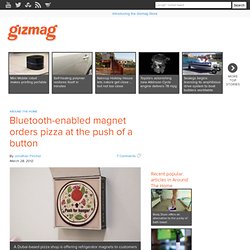
But that still may not be quick enough if you get a craving for your favorite pizza from your favorite pizzeria. That may be why one Dubai-based pizza shop is making things even easier on its customers by offering Bluetooth-enabled refrigerator magnets that can place an order for delivery at the push of a button. Red Tomato Pizza is distributing the magnets to their VIP (Very Important Pizza) customers who request one through the shop's website, where they can also select (and change) their default order. The magnet uses Bluetooth to sync to a customer's smartphone, which issues the order over the Internet once the button is pressed. Source: Red Tomato Pizza via Mashable. SpikerBox lets you listen to bugs' neurons. The SpikerBox is a scientific educational device, that lets you listen to the neural activity of bugs Image Gallery (4 images) Neurons, the nerve cells that send and receive electrical signals within the body, are one of those things that most of us probably don’t give a lot of thought to.

Educational entrepreneurs Timothy Marzullo and Gregory Gage, however, think about them a lot. They think about them so much, in fact, that they’ve designed a gadget that lets anyone listen to the neural electrical activity of bugs, and conduct a series of interesting experiments. Our compulsive consumption of information - The Browser. This interview first appeared in the Browser, as part of the FiveBooks series.

Previous contributors include Paul Krugman, Woody Allen and Ian McEwan. For a daily selection of new article suggestions and FiveBooks interviews, check out the Browser or follow @TheBrowser on Twitter. Is the Internet dividing our attention? Researchers send neutrino-message through 260 yards of rock. Neutrinos have been in the news recently, and although it appears that they probably do not travel faster than light, they still hold court as three of the strangest of the known subatomic particles.

Space Fence Mark II - Prototype S-band radar tracks space junk smaller than an inch across. A prototype of the new Lockheed Martin Space Fence radar system is currently tracking orbiting space objects smaller than was ever possible - down to about a centimeter in size.

In doing so, it met a key contract requirement during a series of demonstration events by proving it could detect and track such small objects. View all Intended to replace the Air Force Space Situational System (AFSSS), a ground-based 217 MHz megawatt-scale radar detector, the prototype for the new Space Fence is capable of tracking more than 200,000 centimeter-sized objects - ten times smaller than can be detected with the previous system. "Our final system design incorporates a scalable, solid-state S-band radar ... capable of detecting much smaller objects than the Air Force’s current system," said Steve Bruce, vice president of Lockheed Martin's Space Fence program.
But is this new Space Fence worth spending a projected US$3.5 billion? Space is full of junk. Source: Lockheed Martin. Analogue text still the best learning tool. The multimedia version that beat plain reading of text was one that combined text and images.
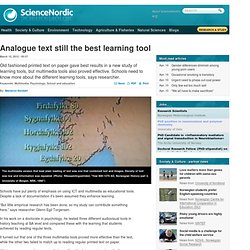
Density of text was low and information was repeated. (Photo: Rikssamlingsstriden "Year 800-1270 AD, Norwegian History part 2, University of Bergen, NRK, 1990") Schools have put plenty of emphasis on using ICT and multimedia as educational tools. Blind-friendly vending machine. Kjersti Maageng Nordås from Jessheim totally understands that NSB’s ticket vending machine is hard to use for visually impaired.

She adds that the vending machine is often out of use when it’s cold outside. (Photo: HiOA) DARPA wants swarms of "disposable" satellites to provide almost-live images on demand. SeeMe would provide eyes in the sky quickly to troops on the ground (Image: DARPA) DARPA, the United States' defense technology research agency that's created such notable projects as the Internet you're using right this moment, is now looking for help in creating a swarm of "disposable" eyes in the sky.

It is seeking technical assistance from a wide range of fields - from auto racing to optics - to create the means to provide on-demand satellite imagery for troops on the front lines. The agency's SeeMe program (Space Enabled Effects for Military Engagements) aims to achieve what currently available military and commercial satellites cannot - near real-time satellite images of an area that could be used to plan military missions from the field. Barnhart says they're hoping to be able to create the small satellites quickly and for a cost of around US$500,000 each, which is why the agency is reaching out to other industries for help. Google to Announce Venture With Belgian Museum. Oolone.com visual search engine. Open your eyes to the web. In Defense of Instagram: News Photography Goes Well With Vintage Cats. Justin Sullivan/Getty Images.

If its critics are to be believed, Instagram is one of the best deals in the world. The totally free app, and others like it, turn the work of talentless amateurs into “fine art.” Or so photographer Nick Stern argued last week in a piece on CNN that made the software sound like magical wowie-zowie dust. In his much-discussed article—called “Why Instagram photos cheat the viewer”—Stern objects to using cell phone apps to create news images, decrying the way the software can manipulate photos, adding dramatic color enhancement and faking selective focus. “The app photographer merely has to click a software button and 10 seconds later is rewarded with a masterpiece,” he writes.
AFP/Getty Images. Stern’s article touched off heated debate among the photojournalism world, which has been struggling to define the role of cell phone photography in the changing digital landscape. New Video Shows Japanese Speech-Jamming Gun in Action. Two Japanese researchers recently introduced a prototype for a device they call a SpeechJammer that can literally “jam” someone’s voice — effectively stopping them from talking. Now they’ve released a video of the device in action. “We have to establish and obey rules for proper turn-taking,” write Kazutaka Kurihara and Koji Tsukada in their article on the SpeechJammer (PDF).
“However, some people tend to lengthen their turns or deliberately disrupt other people when it is their turn … rather than achieve more fruitful discussions.” The researchers released the video after their paper went viral Thursday, to the authors’ apparent surprise. Vivek Ranadive Profile - Vivek Ranadive TopCom Software. Published in the February 2012 issue A single cloud hangs in the sky over San Francisco Bay, like a rip in a blue curtain. Metaphorical search engine looks for un-thought-of connections. Search under 'emergency department' using YossarianLives! FINIS gets out of the pool with open water GPS tracker. The FINIS Hydro Tracker GPS device allows open water swimmers to map their swims and record performance data Image Gallery (2 images) Pivothead glasses record what you see in 1080p. Google adds Esperanto as its 64th machine translatable language. Google to Sell Heads-Up Display Glasses by Year's End.
Screenshot via GoogleThe Google glasses will use augmented reality software to return real-time information about locations and people. 20 Most Amazing Microscope Shots Pictures !!!! These microscope pictures are taken from the book ‘ Microcosmos’, created by Brandon Brill . This book includes many scanning electron microscope (SEM) images of insects, human body parts and household items. Shit Burqueños (New Mexicans) Say. Phonemes probably can't reveal the ancient origins of language after all.
AQUA TEK S – the first waterproof, ruggedized, solar-powered battery case for iPhone. The AQUA TEK S case offers ruggedized protection and a solar panel for charging its own built-in battery Image Gallery (5 images) If you're hoping to attract investors to get yet another iPhone case to an already crowded market, it had better do more than just protect a phone from bumps and scrapes.