
Enterprising primary pupils open their own shop. 6 December 2013Last updated at 19:14 ET By Judith Burns Education reporter, BBC News Children celebrate the opening of their very own shop, with big plans to involve the whole community in the Walker area of Newcastle Primary pupils in inner city Newcastle have taken over a corner shop, selling goods they have designed, made and marketed themselves.
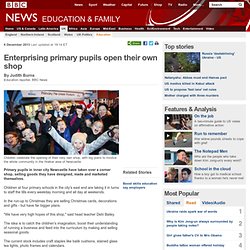
Children at four primary schools in the city's east end are taking it in turns to staff the tills every weekday morning and all day at weekends. In the run-up to Christmas they are selling Christmas cards, decorations and gifts - but have far bigger plans. "We have very high hopes of this shop," said head teacher Debi Bailey. The idea is to catch the children's imagination, boost their understanding of running a business and feed into the curriculum by making and selling seasonal goods. The current stock includes craft staples like batik cushions, stained glass tea lights, photo frames and calendars. Springboard Taking stock. Growth vs Fixed Mindset.
What is Pebble and Why are we doing it? The title for this post, refers to the students first two weeks of our project based learning course, where students analyse: What is learning?
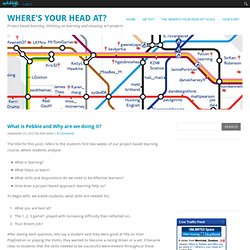
What helps us learn? What skills and dispositions do we need to be effective learners? How does a project based approach learning help us? To begin with, we asked students, what skills are needed for; What you are best at? After asking each question, lets say a student said they were good at Fifa on their PlayStation or playing the Violin, they wanted to become a racing driver or a vet, it became clear to students that the skills needed to be successful were evident throughout these different questions. These are the skills/aptitudes came up with: I asked students to consider from this bank of skills, which would be our most important 4 that we feel shape us as learners and that perhaps we most need to develop this year.
Our ability to be: Confident, Passionate, determined risk-takers when learning. Our next task was to explore what helps us learn. . Growth mindsets learning forum. The Top Five Essential Reads for Teachers « huntingenglish. Lessons Worth Sharing. Developing Curiosity - The 'Curiosity Campaign'
I have been reading a lot over the last few years. Most of it has been about developing my teaching or more specifically Learning to Learn. When I first got my job as the developer of L2L at my school, I was directed towards the Campaign for Learning by various people. It was here that I first heard about a number of the key components of L2L and how it works. Whilst reading through their website in 2007 I came across a really interesting idea that they had begun back in 2000. For those of you that know me or have read previous posts, if a strategy or initiative doesn't catch my attention or I don't see that it will make much of an impact, I don't use it. 'You can switch anyone onto learning by...............making them curious'. Campaign for Learning described the idea as follows: 'The campaign is based on the premise that a desire and motivation to learn can be stimulated by curiosity.
So how does it work? So, what have I done with this. TEDEducation's Channel. 100 different ways to say "good" Academic Video Lectures. The Open University. Welcome to Dylan Wiliam’s (other) website. SAGE Publications Ltd: Assessment and Learning: Second Edition: John Gardner: 9780857023834.
Assessment and Learning places learning at the centre of our concerns and explicitly underscores the importance of assessment in that learning.
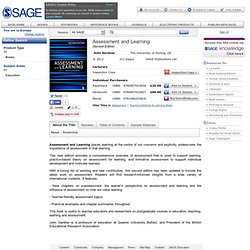
This new edition provides a comprehensive overview of assessment that is used to support learning, practice-based theory on assessment for learning, and formative assessment to support individual development and motivate learners. With a strong list of existing and new contributors, this second edition has been updated to include the latest work on assessment. Readers will find research-informed insights from a wide variety of international contexts. It features: - New chapters on e-assessment, the learner's perspective on assessment and learning and the influence of assessment on how we value learning - Teacher-friendly assessment topics - Practical examples and chapter summaries throughout This book is useful to teacher educators and researchers on postgraduate courses in education, teaching, learning and assessment.
Lesson Study: 3 heads are better than 1. This is our first fully completed lesson study.
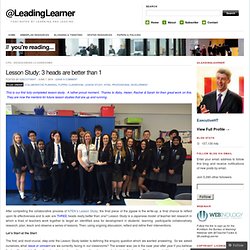
A rather proud moment. Thanks to Abby, Helen, Rachel & Sarah for their great work on this. They are now the mentors for future lesson studies that are up and running. After completing the collaborative process of NTEN’s Lesson Study, the final piece of the jigsaw is the write-up, a final chance to reflect upon its effectiveness and to ask: are THREE heads really better than one? Lesson Study is a Japanese model of teacher-led research in which a triad of teachers work together to target an identified area for development in students’ learning participants collaboratively research, plan, teach and observe a series of lessons.
Let’s Start at the Start The first, and most crucial, step onto the Lesson Study ladder is defining the enquiry question which we wanted answering.