
SaaS Metrics - A Guide to Measuring and Improving What Matters. This blog post looks at the high level goals of a SaaS business and drills down layer by layer to expose the key metrics that will help drive success.
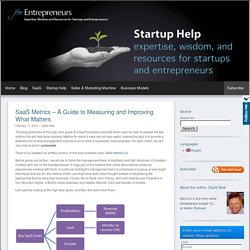
Metrics for metric’s sake are not very useful. Instead the goal is to provide a detailed look at what management must focus on to drive a successful SaaS business. For each metric, we will also look at what is actionable. There is an updated (re-written) version of this post available here: SaaS Metrics 2.0. Before going any further, I would like to thank the management team at HubSpot, and Gail Goodman of Constant Contact, who sits on the HubSpot board. Let’s start by looking at the high level goals, and then drill down from there: Key SaaS Goals Profitability: needs no further explanation. Two Key Guidelines for SaaS startups The above guidelines are not hard and fast rules.
How Sales Complexity impacts startup viability. There is no question that success for the entrepreneur starts with a breakthrough (or at the very least great) product or service.
Yet too often, entrepreneurs fall into the “field of dreams” mentality (in the words of Terence Mann, AKA James Earl Jones: “build it and they’ll come”). But the truth is that defining the product is just the beginning. Entrepreneurs must spend significant time thinking about the complexity of their sales process and the cost of customer acquisition, as these factors will strongly impact a company’s ability to make money and attract investors. An obvious requirement for a successful startup is that they are able to make more money from a customer than they spend for a customer, i.e. Lifetime value (LTV) should be greater than cost of customer acquisition (CAC) (see my prior blog post, Startup Killer: the Cost of Customer Acquisition). Understanding Sales Cycle Complexity. Optimizing your Customer Acquisition Funnel.
This blog post focuses on how B2B companies can optimize their customer acquisition funnels using a customer-centric methodology to analyze and remove blockage points.
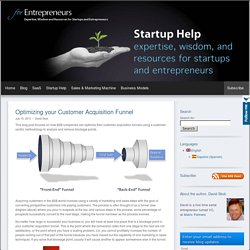
Acquiring customers in the B2B world involves using a variety of marketing and sales steps with the goal of converting prospective customers into paying customers. The process is often thought of as a funnel (see diagram above) where you pour in suspects at the top, and various steps in the process, some percentage of prospects successfully convert to the next stage, making the funnel narrower as the process evolves.
No matter how large or successful your business is, you will have at least one place that is a blockage point in your customer acquisition funnel. As an example, you may have too few visitors coming to your web site, which you see as the top of your funnel. Or you might have plenty of visitors to your website, but too few of them signing up for your trial. Identifying Blockage Points Product/Market Fit Concerns. SaaS Economics - Part 1: The SaaS Cash Flow Trough. This post provides SaaS entrepreneurs with an Excel spreadsheet model and graphs that show the cash flow trough that happens to SaaS, or other subscription/recurring revenue businesses that use a sales organization.
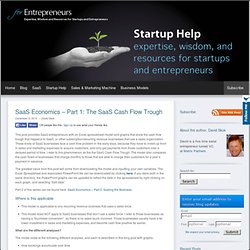
These kinds of SaaS businesses face a cash flow problem in the early days, because they have to invest up front in sales and marketing expenses to acquire customers, and only get payments from those customers over a delayed period of time. SaaS Economics - Part 2: Scaling the Business. This is the second part of a 2 part series that discusses the cash flow trough that happens to SaaS, or other subscription/recurring revenue businesses when they decide to scale their business by ramping sales and marketing.
These kinds of SaaS businesses face a cash flow problem in the early days, because they have to invest up front in sales and marketing expenses to acquire customers, and only get payments from those customers over a delayed period of time. The first part of the series can be found here: SaaS Econonics – Part 1: The SaaS Cash Flow Trough. The greatest value from this post will come from downloading the model and inputting your own variables. The Excel Spreadsheet and associated PowerPoint file can be downloaded by clicking here.
If you store both in the same directory, the PowerPoint graphs can be updated to reflect the data in the spreadsheet by right clicking on each graph, and selecting “Edit data”. Will your 2011 Plan stand up to investor scrutiny? We have just gone through the time of year when startups present their 2011 plans to their boards for approval.

In many ways, these meetings are very similar to the meetings we have with new startups that have projections for how they believe their revenue will grow. What I always find interesting in this process is looking at how the management team came up with the bookings forecast, and what steps they took to validate the number. In a lot of cases, the bookings target is determined using some rough top down logic like “We should be able to easily double the business this year” or “We’re similar to successful startup XYZ, and they hit $8m revenue in their third year, so we should be able to do the same.” SaaS CEOs: Measure Customer Engagement - Increase Conversions & Lower Churn. The goal of a SaaS CEO should be to increase the profit they make from each customer (LTV), and lower the costs in sales and marketing that it takes to acquire each customer (CAC).

Measuring Customer Engagement is a key tool that will help you achieve that goal, as it will allow you to increase your trial conversion rates, which directly reduces CAC. And it will help you lower your churn rates, which directly increases LTV. (There are also other significant benefits that are described below.)
How customer engagement has changed in the on-line world In the old world, most of the ways that companies engaged with their customers would involve human interactions either face-to-face, or over the phone. There are some tools that help us judge how customers as a whole are behaving on-line, but so far those tools have not allowed businesses to analyze customer behavior at the individual level. Why should you care? You might ask why would you care about how individual customers are behaving?
Multi-axis Pricing: a key tool for increasing SaaS revenue. HubSpot's Best Practices for Managing SaaS Inside Sales. Best practices for inside sales managers.

An interview with Mark Roberge, VP of Sales at HubSpot, discussing how he blends science and process with the art of selling. HubSpot is a SaaS company selling Inbound Marketing software. HubSpot has grown revenue over 6,000% in the last four years, placing them #33 on the Inc 500 fastest growing companies list. They now employ about 300 people. I have always been very impressed with how Mark has run their inside sales organization, which has now grown to 110 people. Mark’s background is unusual for a VP of Sales. How did MIT Sloan School influence the way you think about managing? It taught me to seek out science and data whenever possible to understand the business and make decisions.
What are your goals as a sales exec, and what is your strategy for achieving them? Goals are Predictable, Scalable Revenue Growth. Understanding the Customer Buying Cycle and Triggers. This article looks at why customers expect different interactions with you depending on where they are in the buying cycle.
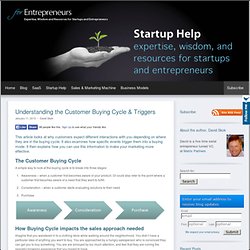
It also examines how specific events trigger them into a buying mode. It then explains how you can use this information to make your marketing more effective. The Customer Buying Cycle A simple way to look at the buying cycle is to break into three stages: Why Sales People shouldn't Prospect - An interview with Aaron Ross. Why Churn is SO critical to success in SaaS. Summary: Illustrates graphically why churn is a huge problem a SaaS company gets larger.
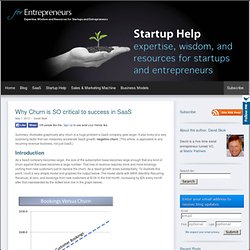
It also looks at a very surprising factor that can massively accelerate SaaS growth: negative churn. (This article is applicable to any recurring revenue business, not just SaaS.) Introduction As a SaaS company becomes larger, the size of the subscription base becomes large enough that any kind of churn against that base becomes a large number. That loss of revenue requires more and more bookings coming from new customers just to replace the churn. The red and yellow lines show the lost revenue due to customers cancelling their subscriptions (churn).
Looking at the graph above, we can see that Churn is really not that big of a number in the early startup months. The graph below shows the impact on Total MRR (monthly recurring revenue) of each scenario, which is fairly substantial. The Impact of Negative Churn. Pacific Crest's 2011 SaaS Survey. Pacific Crest, an investment banking firm with a strong focus on SaaS, has surveyed a 70 SaaS companies with very interesting results. There is some great data on topics such as growth rates, cost of customer acquisition, churn/retention, expense models, capital efficiency, etc. The full survey, which was put together by David Spitz and his team (follow @dspitz on Twitter), can be found here. In this article, I include many of their slides, and the associated Pacific Crest commentary. In a few cases, I add my own commentary prefaced by my initials DRS. Metrics and Compensation for SaaS Inside Sales. SaaS Metrics 2.0 – A Guide to Measuring and Improving what Matters.