Systems Theory

TwitterFacebook
Get flash to fully experience Pearltrees
1. What is The Tipping Point about? It's a book about change. In particular, it's a book that presents a new way of understanding why change so often happens as quickly and as unexpectedly as it does. For example, why did crime drop so dramatically in New York City in the mid-1990's? How does a novel written by an unknown author end up as national bestseller? http://www.gladwell.com/tippingpoint/index.html

the tipping point - www.gladwell.com (HTTP)

Complex adaptive system - Wikipedia, the free encyclopedia - en.wikipedia.org (HTTP)

Complex adaptive systems are special cases of complex systems , often defined as a 'complex macroscopic collection' of relatively 'similar and partially connected micro-structures' – formed in order to adapt to the changing environment, and increase its survivability as a macro-structure . [ 1 ] [ 2 ] [ 3 ] They are complex ; in that they are dynamic networks of interactions , and their relationships are not aggregations of the individual static entities. They are adaptive ; in that the individual and collective behavior mutate and self-organize corresponding to the change-initiating micro-event or collection of events. [ 1 ] [ 2 ] [ edit ] Overview http://en.wikipedia.org/wiki/Complex_adaptive_system
http://pubmedcentralcanada.ca/articlerender.cgi?accid=PMC2817139

Symbiosis as a source of selectable epigenetic variation: taking the heat for the big guy - pubmedcentralcanada.ca (HTTP)

Darwin's (1859) idea of the ‘struggle for existence’ where competition exists between ‘one individual with another of the same species or with the individuals of distinct species’ sets up a framework where each individual is essentially singular, competing only for itself and the survival and propagation of its lineage. But this situation changes if the ‘individual’ is actually a ‘team’ or a ‘consortium’ of cells with different genotypes. Gilbert (2002) referred to this chimeric mode of development as ‘interspecies epigenesis,’ emphasizing the developmental roles played by symbionts and the notion that the fertilized egg is not an autopoietic, self-creating, entity. Rosenberg et al . (2007) referred to this phenomenon of variation through symbiosis as ‘the hologenome theory of evolution’. They referred to the host and its full symbiont population as the holobiont , and they named the combination of the host genome and the genomes of all its symbiotic organisms the hologenome .
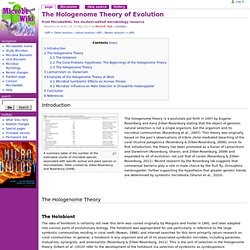
Introduction A summary table of the number of the estimated counts of microbial species associated with specific animal and plant species or microhabitats. Table created by Zilber-Rosenburg and Rosenburg (2008). The hologenome theory is a postulate put forth in 2007 by Eugene Rosenberg and Ilana Zilber-Rosenburg stating that the object of genomic natural selection is not a single organism, but the organism and its microbial communities (Rosenburg et al. , 2007).
The Hologenome Theory of Evolution - MicrobeWiki - microbewiki.kenyon.edu (HTTP)

http://microbewiki.kenyon.edu/index.php?title=The_Hologenome_Theory_of_Evolution&oldid=64475