
Rafranz Davis - FOREST OF THE RAIN PRODUCTIONS An Educational Affairs Organization. Educator Resources. Untitled. Teaching Resources, Lesson Plans, and More - WISE: Working to Improve Schools and Education. It is Personal and Dangerous Now. 2013 has been an interesting year.
Education is being juggled more than ever between pedagogy and corporate control AND it is personal — for you — for me — for our children. The marketing strategy of adaptive learning systems is that of 24/7 services that you can access at any time, in any place and at any pace. Robert Reich: The destructive myth at the heart of American “public” education. American kids are getting ready to head back to school.
But the schools they’re heading back to differ dramatically by family income. Which helps explain the growing achievement gap between lower and higher-income children. Thirty years ago, the average gap on SAT-type tests between children of families in the richest 10 percent and bottom 10 percent was about 90 points on an 800-point scale. New Report: Technology Can Close Achievement Gaps and Improve Learning Outcomes for At-Risk Students. Press Release: New Report: Technology Can Close Achievement Gaps and Improve Learning Outcomes for At-Risk Students Report Identifies Key Strategies to Successful Technology Implementation WASHINGTON, DC – As school districts around the country consider investing in technology as a way to improve student outcomes, a new report from the Alliance for Excellent Education and the Stanford Center for Opportunity Policy in Education (SCOPE) finds that technology—when implemented properly—can produce significant gains in student achievement and boost engagement, particularly among students most at risk.
1-855-8-INTERNET (1-855-846-8376) The Root (TheRoot) How education reform drives gentrification. Stephanie Yao Long/The Oregonian/Landov Public school teachers in Portland, Ore., and their students are doing a victory lap.
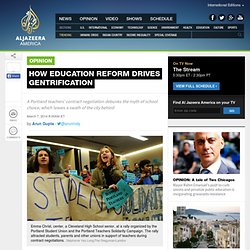
Nearly a year after unveiling a contract proposal that would have put the squeeze on the 2,900-member Portland Association of Teachers (PAT), the Portland School Board on March 3 approved a contract that acceded to virtually every demand from the teachers’ union. Digital Tools Can’t Magically Create Connections. Using Music to Close the Academic Gap - Lori Miller Kase. Several times a week, a group of at-risk youth in Los Angeles reports to makeshift music rooms at Alexandria Elementary School near Koreatown for lessons in violin or cello or bass—and to Saturday ensemble programs where they learn to play with bands and orchestras.
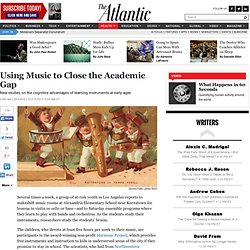
As the students study their instruments, researchers study the students’ brains. The children, who devote at least five hours per week to their music, are participants in the award-winning non-profit Harmony Project, which provides free instruments and instruction to kids in underserved areas of the city if they promise to stay in school. The scientists, who hail from Northwestern University’s Auditory Neuroscience Laboratory, travel from Evanston, Illinois to a satellite lab in Hollywood for a few weeks each year to examine the impact of the music lessons on the children’s language and cognitive skills.
Where do people talk honestly about race? At the A.C.T.O.R. series. By Rachel Mullin A.C.T.O.R. conversation with Tony Award-winning playwright, David Henry Hwang about his play Yellow Face.
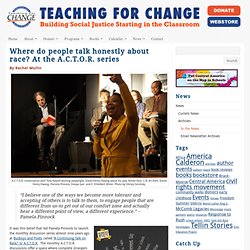
L-R: Ari Roth, David Henry Hwang, Pamela Pinnock, Deepa Iyer, and E. Ethelbert Miller. Photo by Shirley Serotsky. University School Literacy and Culture. A summary from "The Early Catastrophe: The 30 Million Word Gap by Age 3" by University of Kansas researchers Betty Hart and Todd R.
Risley. (2003). American Educator. Spring: 4-9, which was exerpted with permission from B. Rethinking Schools Online. Become a subscriber or online account holder to read this article and hundreds more.
Learn more. Already a subscriber or account holder? Log in here. Learning in the Digital Age: Control or Connection? Self-Directed Learning: An Inner-City Perspective. By Tiffany Mikell While touring for his book, Dale Stephens stopped by the Chicago area to participate in a panel discussion on taking control of your education by following your passion. The event was held in a high school auditorium and I had the pleasure of being in the audience that evening. The panel shared inspiring stories of challenging the educational status quo. Social Inequality. A Collection Of Useful Posts, Articles & Videos On Race & Racism – Help Me Find More. Issues of race and racism are critical for us to discuss and act on in our classrooms, among the teaching profession, and in society.
I’ve posted a number of useful related resources over the years, and I thought this would be a good time to bring them all together and to also invite readers to contribute more. Here are my choices, so far, for inclusion in A Collection Of Useful Posts, Articles & Videos On Race & Racism: The Best Posts, Articles & Lesson Plans On The Jordan Davis Tragedy & Verdict: Our “Classrooms Are Full Of Him” The Best Resources For Lessons On Trayvon Martin. A Collection Of Useful Posts, Articles & Videos On Race & Racism – Help Me Find More. Diversity, Multicultural, Cultural Competence, & Inclusion Education Training. Environmental Justice News. Why whites don’t see racism: Reagan Democrats are Stephen Colbert Democrats now.
There is a perception gap in the electorate between blacks and non-blacks about affirmative action in college admissions and between whites and non-whites about issues of racial inequality generally.

For example, a CNN survey conducted in 2009 found that 55 percent of blacks thought discrimination was a very serious problem, while only 17 percent of whites felt that way. Similarly, according to a 2009 Pew Research Center survey on race, 80 percent of blacks felt that equality has not been achieved and 43 percent of blacks thought there was still “a lot of discrimination,” while only 13 percent of whites believed that there was much anti-black bias. The same survey also found that 54 percent of whites believed the country had made the necessary changes to give African Americans rights equal to whites, while only 13 percent of blacks believed this. ELL Students Neglected in School Turnaround Efforts. Policy & Research | News ELL Students Neglected in School Turnaround Efforts A new evaluation of School Improvement Grant recipients shows that even in schools with high percentages of English language learners, ELL students were poorly represented in strategic reform efforts.
The report — Study of School Turnaround: A Focused Look at Schools Receiving School Improvement Grants That Have Large Percentages of English Language Learner Students (issued by the United States Department of Education's Institute of Education Sciences) — looked at 11 schools that participated in the SIG program over a three-year period (from 2010–2011 to 2012–2013) and evaluated the depth to which these schools addressed the needs of ELL students, using a point-based system. Poverty in America - The Living Wage Calculator. Poor Students Struggle as Class Plays a Greater Role in Success. "My Teacher Is an App" (This is a long one.) So I hope no one minds if I continue to try to document the ways in which "education" is being reframed in this country at the peril, I think, of losing everything that is best about schools and teachers and classrooms. If you're not up to speed with these reframing efforts, the above titled article in the Wall Street Journal this morning should do the trick.
Why is digital inclusion essential? Over the last years, we have seen the usage of the Internet skyrocketing globally. As most of us take for granted our access to the Web, we usually forget that the largest part of our world is not yet connected. A quick search on the Web illustrates this easily: out of the 6.9 Billion people in the planet, 67% do NOT use the Internet regularly. Critical Media Literacy. Broadband access in the United States is even worse than you think. Given the dismal state of broadband connections in America, it was illuminating recently to hear a major telecom executive paint a rosy picture of where the country stands.
When Wall Street Journal Deputy Managing Editor Alan Murray asked how the United States ranks in broadband, Verizon CEO Ivan Seidenberg didn't hesitate: "One. Not even close. " To support his statement, Seidenberg claimed that "in the U.S., there is greater household penetration of access to the Internet than any country in Europe. " Compare that with what Federal Communications Commission Chairman Julius Genachowski recently told a Senate committee: "Our record shows roughly 65 percent adoption in the U.S. compared to significantly higher adoption percentages—up to 90 percent or more—for some countries in Asia and Western Europe. " Technology in Schools Still Subject to Digital, Income Divides. Your Guide to the Digital Divide. How Do Parents Think ‘Educational’ Screen Time Affects Learning? Digital Tools. A Guide to Statistics on Historical Trends in Income Inequality. The broad facts of income inequality over the past six decades are easily summarized:
Edutopia 2014. Reclaiming the Conversation on Education. Social Justice & Technology. Connecting the Digital Divide to Digital Literacies. 6.8.12 | The term “digital divide” has long been used to describe the gap between those with access to communications technology and those without—applying to both home computer ownership as well as the delivery of home broadband access, which is still an issue.
In fact, though 65 percent of households (pdf) have broadband access, that figure drops to 40 percent in households with less than $20,000 in annual income. More recently, the term has referred to the gap in the type of engagement with the digital world. New ‘Digital Divide’ Seen in Wasting Time Online. COLORLINES. Granta 92: The View from Africa. A Simple Way to Send Poor Kids to Top Colleges. Dangerously Irrelevant.
Internet Access and the New Divide. Innovating civic media tools and practices together with communities. Civic Media Lunch: Technology for Peacebuilding in Sudan and Cyprus. FCC super Wi-Fi plan: There is no plan. Photo by Mark Wilson/Getty Images A somewhat confusingly structured Cecilia Kang article (the inverted pyramid is not a great way to explain everything) has got the whole Internet abuzz about an FCC plan to build a national Super Wi-Fi network and the evil telecommunications companies who are trying to kill it. The FCC does have a good idea here and the telecommunications companies are evil, but there is no such plan. Tech, telecom giants take sides as FCC proposes large public WiFi networks. There Is No FCC Plan For Free Nationwide Super WiFi, Why Won't This Story Die? Digital Divide in Mississippi Splits Along Racial Lines, Report Finds. Bringing a Nation Online-The Role of Federal Leadership fi… - bringing_a_nation.pdf. Community-Scale Broadband Solutions Are Critical.
National Broadband Plan Vital to Closing Digital Divide, FCC Tells Senate Committee. Advocates Urge Increased Broadband Access for Minority Communities. Universal broadband should be about control, not just access. Student's Social-Media-Fueled Campaign Propels Him Into Office. Poverty Is Rooted In US Education System, Research Finds. 11 Facts about Education and Poverty in America.
Digital Inclusion Network Home: E. The National Broadband Plan - Broadband.gov. You Can’t Get There from Here. Equity and social justice from the inside-out: Ten commitments of a multicultural educator « Fedcan Blog. Poverty and Education – The Challenge of Improving Schools.