
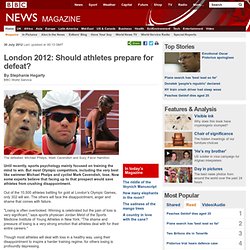
Methods of Training GCSE Theory Lesson #pegeeks. 1 Elite sport - Funding elite sport. Lab UK - Experiments - BBC - Can You Compete Under Pressure? Olympics 2012: The importance of sport psychology. The Science Behind the Bike. London 2012: Should athletes prepare for defeat? 30 July 2012Last updated at 00:13 GMT By Stephanie Hegarty BBC World Service The defeated: Michael Phelps, Mark Cavendish and Suzy Favor Hamilton Until recently, sports psychology mainly focused on training the mind to win.
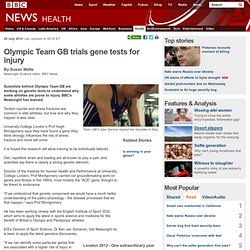
But most Olympic competitors, including the very best like swimmer Michael Phelps and cyclist Mark Cavendish, lose. Olympic Team GB trials gene tests for injury. 25 July 2012Last updated at 00:05 ET By Susan Watts Newsnight Science editor, BBC News Team GB's Alex Danson injured her shoulder in May Scientists behind Olympic Team GB are working on genetic tests to understand why some athletes are prone to injury, BBC's Newsnight has learned.
Tendon injuries and stress fractures are common in elite athletes, but how and why they happen is less clear. University College London's Prof Hugh Montgomery says they have found a gene they think strongly influences the risk of stress fracture and more will come. It is hoped the research will allow training to be individually tailored. Diet, repetitive strain and loading are all known to play a part, and scientists say there is clearly a strong genetic element. Director of the Institute for Human Health and Performance at University College London, Prof Montgomery carried out groundbreaking work on genes and fitness in the 1990s, most notably the "ACE" gene, thought to be linked to endurance.
Olympic athletes use devices to improve performance. Science Of The Summer Olympics: Engineering In Sports. "Science of the Summer Olympics: Engineering In Sports,” the fourth and latest installment in the “Science of Sports” franchise, explores the science, engineering and technology that are helping athletes maximize their performance at the 2012 London Games.
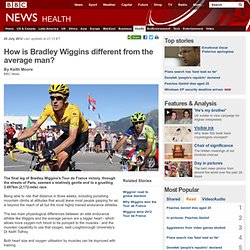
Timing is everything, especially at the 2012 Summer Olympics where even a millisecond could mean the difference... Highly engineered safety helmets are an essential part of many olympians' athletic gear. How is Bradley Wiggins different from the average man? 25 July 2012Last updated at 21:13 ET By Keith Moore BBC News The final leg of Bradley Wiggins's Tour de France victory, through the streets of Paris, seemed a relatively gentle end to a gruelling 3,497km (2,172-mile) race.
Sam Murphy - Health & Fitness Expert & Author. It’s dawn, and I am sitting on a fold-up chair in a field, eating a bowl of porridge.
At this moment in time, it is the best porridge I’ve ever tasted, warming my insides and replenishing my much-depleted energy stores like five-star fuel. I savour every mouthful as I watch the mist rise above the lake. Beyond it, brightly-clad runners dart in and out of the trees. There goes my teammate John, smooth and steady. Olympics attacked for fast food and fizzy drink links.
Health campaigners are urging the International Olympic Committee (IOC) to ban junk food and fizzy drink brands from future sporting sponsorship deals in a critical new report which says the committee has squandered the chance to create a positive health legacy from the London 2012 Games.

The Obesity Games report, published by The Childrens' Food Campaign (CFC), found that corporate sponsorship accounts for less than 10% of the total funding for the London 2012 Games, while fast food sponsors contribute only about 2% of the IOC income. Yet the major sponsors Coca-Cola, McDonald's and Cadbury are given an unrivalled platform to promote their unhealthy brands and products, it says. VIDEO – Altitude training in the England gym. National Fitness Coach Paul Stridgeon explains SA altitude preparations Simulated altitude machines and spinning get England ready for Highveld England are now on the elevated eastern plateau of Johannesburg in South Africa to prepare for three games at altitude, starting with the match against the SA Barbarians South in Kimberley on Wednesday.
Altitude training: Challenging conventional wisdom. The Rift Valley in Kenya is a world-renowned destination for altitude training As elite athletes prepare for the 2012 London Olympics, many will be seeking to maximise their impact with training sessions at high altitudes.
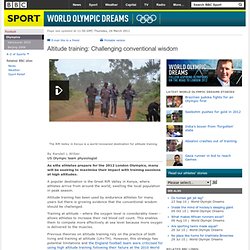
A popular destination is the Great Rift Valley in Kenya, where athletes arrive from around the world, swelling the local population in peak season. Altitude training has been used by endurance athletes for many years but there is growing evidence that the conventional wisdom should be challenged. Training at altitude - where the oxygen level is considerably lower - allows athletes to increase their red blood cell count.
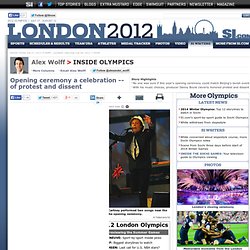
Olympics 2012: Video analysis software powers Team GB. Of protest and dissent - Alex Wolff. Paul McCartney performed two songs near the end of the opening ceremony.
Al Tielemans/SI 2012 London Olympics. Hot pants are British team's secret weapon in medal push. Great Britain's track cycling gold medal hope Victoria Pendleton.
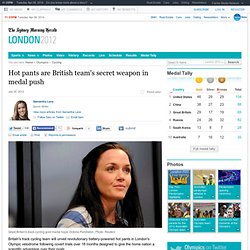
Photo: Reuters Britain's track cycling team will unveil revolutionary battery-powered hot pants in London's Olympic velodrome following covert trials over 18 months designed to give the home nation a scientific advantage over their rivals. Official Olympic Games Report 1960 Rome. Faster, higher, stronger - with technology's help. Since the days of woollen shorts and cinder track, athletic performance has kept on improving. As time goes by, there have simply been more and more people on the planet - so there are more exceptional athletes to choose from nutrition, medicine and training facilities have improved steadily, too. But in most sports it is technology that is making the biggest difference to how far, how high, or how fast people can go. At Loughborough University, they are designing power into pairs of sprinters spikes.
Your Olympic athlete body match. 30 July 2012Last updated at 12:14 ET Olympic athletes come in all shapes and sizes, from the lithe limbs of Japan's Asuka Teramoto to the gargantuan frame of China's Zhaoxu Zhang. London 2012 Olympics: how technology is aiding Team GB. “After one session I became a lot more aerodynamic,” explained Lucy Hall, one of the domestiques aiming to help Helen Jenkins win gold in the women’s triathlon competition. “I worked on my shoulder position, got a lot more narrow. My shoulders were quite relaxed and I needed to teach my body how to bring my shoulders in without becoming tense.
"With the reviews from here, I have been successful, though. In terms of energy, you can gain 10 or 15 watts. Olympics badminton: Eight women disqualified from doubles. Elite performance via talent transfer. The final instalment in this series on pathways to elite performance will discuss elite performance via talent transfer. For this post I will take a slightly different approach to the previous articles in this series – rather than review the scientific literature, I am going to discuss three specific case studies that I think you will agree provide convincing evidence supporting talent transfer as a viable pathway toward elite performance. If you are interested in reading more about the science of talent transfer please refer to references 1, 2 and 3 below.
Lewis and Jenson fuel up on Lucozade for the Malaysian Grand Prix. The Physical Education Teacher. Just a quick post on my recent use of Audiboo. I’ve been looking for a tool which would allow me to create short & sharp podcasts for students to listen to as a quick revision of certain topics. Human Platform. Jigsaw%20article%20AC. Olympic film highlights technology support for British athletes. Subscribe Shelly WoodsBAE Systems BAE Systems 12 January 2012.