
A 19-Year Study Reveals Kindergarten Students With These 2 Skills Are Twice as Likely to Obtain a College Degree (and They Have Nothing to Do With Reading) Can Free Play Prevent Depression and Anxiety In Kids? Key Person & Attachment - Early Years Matters. The Key Person Children thrive from a base of loving and secure relationships. This is normally provided by a child’s parents but it can also be provided by a key person. A key person is a named member of staff with responsibilities for a small group of children who helps those children in the group feel safe and cared for. The role is an important one and an approach set out in the EYFS which is working successfully in settings and in Reception classes. Page from English in Early Childhood - British Council. Ideas, tips and resources for primary language teachers.
Play and learning. Theimportanceofplay. Why play-based learning? (free article) - Early Childhood Australia. Stephen Krashen's Theory of Second Language Acquisition. Página inicial Portuguese version Language acquisition does not require extensive use of conscious grammatical rules, and does not require tedious drill. Acquisition requires meaningful interaction in the target language - natural communication - in which speakers are concerned not with the form of their utterances but with the messages they are conveying and understanding. ... 'comprehensible input' is the crucial and necessary ingredient for the acquisition of language.
The best methods are therefore those that supply 'comprehensible input' in low anxiety situations, containing messages that students really want to hear. In the real world, conversations with sympathetic native speakers who are willing to help the acquirer understand are very helpful. Introduction. MIT Brain Study: Back-And-Forth Talk Key To Developing Kids' Verbal Skills. New MIT research finds that for children's brain development, parents don't just need to talk to their kids — it's important to talk with them, in back-and-forth exchanges. "What we found is, the more often parents engaged in back-and-forth conversation with their child, the stronger was the brain response in the front of the brain to language," said cognitive neuroscience professor John Gabrieli.
Story continues below Most Viewed Stories That stronger brain response, measured as children ages 4 to 6 lay in a scanner listening to simple stories, reflects a deeper, more intimate engagement with language, said graduate student Rachel Romeo. On average, a child from a better-off, more-educated family is likely to hear 30 million more words in the first three years of life than a child from a less-well-off family. Get personal health and local medical research news sent to your inbox each week.
That finding from 1995 helped explain some school achievement gaps. But Dr. The Brain-Changing Power of Conversation. The Science Researchers used highly faithful audio recorders — a system called Language Environment Analysis (known as LENA) — to capture every word spoken or heard by 36 4–6 year olds from various socioeconomic backgrounds over two full days. The recordings were analyzed to measure the number of words spoken by each child, the number of words spoken to each child, and the number of conversational turns — back-and-forth exchanges initiated by either adult or child.
Comparing those measurements with brain scans of the individual children, the analysis found that differences in the number of conversational turns accounted for differences in brain physiology, as well as for differences in language skills including vocabulary, grammar, and verbal reasoning. Read the MIT News story for a fuller summary of the research. The Takeaways The “conversational turns” are key here, the researchers say. 9 Things You Need to Know About Play (and Preventing Challenging Behavior!) — Challenging Behavior. Over and over again I’ve seen examples of intentional support for a child’s play result in language spurts, increased attention span, social skills, friendships formed, and dramatic reductions or the elimination of the challenging behavior…sometimes even when the behavior was occurring at other times of the day.
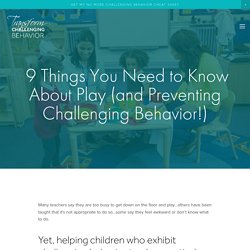
Curious? Read on… 1. Children need 45-60 consecutive minutes of play time per day. Play takes time. 2. If we want children to control their impulses, follow the rules and routines of our classrooms, and be nice to others then play needs to be at the center of the curriculum. 3. 5 Ways to Prevent Challenging Behavior with a "Sensory- Seeking" Child with a Short Attention Span — Challenging Behavior. Let’s think about how we can build on his interest in water and build on the fact that water play seems to self-regulate him. These ideas can be adapted for any child who moves rapidly from one activity to the next and who seems to be "sensory seeking," meaning they seek out sensory experiences such as playing with water, sand, or glue. Or, who consistently crash their trike into the wall or push into other children, seemingly for no reason.
Here are some thoughts and suggestions: 1. Offer outdoor water play, ideally first thing each day. I think the fact that you’ve identified both that he loves water and that this seems to be the only time he is “completely regulated” is KEY.