
Patrick Gliwa
One Million Children Labor in Africa's Goldmines. Nine-year-old Karim Sawadogo works with his uncle at a gold mine.

Photo by Larry Price. TIÉBÉLÉ, Burkina Faso — On the rocky ground outside the Kollo mining village near the border between Burkina Faso and Ghana, about 100 people are working, 30 or so of them children. They smash boulders into pebbles and pebbles into grit with primitive hammers and sticks. They haul buckets of well water up the hillside and, pouring this water into shallow pans filled with rock and dirt, they swirl the muddy mix, looking in the silt for tiny flecks of gold. Nearby, a small hill rises from this barren gold field, and atop this hill are hand-dug shafts that plunge 150 feet into the ground. The shaft ends in a cramped, pitch-dark pit. The United Nations’ International Labor Organization estimates that as many as a million children between ages 5 and 17 work in the small-scale gold mines of Africa for as little as $2 a day.
The U.S. The U.S. The nature of the mining makes enforcement difficult. Child labor in Factories During the Industrial Revolution. 1.
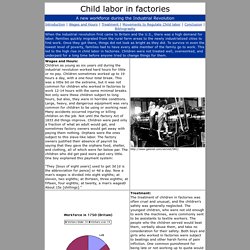
"The Industrial Revolution, 1700-1900. " Child Labor in America: Investigative Photos of Lewis Hine. About these Photos Faces of Lost Youth Left - Furman Owens, 12 years old.

Can't read. Child labour - Wikipedia. A succession of laws on child labour, the so-called Factory Acts, were passed in the UK in the 19th century.
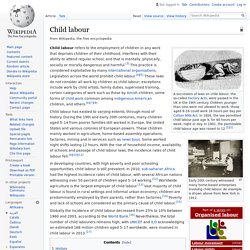
Children younger than nine were not allowed to work, those aged 9–16 could work 16 hours per day per Cotton Mills Act. In 1856, the law permitted child labour past age 9, for 60 hours per week, night or day. In 1901, the permissible child labour age was raised to 12.[1][2] Early 20th century witnessed many home-based enterprises involving child labour. An example is shown above from New York in 1912. Child labour refers to the employment of children in any work that deprives children of their childhood, interferes with their ability to attend regular school, and that is mentally, physically, socially or morally dangerous and harmful.[3] This practice is considered exploitative by many international organisations.
Child labour has existed to varying extents, through most of history. History. Want to know about child labor - child labour? Child Labor Bonded child laborer working in brick kiln factory (Photo taken by Mathias Heng during a Mission funded by the Society.
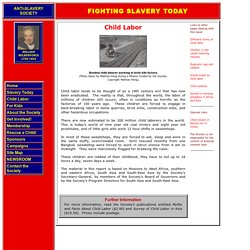
Copyright Mathias Heng). Child labor tends to be thought of as a 19th century evil that has now been eradicated. The reality is that, throughout the world, the labor of millions of children still occurs, often in conditions as horrific as the factories of 150 years ago. These children are forced to engage in back-breaking labor in stone quarries, brick kilns, construction sites, and other hazardous occupations. There are now estimated to be 200 million child laborers in the world. In most of these sweatshops, they are forced to eat, sleep and work in the same stuffy, overcrowded room. These children are robbed of their childhood, they have to toil up to 18 hours a day, seven days a week. Child labor in eastern Cameroon′s gold mines. The road to Betare-Oya in eastern Cameroon is better than it used to be.
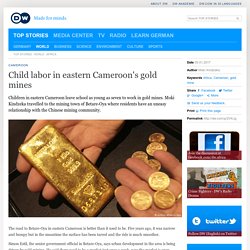
Five years ago, it was narrow and bumpy but in the meantime the surface has been tarred and the ride is much smoother. Simon Estil, the senior government official in Betare-Oya, says urban development in the area is being driven by gold mining. He said there used to be a market just once a week, now the market is open daily and a second one has sprung up. Young traders used to sell fuel in cans, but now there are four fuel stations even though mining is still on a small-scale. "That is enough to make you understand how gold mining can transform a locality," he told DW. 30-year-old Armand Zibi is digging away at a gold mine just 25 kilometers (16 miles) from the center of Betare-Oya. 'Money today' Individual incomes like these are having an impact on life in Betare-Oya.
"They prefer the money they see today to promises of a better future after an education that they are not even sure of," she told DW.