
European Alien Species Information Network - European Commission. Invasive Alien Species - Environment. Additional tools Invasive Alien Species are animals and plants that are introduced accidently or deliberately into a natural environment where they are not normally found, with serious negative consequences for their new environment.

They represent a major threat to native plants and animals in Europe, causing damage worth billions of euros to the European economy every year. Urn:nbn:se:norden:org:diva-3928 : Invasive Alien Species : Pathway Analysis and Horizon Scanning for Countries in Northern Europe. ReferencesLink to record Permanent link Direct link Invasive Alien Species : Pathway Analysis and Horizon Scanning for Countries in Northern Europe Responsible organisation 2015 (English)Book (Other academic) Abstract [en] Invasive alien species are one of the main drivers of biodiversity loss, due to their ability to disperse and cause negative effects on native species and the environment.

Place, publisher, year, pages Copenhagen: Nordisk Ministerråd, 2015. , 222 p. Series TemaNord, ISSN 0908-6692 ; 2015:517 National Category Natural Sciences Research subject. JOL_2014_317_R_0003. ALIEN CHALLENGE (COST Action TD1209) Sep. 29, 2014 - European Council adopts rules on invasive alien species The Council today adopted the "Regulation of the European Parliament and of the Council on the prevention and management of the introduction and spread of invasive alien species" (see updated text here).

For additional information, you can find an article on the issue here and the official press release of the European Council on the following link Aug. 31, 2014 - Questionnaire on IAS databases As part of the EU project (Alien challenge - COST TD1209) we want to identify the user data requirements in the field of biological invasions. Therefore we are asking for your help. The questionnaire is available at The aim of our activity is to assess how individual databases are used, as well as identifying their omissions or weak points and where the databases should evolve to be user friendly.
In case of any questions do not hesitate to contact us at pergl@ibot.cas.cz On 23 June 2014, the Action leader Dr. See. Impacts of invasive alien species in Europe. Invasive alien species indicators in Europe. 2013.0221 European Parliament briefing on invasive alien species. 22 February 2013 | News story Invasive Alien Species (IAS) poses a significant threat to native biodiversity in Europe, as well as to our economy and health.

They cause some 12.5 billion Euro worth of damage each year in the European Union alone. On 21 February, BirdLife and IUCN co-hosted an event in the European Parliament in Brussels to shed some light on this ticking time bomb ahead of the EU legislative proposal that is expected in March. The event was hosted by MEP Poc, Group of the Progressive Alliance of Socialists & Democrats (S&D) and supported by the European Habitats Forum. One of the better known examples of the economic damages caused by an IAS is the case of the American Comb jellyfish in the Black Sea. European Commissioner for the Environment, Dr Janez Potočnik stated in his opening address that the root of the problem is related to the effects of globalisation with an increase in travel and trade around the globe.
ALARM - Assessing Large scale Risks for biodiversity with tested Methods. NOBANIS - European Network on Invasive Species. ESENIAS. DAISIE. EPPO 2013 Communications Workshop. Oeiras (PT), 2013-10-08/10 A joint EPPO/CoE/IUCN ISSG Workshop took place on 2013-10-08/10 in Oeiras in Portugal at the kind invitation of the Direcção-Geral de Alimentação e Veterinária (Portuguese Plant Protection Organization), the Centre for Functional Ecology (University of Coimbra) and the Agrarian School of Coimbra (Instituto Politécnico de Coimbra).
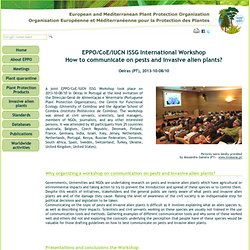
The workshop was aimed at civil servants, scientists, land managers, members of NGOs, journalists, and any other interested persons. It was attended by 65 participants from 25 countries (Australia, Belgium, Czech Republic, Denmark, Finland, France, Germany, India, Israel, Italy, Jersey, Netherlands, Netherlands, Portugal, Kenya, Russian Federation, Slovenia, South Africa, Spain, Sweden, Switzerland, Turkey, Ukraine, United Kingdom, United States). Pictures were kindly provided by Alexandre Gamela (PT) - www.invasoras.pt Why organizing a workshop on communication on pests and invasive alien plants?
Video 1video 2. European Alien Species Information Network - European Commission. Bern Convention: Group of Experts on Invasive Alien Species. Nature Bern Convention Group of Experts on Invasive Alien Species (IAS) The Bern Convention created in 1992 a specialised group of experts called "Group of Experts on Invasive Alien Species".

The group collected and analysed different national laws dealing with invasive species and proposed work aimed at the harmonisation of national regulations on introduced species, particularly on the fields of definitions, territorial scope of regulation, listing of species whose introduction is undesirable, identification of authorities responsible for permits, conditions for issuing such permits and control involved. One of the main products of the Group was the European Strategy on IAS. The group of experts meets every two years to check progress in implementation and propose new ideas. The Group held its last meeting in 2014. Report of the 7th meeting - T/PVS(2007)09.
EC Invasive Alien Species. RINSE (Reducing the Impact of Non-native Species in Europe)