
Friedrich Hayek. Pour les articles homonymes, voir Hayek. signature Vue de la sépulture.
Il est considéré comme un théoricien social ainsi qu'un penseur politique majeur du XXe siècle[3],[4], et son compte rendu sur la manière dont le changement des prix communique des informations aux individus les aidant à coordonner leurs plans est largement considéré comme une réalisation importante en économie[5], conduisant à son prix Nobel[6],[7]. Hayek a servi durant la Première Guerre mondiale et déclara que son expérience dans la guerre et son désir d'aider à éviter de nouveau les erreurs qui ont conduit à ce conflit l'ont amené à étudier les sciences économiques. Il vécut en Autriche, au Royaume-Uni, aux États-Unis, en Allemagne, et a été naturalisé britannique en 1938. 1972-2012 : le Club de Rome confirme la date de la catastrophe. Le Club de Rome. 1.
Qu’est ce que le Club de Rome ? Le Club de Rome est une organisation indépendante, à but non lucratif. Dans son travail, le Club de Rome se concentre sur les causes premières des challenges et des crises auxquelles le monde se trouve confronté ’aujourd’hui : nos concepts modernes de croissance, de développement et de mondialisation. Qu'y avait-t-il donc dans le fameux "Rapport du Club de Rome" ? Documentation > Divers énergie > Divers > Qu'y avait-t-il donc dans le fameux "Rapport du Club de Rome" ?
Club de Rome. Le Club de Rome est un groupe de réflexion réunissant des scientifiques, des économistes, des fonctionnaires nationaux et internationaux, ainsi que des industriels de 52 pays, préoccupés des problèmes complexes auxquels doivent faire face toutes les sociétés, tant industrialisées qu'en développement.
Réunie pour la première fois en avril 1968, l'organisation acquiert une notoriété mondiale à l'occasion de la publication de Les Limites à la croissance en 1972, aussi connue sous le nom de rapport Meadows, qui constitue la première étude importante mettant en exergue les dangers, pour la Terre et l'humanité, de la croissance économique et démographique que connaît alors le monde.
Frédéric Bastiat. Un article de Wikipédia, l'encyclopédie libre.
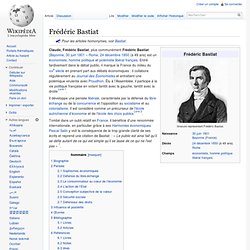
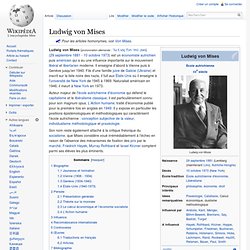
Pour les articles homonymes, voir Bastiat. Frédéric Bastiat. Frédéric Bastiat - Bastiat.org - Nous démystifions les sophismes économiques depuis 1845. Théorie du ruissellement. Un article de Wikipédia, l'encyclopédie libre. La théorie du ruissellement et la politique économique libérale[modifier | modifier le code] Une conséquence de cette théorie est qu'une ponction étatique sur les revenus des particuliers transfère simplement, sous l'organisation de l'État, une redistribution qui serait naturellement assurée par le jeu de la consommation et de l'investissement des particuliers. Madoff damage. Ludwig von Mises. Un article de Wikipédia, l'encyclopédie libre.
Ludwig von Mises École autrichienne. Wikiberal. Milton Friedman - Capitalisme et liberté. Un article de Wikipédia, l'encyclopédie libre.
Capitalisme et liberté (titre original : Capitalism and Freedom) est un livre de Milton Friedman, publié en 1962. Adam Smith. Adam Smith est né à Kirkcaldy en Écosse dans une famille de fonctionnaires.
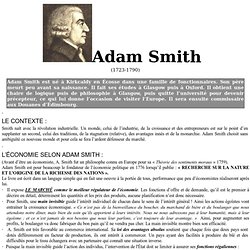
Son père meurt peu avant sa naissance. Il fait ses études à Glasgow puis à Oxford. Il obtient une chaire de logique puis de philosophie à Glasgow, puis quitte l’université pour devenir précepteur, ce qui lui donne l’occasion de visiter l’Europe. Keynesian economics. Keynes Was Right. Keynésianisme. Un article de Wikipédia, l'encyclopédie libre.
John Maynard Keynes. John Maynard Keynes. John Maynard Keynes Was the Warren Buffett of His Day - Matthew O'Brien - Business. His investing acumen explains why Keynes was skeptical of markets and favored public spending.
How would you like to outperform the stock market by 8 percentage points a year? This isn't some Madoff-style pitch. It's what economist John Maynard Keynes did over a twenty-year period that spanned the Great Depression. As Jason Zweig of The Wall Street Journal points out, it's an investing performance that puts Keynes in very elite company over the past century -- Warren Buffett company, to be exact. But more importantly, understanding how Keynes outperformed the markets so much explains why he mistrusted markets so much. Keynes famously took a dim view of how well unregulated markets allocate capital. If prices really can get so unmoored from fundamentals, investors are left with two basic strategies. Of course, there's a third option: buy undervalued stocks.
. * Credit default swaps change this calculus. Portail:Économie. Cependant, le mot est polysémique. L’économie est le concept étudié par les sciences économiques, celles-ci prenant appui sur des théories économiques, et sur la gestion pour sa mise en pratique. Le terme « d’économie » (economics en anglais), au sens uniquement d’économie politique, a été popularisé par les économistes néoclassiques tel qu’Alfred Marshall. Le mot « économie » devient alors, de façon concise, synonyme de « science économique » et peut être considéré comme substitut de l’expression « économie politique ». Portail:Libéralisme. David Ricardo.