
31 Ways To Know You're In The Right Relationship. As anyone living in the age of depressing divorce rates knows, a happy long-term couple is almost like a unicorn: If by some miracle you encounter it, you can't stop staring, and you have a feeling no one will ever believe you when you tell them you saw it.

The Internet is filled with articles on how to decide when to end it, how to recognize when your relationship is toxic, codependent, one-sided, stagnant, asexual, manipulative. Margaret Paul, Ph.D.: Resolving Relationship Problems by Letting Go of Problem-Solving. "We never seem to be able to solve any problems," Kaylee told me in a phone session.

"Every time we sit down to solve a problem, we end up fighting. Margaret Paul, Ph.D.: Is This Love or Emotional Dependency? One of my clients, whose ex-girlfriend recently broke up with him, asked me the following question: I think I still love her, but is this love or just emotional dependency?

Many times I ask myself if falling in love comes from the wounded self because (for me at least) it feels as if I can't live without the other person. The Science of Heartache. ©iStockphoto.com/Sabrina Dei Nobili Since the two of you split up, your head has felt like a helium balloon about to burst.

A family of squirrels seems to have moved into your stomach, your heart feels as if it's clamped in a vise, and though you've emptied a bottle of the natural sleep aid melatonin, you haven't caught a wink all week. No question about it: Losing your one-and-only is a bitch. But stop clutching your chest—the real pain is coming from inside your head. If you think you hate being dumped, your brain hates it even more. Your new singledom isn't helping any either: When you're in love, certain areas of your gray matter are happily awash in dopamine and oxytocin, hormones that give you feelings of pleasure and contentment, says Lucy Brown, Ph.D., a professor of neurobiology at Albert Einstein College of Medicine in New York City.
The good news: Though you may feel emotionally trampled for a while, you can at least ease your body's pain. How to Develop Sexual and Romantic Attraction to People Who Are Good for You. We can’t force our sexual attractions. Most of us have learned that the hard way. Yet, there’s something profound that most of us have never been taught: Although sexual attractions can’t be controlled, they can be educated. This post will teach some ways to cultivate sexual and romantic attraction to people who are kind, respectful and available.
Sometimes It’s Not You, or the Math - Modern Love. Is Marriage Good for Your Health? Farr’s was among the first scholarly works to suggest that there is a health advantage to marriage and to identify marital loss as a significant risk factor for poor health.

Married people, the data seemed to show, lived longer, healthier lives. “Marriage is a healthy estate,” Farr concluded. “The single individual is more likely to be wrecked on his voyage than the lives joined together in matrimony.” While Farr’s own study is no longer relevant to the social realities of today’s world — his three categories exclude couples living together, gay couples and the divorced, for instance — his overarching finding about the health benefits of marriage seems to have stood the test of time. The Generous Marriage. Hammerpress This column appears in the Dec. 11 issue of The New York Times Magazine.
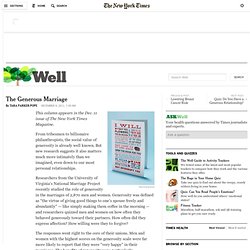
From tribesmen to billionaire philanthropists, the social value of generosity is already well known. But new research suggests it also matters much more intimately than we imagined, even down to our most personal relationships. Researchers from the University of Virginia’s National Marriage Project recently studied the role of generosity in the marriages of 2,870 men and women.
Generosity was defined as “the virtue of giving good things to one’s spouse freely and abundantly” — like simply making them coffee in the morning — and researchers quizzed men and women on how often they behaved generously toward their partners. The Science of a Happy Marriage. Stuart Bradford Why do some men and women cheat on their partners while others resist the temptation?

To find the answer, a growing body of research is focusing on the science of commitment. Scientists are studying everything from the biological factors that seem to influence marital stability to a person’s psychological response after flirting with a stranger. Their findings suggest that while some people may be naturally more resistant to temptation, men and women can also train themselves to protect their relationships and raise their feelings of commitment.
Recent studies have raised questions about whether genetic factors may influence commitment and marital stability. Over all, men who carried a variation in the gene were less likely to be married, and those who had wed were more likely to have had serious marital problems and unhappy wives. Although the trait is often called the “fidelity gene,” Mr. No pattern emerged among the study participants who imagined a routine encounter.