
Stats_decision.pdf. What is the difference between categorical, ordinal and interval variables? What is the difference between categorical, ordinal and interval variables?
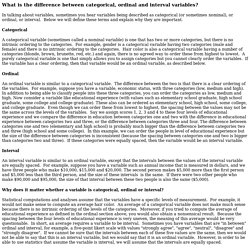
In talking about variables, sometimes you hear variables being described as categorical (or sometimes nominal), or ordinal, or interval. Below we will define these terms and explain why they are important. Categorical A categorical variable (sometimes called a nominal variable) is one that has two or more categories, but there is no intrinsic ordering to the categories. For example, gender is a categorical variable having two categories (male and female) and there is no intrinsic ordering to the categories. Ordinal An ordinal variable is similar to a categorical variable. Interval An interval variable is similar to an ordinal variable, except that the intervals between the values of the interval variable are equally spaced.
Why does it matter whether a variable is categorical, ordinal or interval? Statistical computations and analyses assume that the variables have a specific levels of measurement. Choosing the Correct Statistical Test (CHS 627: University of Alabama) SUBDUE - Graph Based Knowledge Discovery. Statistics books for (free) download. This post will eventually grow to hold a wide list of books on statistics (e-books, pdf books and so on) that are available for free download.
But for now we’ll start off with just one several books: The Elements of Statistical Learning written by Trevor Hastie, Robert Tibshirani and Jerome Friedman. you can legally download a copy of the book in pdf format from the authors website! Direct download (First discovered on the “one R tip a day” blog)Statistics (Probability and Data Analysis) – a wikibook. Download linkIntroduction to Statistical Thought by Michael Lavine.
The book is organized into seven chapters: “Probability,” “Modes of Inference,” “Regression,” “More Probability,” “Special Distributions,” “More Models,” and “Mathematical Statistics.” and makes extensive use of R. BOL: Bioinformatics Protocols. RNA Seq Basic Galaxy Tutorial RNA-Seq tutorial based on Trapnell et al. (2012) Nature Protocols In this tutorial we cover the concepts of RNA-Seq differential gene expression (DGE) analysis using a very small synthetic dataset from a well studied organism.
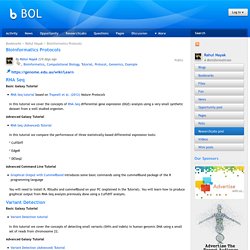
Advanced Galaxy Tutorial RNA-Seq (Advanced) Tutorial In this tutorial we compare the performance of three statistically-based differential expression tools: * CuffDiff * EdgeR * DESeq2. Article series : Nature Reviews Genetics. Suresh Kumar's Bioinformatics Links. A Statistical Learning/Pattern Recognition Glossary. Python Tools for Machine Learning. Python is one of the best programming languages out there, with an extensive coverage in scientific computing: computer vision, artificial intelligence, mathematics, astronomy to name a few.
Unsurprisingly, this holds true for machine learning as well. Of course, it has some disadvantages too; one of which is that the tools and libraries for Python are scattered. If you are a unix-minded person, this works quite conveniently as every tool does one thing and does it well. However, this also requires you to know different libraries and tools, including their advantages and disadvantages, to be able to make a sound decision for the systems that you are building. Tools by themselves do not make a system or product better, but with the right tools we can work much more efficiently and be more productive. This post aims to list and describe the most useful machine learning tools and libraries that are available for Python. Scikit-Learn Statsmodels PyMC PyMC is the tool of choice for Bayesians.
Everything You Wanted to Know About Machine Learning, But Were Too Afraid To Ask (Part One) Recently , Professor Pedro Domingos, one of the top machine learning researchers in the world, wrote a great article in the Communications of the ACM entitled “A Few Useful Things to Know about Machine Learning“.
In it, he not only summarizes the general ideas in machine learning in fairly accessible terms, but he also manages to impart most of the things we’ve come to regard as common sense or folk wisdom in the field. It’s a great article because it’s a brilliant man with deep experience who is an excellent teacher writing for “the rest of us”, and writing about things we need to know. And he manages to cover a huge amount of ground in nine pages. Now, while it’s very light reading for the academic literature, it’s fairly dense by other comparisons. How Does Machine Learning Work? We know that supervised machine learning models (the ones you build at BigML) can predict one field in your data (the objective field) from some or all of the others (the input fields). Not so fast. Stay Tuned. Resume / Application - Words To Use. Daily Zen List — 15 Books to Teach You a New Skill. 70 of the Most Useful Websites on the Internet.
Search results. Interesting Papers - Anshul Kundaje.