
Infographic: Media Consolidation – The Illusion of Choice. How much choice does the mainstream US media really offer?

Family financial blogger Frugal Dad has created this infographic that lays out the extent of media consolidation in the US, where just six media giants control 90% of all TV, news, radio and film. Doing a Background Check on CNN. Since CNN broadcasters seem so intent on looking back decades into promo letters and newletters put out by one of Ron Paul's organizations,when everyone admits Ron Paul did not write the letters, lets take a look at the background of some of those affiliated with CNN.
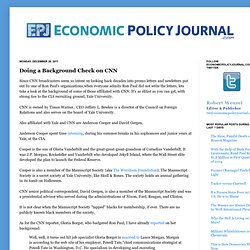
It's as elitist as you can get, with strong ties to the CIA recruiting ground, Yale University. CNN is owned by Times Warner, CEO Jeffery L. Bewkes is a director of the Council on Foreign Relations and also serves on the board of Yale University. Also affiliated with Yale and CNN are Anderson Cooper and David Gergen. Anderson Cooper Comes In From the Cold. Turns out the dashing young CNN star and former host of “The Mole” had a very interesting summer job during his Yale years.
Anderson Cooper worked for the CIA. Following his sophomore and junior years at Yale — a well-known recruiting ground for the CIA — Cooper spent his summers interning at the agency’s monolithic headquarters in Langley, Virginia, in a program for students interested in intelligence work. His involvement with the agency ended there, and he chose not to pursue a job with the agency after graduation, according to a CNN spokeswoman, who confirmed details of Cooper’s CIA involvement to Radar. Well, isn’t that special? We suppose it’s no real surprise that an ambitious young Ivy Leaguer from a powerful East Coast family would wind up working for the Firm.
Wolf Blitzer: From AIPAC Lobbyist to CNN's Chief News Anchor. Fox and G.E. Reach Deal to End O’Reilly-Olbermann Feud. OUTFOXED: Rupert Murdoch's War on Journalism. Media Reacts To Conan's Same-Sex Wedding News. Busted:Fox News CPAC Ron Paul Video Deception. BLATANT CENSORSHIP by CNN of Soldier Supporting Ron Paul's Foreign Policy [PLEASE RE-POST NOW]
Soldier in Trouble for Praising Ron Paul on National TV. Jan 5, 2012 10:41am Rep.
Ron Paul likes to silence the GOP rivals who criticize his foreign policy as “dangerous” by reminding them that he receives more financial support from military personal than all the other candidates combined. But the Army is now investigating whether a 28-year old reservist breached military protocol when he praised Paul’s foreign policy positions on national television during a Paul rally Tuesday night. Raw footage shows Ron Paul DIDN'T storm out of CNN interview over racist newsletters... the interview was simply done.
By Meghan Keneally Updated: 20:15 GMT, 24 December 2011 Reports that Republican presidential candidate Ron Paul stormed out of a CNN interview earlier this week seem to be dramatically over-exaggerated.
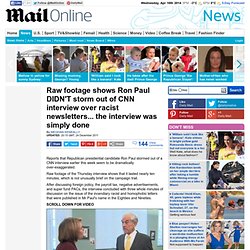
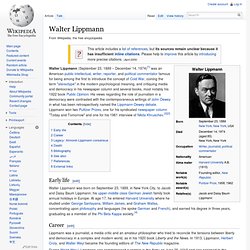
Raw footage of the Thursday interview shows that it lasted nearly ten minutes, which is not unusually brief on the campaign trail. After discussing foreign policy, the payroll tax, negative advertisements, and super fund PACs, the interview concluded with three whole minutes of discussion on the issue of the incendiary racist and homophobic letters that were published in Mr Paul's name in the Eighties and Nineties. Touchy: Earlier reports made it seem like Ron Paul stormed out of the interview, while the raw footage makes it seem like it was simply over The newly-released CNN footage shows something entirely different. After fielding repeated questions about the controversial newsletters, Mr Paul began wrapping up the interview. Walter Lippmann. Early life[edit] Career[edit] Lippmann was a journalist, a media critic and an amateur philosopher who tried to reconcile the tensions between liberty and democracy in a complex and modern world, as in his 1920 book Liberty and the News.
Edward Bernays. The Century Of The Self-Full Length Documentary. Vance Packard. Vance Packard (May 22, 1914 – December 12, 1996) was an American journalist, social critic, and author.
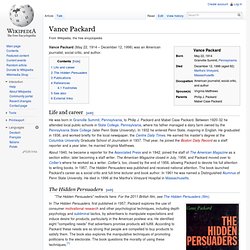
Life and career[edit] Wilfred Trotter. Life[edit] Born in Coleford, Gloucestershire in 1872, Trotter moved to London to attend college at age 16.

An excellent medical student, he decided to specialise in surgery and was appointed Surgical Registrar at University College Hospital in 1901 and Assistant Surgeon in 1906. He opened his own practice after obtaining his medical degree. He was also a keen writer, with an interest in science and philosophy. In 1908, he published two papers on the subject of herd mentality, which were precursors to his later, more famous, work. Working at University College Hospital in London as professor of surgery, he held the office of honorary surgeon to King George V from 1928 to 1932. Gustave Le Bon. Gustave Le Bon (7 May 1841 – 13 December 1931) was a French social psychologist, sociologist, anthropologist, inventor, and amateur physicist.
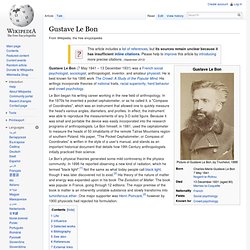
He is best known for his 1895 work The Crowd: A Study of the Popular Mind. Noam Chomsky Manufacturing Consent. The Noam Chomsky Website. War Made Easy. Hearts & Minds - Vietnam Documentary - New Trailer.