
Meet the Personal Chef of Pot. Jonesing for some gourmet tri-tip and a solid buzz?

Check out Cannabis Catering, a San Francisco-based outfit that specializes in marijuana cuisine. The brainchild of Chef Frederick Nesbitt, a California Culinary Academy-trained chef who has worked as personal chef for Jerry Rice and John Madden, Cannabis Catering offers four and five-course meals laced with ganja. The idea for Cannabis Catering came to Nesbitt when he learned that his friend's diabetic mother had been diagnosed with cancer.
"I would bring back edibles [from the dispensary], but they're so high in high-fructose corn syrup that she was high off sugar rather than being medicated," he says. So Nesbitt began experimenting with his own pot food--starting with mashed potatoes. The Most Unhealthy Foods in Your Supermarket Part 2 at Good Health Naturally. 1.
Aspartame (Artificial sweetener: Trade Name Equal and NutraSweet) As a natural health consultant I’m always trying to convince people to eat less sugar. But sometimes a little big of sugar is much healthier than some of the artificial alternatives. There are far worse things than sugar hiding in your food. Aspartame, the artificial sweetener also known as Equal and NutraSweet was first approved for use in dry foods in 1981. Why is aspartame so bad for you? Aspartame is broken down or metabolised into the well known toxin, methanol (wood alcohol).Methanol is then converted to formaldehyde and formic acid (which is responsible for the pain caused by ant stings).Formaldehyde is a potent neurotoxin and causes damage to the nervous system. Other documented effects of methanol poisoning include vision problems and problems with DNA replication which can cause cancer and birth defects.
Aspartame can also mimic or worsen the following disease: Essential Oils Chart: Unmasking black peppers secrets as a fat fighter. A new study provides a long-sought explanation for the beneficial fat-fighting effects of black pepper.
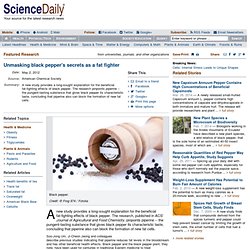
The research, published in ACS' Journal of Agricultural and Food Chemistry, pinpoints piperine -- the pungent-tasting substance that gives black pepper its characteristic taste, concluding that piperine also can block the formation of new fat cells. Soo-Jong Um, Ji-Cheon Jeong and colleagues describe previous studies indicating that piperine reduces fat levels in the bloodstream and has other beneficial health effects. Black pepper and the black pepper plant, they note, have been used for centuries in traditional Eastern medicine to treat gastrointestinal distress, pain, inflammation and other disorders. Despite that long medicinal history, scientists know little about how piperine works on the innermost molecular level. The scientists set out to get that information about piperine's anti-fat effects.
GMO Foods: What They Are and How You Can Avoid Them. Genetically Modified Foods are crop plants (fruits, vegetables and grains) that have been altered using molecular biology techniques that intentionally enhance certain properties of the plant that are seen as beneficial for the plants proliferation and growth.
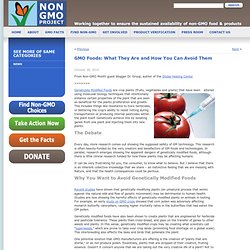
This includes things like resistance to toxic herbicides, or bettering the crop’s ability to resist rotting during transportation or producing internal pesticides within the plant itself. Geneticists achieve this by isolating genes from one plant and injecting them into new plants. The Debate. Grass Fed vs. Grain Fed Beef? Curried Cauliflower Soup. The Munchies, Marijuana and Happiness. Why does smoking marijuana produce the munchies? What does this peculiar response tell us about our brain ? It turns out, quite a lot; particularly with regard to our ability to experience happiness and joy and to avoid obesity and depression . The craving for food while smoking is likely due to the stimulation of marijuana receptors in the feeding centers of our brain.
The munchies drew the attention of neuroscientists who then conducted a series of clinical trials using a novel drug, called rimonabant, that potently block the brain's marijuana receptors. Their hope was that blocking the action of the brain's marijuana neurotransmitter system in the feeding center would produce an "anti-munchies" effect, thereby reducing food consumption and providing help to overweight patients. I was recently honored by an invitation to give a TED talk on this topic area. Unfortunately, some major side effects were reported after long term treatment with the drug.
10 Deceptive Food Labels. Dangers of Processed Foods & Charging LIFE. Dangers of Processed FoodsAuthor: Patrick Henry Ever wonder what’s really in that hamburger or what makes those Oreos so scrumptious?
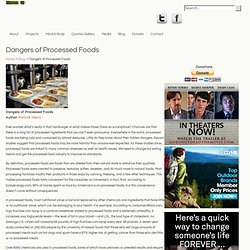
Chances are that there is a long list of processed ingredients that you can’t even pronounce. Everywhere in the world, processed foods are being sold and consumed by almost everyone. Little do they know about their hidden dangers. Recent studies suggest that processed foods may be more harmful than anyone ever expected. By definition, processed foods are foods that are altered from their natural state to enhance their qualities.
Popcorn has higher antioxidant levels than fruits and vegetables - Health. Hulls of the popcorn—the part that everyone hates—actually has the highest concentration of polyphenols and fibre.
Popcorn contains more of the healthful antioxidant substances called “polyphenols” than fruits and vegetables, say scientists. Joe Vinson, PhD, a pioneer in analysing healthful components in chocolate, nuts and other common foods, explained that the polyphenols are more concentrated in popcorn, which averages only about 4% water, while polyphenols are diluted in the 90% water that makes up many fruits and vegetables.
In another surprising finding, the researchers discovered that the hulls of the popcorn—the part that everyone hates for its tendency to get caught in the teeth—actually has the highest concentration of polyphenols and fibre. “Those hulls deserve more respect. They are nutritional gold nuggets,” said Vinson, who is with the University of Scranton in Pennsylvania. Vinson concluded, “Popcorn may be the perfect snack food. Bovine milk in human nutrition - a review. Pediatric Nutrition - Genetically Modified Foods and Your Child - Naturally Savvy.
The Hidden Sodium in Chicken. Poultry has a salty little secret.
One chicken breast could eat up 20% of your sodium limit—before you even start to cook. "As American as boneless, skinless chicken breast" doesn't have quite the same ring to it as "American as apple pie," but it's far more appropriate: We eat an average of 87 pounds of chicken per year, up 81% from 48 pounds in 1980. This makes the plumping practice in poultry processing even more troubling. About one-third of the fresh chicken found in supermarket meat cases has been synthetically saturated with a mix of water, salt, and other additives via needle injections and high-pressure vacuum tumbling. The process is designed to make naturally lean poultry meat juicier and more tender. Worse, it's 500% more sodium than is found naturally in untreated chicken. With injections totaling 15% or more of the meat's weight, a 7-pound enhanced chicken might net only 6 pounds of meat.
Why are toxic trans fats in food still legal in the UK? - Food & Drink, Life & Style. If you're raising your children in Denmark, for instance, or Switzerland, or even New York City, with its plethora of delis and fast-food outlets, you could be pretty sure that this was true: the law says so.
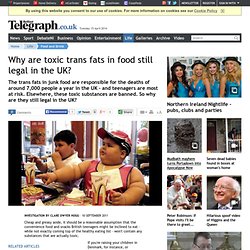
But if they're eating food in the UK, it's best not to assume so. Within many shop-bought pastries, cakes, doughnuts, crisps, processed meats, soups, frozen food, biscuits, chocolate bars, breakfast cereals and takeaway food, exists an ingredient that the World Health Organisation (WHO) declared toxic in 2009. It's hydrogenated vegetable oil, otherwise known as trans fat, and it doesn't even have to appear clearly on ingredients labels.
Have a look, and you might find it called 'shortening', or 'hydrogenated fats', maybe 'hydrogenated vegetable oils' (HVOs), perhaps 'partially hydrogenated vegetable oils' (PHVOs), or... not mentioned at all. Whatever they choose to call it (there's no regulated terminology) it's one of the food industry's handiest industrial ingredients. Colonialism and The American Diet. Global Food Disparity: A Photo Diary - StumbleUpon. In an increasingly globalized world, it’s still sometimes shocking to see just how disparate our lives are compared with other human beings around the world. A book of photographs by Peter Menzel called "Hungry Planet: What the World Eats" ("©Peter Menzel www.menzelphoto.com.
Ten Speed Press, published in 2005) makes a relevant point with great irony: at a time when hundreds of millions of people don't have enough to eat, hundreds of millions more are eating too much and are overweight or obese. In observing what six billion eat for dinner the authors note, "Today, more people are overweight than underweight.
" It is these cultural differences, emphasized and reinforced by the author, which exemplifies the lifestyles and dietary habits of people around the world. You can buy the book here. Meet the The Manzo family of Sicily. AN OVERVIEW OF THE VIRTUES. By James B.
How to Hate Your Wife (Luke 14:25-35. 25 Large crowds were traveling with Jesus, and turning to them he said: 26 “If anyone comes to me and does not hate his father and mother, his wife and children, his brothers and sisters—yes, even his own life—he cannot be my disciple. 27 And anyone who does not carry his cross and follow me cannot be my disciple. 28 “Suppose251 one of you wants to build a tower.

Will he not first sit down and estimate the cost to see if he has enough money to complete it? 29 For if he lays the foundation and is not able to finish it, everyone who sees it will ridicule him, 30 saying, ‘This fellow began to build and was not able to finish.’ 31 “Or suppose a king is about to go to war against another king. Will he not first sit down and consider whether he is able with ten thousand men to oppose the one coming against him with twenty thousand? 32 If he is not able, he will send a delegation while the other is still a long way off and will ask for terms of peace. 'What Should I Do With My Life?' 50 Lessons I wish I had learned earlier. Welcome to our blog! Here you'll find bits and pieces of wisdom learned from cycling 17,000 miles from Alaska to Argentina together as a family. Hope it inspires you to live your dream! My book about our journey, Changing Gears, is now released!
Read a preview here Now that I’m old and gray (but not quite in my rocker yet!) You’re stronger than you think you are.Mistakes teach you important lessons. What is meditation? - Meditation Explanation. Despite all its popularity, today very few of us truly know what meditation is. Some regard meditation is the mental concentration on something, others consider that we meditate when we imagine something that gives us peace or satisfaction. All these methods are being with one goal to slow down and, eventually, completely stop the incessant activity of our minds. These exercises are not really meditation – they are substitutes for meditation because it is normally very difficult to stop our minds all-together. In reality, meditation is a state of thoughtless awareness. It is not an act of doing – it is a state of awareness. Snapshots from Italy «
Am also posting on a Tumblr site that Angelyn and I created to chronicle our entire trip. Click on the image below for more pics and stories. With your eyes. « a faithful walk. Study Sheds Light On Gluten Sensitivity. Millennials in the Workplace: R U Ready? After the 1989 launch of Sports Illustrated for Kids, editors at Advertising Age challenged readers to come up with the next child-focused magazines likely to hit newsstands. Generation Y: They've arrived at work with a new attitude. Tell Me a Story. Why Go to College? 40 Reasons to Go to College. 1.A Better Paying Job. Log In - The New York Times. James Mollison's Photos of Children's Bedrooms Are a Commentary on Class and Poverty.
Phil Borges - People of Indigenous Cultures - Photography - World... - StumbleUpon.