
William Shakespeare. William Shakespeare (/ˈʃeɪkspɪər/;[1] 26 April 1564 (baptised) – 23 April 1616)[nb 1] was an English poet, playwright, and actor, widely regarded as the greatest writer in the English language and the world's pre-eminent dramatist.[2] He is often called England's national poet, and the "Bard of Avon".[3][nb 2] His extant works, including collaborations, consist of approximately 38 plays,[nb 3] 154 sonnets, two long narrative poems, and a few other verses, some of uncertain authorship.
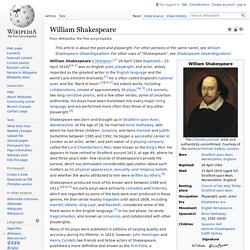
His plays have been translated into every major living language and are performed more often than those of any other playwright.[4] Shakespeare produced most of his known work between 1589 and 1613.[6][nb 4] His early plays were primarily comedies and histories, which are regarded as some of the best work ever produced in these genres. Many of his plays were published in editions of varying quality and accuracy during his lifetime. Life Early life London and theatrical career Later years and death man Plays. Globe Theatre. The Globe Theatre was a theatre in London associated with William Shakespeare.

It was built in 1599 by Shakespeare's playing company, the Lord Chamberlain's Men, on land owned by Thomas Brend and inherited by his son, Nicholas Brend and grandson Sir Matthew Brend, and was destroyed by fire on 29 June 1613.[4] A second Globe Theatre was built on the same site by June 1614 and closed in 1642.[5] A modern reconstruction of the Globe, named "Shakespeare's Globe", opened in 1997 approximately 750 feet (230 m) from the site of the original theatre.[6] Location[edit] History[edit] Second Globe Theatre, detail from Hollar's View of London, 1647. The Globe Theatre is shown at the bottom centre of this London street map[12] Position on modern street plan Site of the Globe Theatre, from Park Street; the dark line in the centre marks the foundation line. Like all the other theatres in London, the Globe was closed down by the Puritans in 1642. Layout[edit] Motto[edit] Notes[edit] Shakespeare's Impact. Why Study Shakespeare?
The Reasons Behind Shakespeare's Influence and Popularity Ben Jonson anticipated Shakespeare's dazzling future when he declared, "He was not of an age, but for all time! " in the preface to the First Folio. While most people know that Shakespeare is, in fact, the most popular dramatist and poet the Western world has ever produced, students new to his work often wonder why this is so.
The following are the top four reasons why Shakespeare has stood the test of time. 1) Illumination of the Human Experience Shakespeare's ability to summarize the range of human emotions in simple yet profoundly eloquent verse is perhaps the greatest reason for his enduring popularity. Here are some examples of Shakespeare's most popular passages: • The seven ages of man • Shall I compare thee to a summer's day?
2) Great Stories Marchette Chute, in the Introduction to her famous retelling of Shakespeare's stories, summarizes one of the reasons for Shakespeare's immeasurable fame: References.