
Yr 12: English Ext: After the bomb. Prejudice. The Romantic Age: Topic 2: Overview. The Gothic begins with later-eighteenth-century writers' turn to the past; in the context of the Romantic period, the Gothic is, then, a type of imitation medievalism.
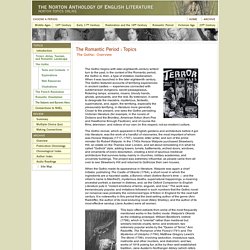
When it was launched in the later eighteenth century, The Gothic featured accounts of terrifying experiences in ancient castles — experiences connected with subterranean dungeons, secret passageways, flickering lamps, screams, moans, bloody hands, ghosts, graveyards, and the rest. By extension, it came to designate the macabre, mysterious, fantastic, supernatural, and, again, the terrifying, especially the pleasurably terrifying, in literature more generally. Closer to the present, one sees the Gothic pervading Victorian literature (for example, in the novels of Dickens and the Brontës), American fiction (from Poe and Hawthorne through Faulkner), and of course the films, television, and videos of our own (in this respect, not-so-modern) culture.
My own agitation and anguish was extreme during the whole trial.
War. Children and War : Webguide & Research. Shakespeare. Ext 2. Gothicism. Into the World. Poetry. Guide to the new English K–10 Syllabus. This video explains the key features of all four syllabuses for Kindergarten to Year 6.

View at full screen and adjust quality settings as required. Download:Kindergarten to Year 6 Guide to the new NSW K–10 syllabuses (PDF, 15 pages, 1.15MB)English Years 7–10 Guide to the new NSW K–10 syllabus (PDF, 4 pages, 172KB) The new English K–10 Syllabus includes agreed Australian curriculum content and content that clarifies learning for English from Kindergarten to Year 10.
The stage statements for Early Stage 1 to Stage 5 reflect the intent of the Australian curriculum achievement standards. Implementation The Australian curriculum is being implemented in New South Wales through new syllabuses developed by the Board of Studies for English, Mathematics, Science, and History. In K–6 the syllabuses are designed to be taught within the Board's recommended percentages of time for each key learning area in a typical school week. NSW syllabuses What is new? Kindergarten – Year 6 Years 7–10. English K–10. Project Based Learning. Positive education: Creating flourishing students, staff and schools. By Dr Suzy Green MAPS, Coaching Psychology Unit, University of Sydney, and Positive Psychology Institute, Dr Lindsay Oades, Director, Australian Institute of Business Well-Being, University of Wollongong, and Paula Robinson, Positive Psychology Institute This article provides an introduction to the field of ‘positive education' and demonstrates how applied positive psychology, which includes evidence-based coaching, can inform and assist schools to develop and maintain the optimal functioning of students and staff.

We encourage those working in or with schools to think strategically in creating positive education programs that support and sustain a positive school climate and culture for whole school wellbeing. What is positive education? In Australia and globally there is growing interest in positive education. Whilst the sub-field of positive education is relatively new, it has a long history. Why positive education? What does the future hold for positive education? Conclusion.
Women in Media. Graphic novel. Belonging.