
AUSTRALIAN HISTORY, INFORMATION ABOUT AUSTRALIAS PAST, ABORIGINAL HISTORY IN AUSTRALIA, THINGS THAT HAVE HAPPENED IN AUSTRALIA, KEY DATES IN AUSTRALIAN HISTORY. The first settlers are thought to have arrived around 50,000 years ago.

This would have most likely been at a time when the sea levels were low, the land was more humid and animals larger. Although much of Australia became populated, the central dry areas didn't attract settlers until around 25,000 years ago. The population grew proportionately quicker around 10,000 years ago as the climate improved. At the time of British settlement at Sydney Cove it is estimated that 300,000 aboriginal people, speaking around 250 languages inhabited Australia. On arrival, finding no obvious political structure, the Europeans took the land as their own. During the early part of the 20th century legislation's were passed to segregate and protect Aboriginals. After World War II, assimilation became the governments aim. During the 1960's the legislation was reviewed and the Federal Government passed legislation for all Aboriginals to be given citizen status. Mirror of the World , State Library of Victoria. Burke and Wills: The Art of Science.
Science assists us to understand the world.
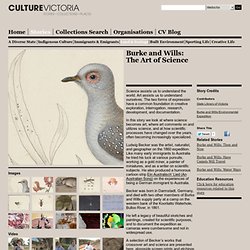
Art assists us to understand ourselves. The two forms of expression have a common foundation in creative exploration, interrogation, research, development, and documentation. In this story we look at where science becomes art, where art comments on and utilizes science, and at how scientific processes have changed over the years, often becoming increasingly specialized. Ludwig Becker was the artist, naturalist, and geographer on the 1860 expedition. Like many early immigrants to Australia he tried his luck at various pursuits, working as a gold miner, a painter of miniatures, and as a writer on scientific subjects. AUSTRALIAN HISTORY, INFORMATION ABOUT AUSTRALIAS PAST, ABORIGINAL HISTORY IN AUSTRALIA, THINGS THAT HAVE HAPPENED IN AUSTRALIA, KEY DATES IN AUSTRALIAN HISTORY.
Australian History. Home Search Site Contact Us Site Map Our FREE ebooks Help to download and convert files on this site Project Gutenberg Australia gratefully acknowledges the significant contribution of Sue Asscher in preparing many of the eBooks relating to Australian History, which are available from this page.
Australian History Resources relating to Australian History available from Project Gutenberg Australia and Project Gutenberg in the U.S. Links to other sites covering Australian History John White, surgeon on the First Fleet to sail to Australia, in 1787-88. The first authenticated discovery of Australia was by William Jansz in 1606. The convicts were put on board the ships of the First Fleet in March 1787 and arrived at Sydney Cove on 26 January, 1788--the day now commemorated as "Australia Day". Another account, "Journal of a Voyage to New South Wales", by John Wright, Surgeon-General to the Settlement, was first published in 1790. Quite a recommendation! Watkin Tench. Australian History. Picture Australia This useful resource has been produced by the National Library of Australia. It consists of links to images of all types related to Australia.
You can search for people, places and events using the Search option. An advanced search allows you to specify a date or place. For date ranges, use an asteric (eg 193* will find images from the 1930s) Indigenous Australia Timeline From pre-contact to 2000. Significant dates in Australian history from 1486 -1945 This website from Project Gutenberg of Australia provides a list of important dates in the history of Australia and a brief caption outlining the event that occurred on that date. Documenting a democracy: timeline from 1600s to 1836 Exploration timeline - Australian land and sea exploration. Australian History. The Australia's Prime Ministers website contains information about the life and times of Australia's Prime Ministers from 1901 to the present; and is a portal to Australian and overseas institutions with archives on these prime ministers.
National Archives of Australia The Australian War Memorial's National Collection holds printed and written records, photographs, film and sound recordings and military heraldry and technology related to Australia's Prime Ministers. Australian War Memorial The Australia-Japan Research Project (AJRP) aims to provide a resource for historians and others interested in the Australia-Japan relationship, especially in war, from 1901 to 1957. The website contains a database of historic materials, several research essays and seminar papers, and various research aids, including glossaries and thesauri of geographical and military terms. National Library of Australia Museum of Australian Democracy at Old Parliament House. Australian History. Dig - The Burke & Wills Research Gateway.
Australian History. A Place Called Victoria - People, Places and Events. Org.