
The General Prologue Audio. John Milton's Paradise Lost The Morgan Library & Museum Online Exhibitions - Click play button to listen to Mark Rylance reciting the invocation to the muse from Paradise Lost and Sonnet XXII.
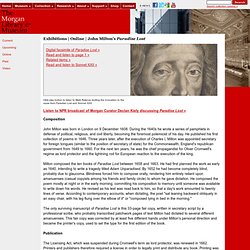
Listen to NPR broadcast of Morgan Curator Declan Kiely discussing Paradise Lost » Composition John Milton was born in London on 9 December 1608. During the 1640s he wrote a series of pamphlets in defense of political, religious, and civil liberty, becoming the foremost polemicist of his day. He published his first collection of poems in 1646. Milton composed the ten books of Paradise Lost between 1658 and 1663. The only surviving manuscript of Paradise Lost is this 33-page fair copy, written in secretary script by a professional scribe, who probably transcribed patchwork pages of text Milton had dictated to several different amanuenses.
Publication The Licensing Act, which was suspended during Cromwell's term as lord protector, was renewed in 1662. Milton sold Paradise Lost to the printer Samuel Simmons for £5. Photography by Graham Haber. William Blake's World: "A New Heaven Is Begun" The Morgan Library & Museum Online Exhibitions - William Blake's World: "A New Heaven Is Begun" | IntroductionSeptember 11, 2009, through January 3, 2010 William Blake (1757–1827) occupies a unique place in the history of Western art.
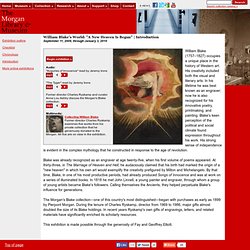
His creativity included both the visual and literary arts. In his lifetime he was best known as an engraver; now he is also recognized for his innovative poetry, printmaking, and painting. Blake's keen perception of the political and social climate found expression throughout his work. His strong sense of independence is evident in the complex mythology that he constructed in response to the age of revolution. Blake was already recognized as an engraver at age twenty-five, when his first volume of poems appeared.
The Life of Geoffrey Chaucer (c. 1343-1400) [Chaucer Biography] GEOFFREY CHAUCER, English poet.
![The Life of Geoffrey Chaucer (c. 1343-1400) [Chaucer Biography]](http://cdn.pearltrees.com/s/pic/th/geoffrey-chaucer-biography-18728798)
The name Chaucer, a French form of the Latin calcearius, a shoemaker, is found in London and the eastern counties as early as the second half of the 13th century. Some of the London Chaucers lived in Cordwainer Street, in the shoemakers' quarter; several of them, however, were vintners, and among others the poet's father John, and probably also his grandfather Robert.
Legal pleadings inform us that in December 1324 John Chaucer was not much over twelve years old, and that he was still unmarried in 1328, the year which used to be considered that of Geoffrey's birth. The poet was probably born from eight to twelve years later, since in 1386, when giving evidence in Sir Richard le Scrope's suit against Sir Robert Grosvenor as to the right to bear certain arms, he was set down as "del age de xl ans et plus, armeez par xxvij ans. " The Chaucer Review - Reinventing Chaucer: Helgeland's A Knight's Tale. E211 Guide to Chaucer Pronunciation. E211: British Literature to 1760 Pronouncing Chaucer's English Alfred Drake | Uni Hall 329 | W 3-4 | ajdrake@ajdrake.com Linda Georgianna, UCI.
Did Climate Inspire the Birth of a Monster? <i>Frankenstein</i> Quiz. William Blake's Notebook. Taking Liberties - Star Items - William Blake'snotebook. The Rime of the Ancient Mariner Questions. Education: Ph.D., University of MichiganB.A., M.A., University of Kentucky Teaching: English Composition I and IIBritish Literature Survey I and IIRomantic LiteratureVictorian LiteratureModern British LiteratureAnglo-Irish LiteratureIrish Myth and Folklore Teaching and Research Areas:
Film Network - Films - The Periwig Maker. Legacies - Myths and Legends - England - Derby - Living with the plague - Article Page 1. The Victorian Prose Archive, Alfred J. Drake. Witchcraft Documents [15th Century] Back to Medieval Source Book | ORB Main Page | Links to Other Medieval Sites | The really intense period of persecution of witches did not come until the late 16th and 17th centuries.
![Witchcraft Documents [15th Century]](http://cdn.pearltrees.com/s/pic/th/sourcebook-witchcraft-18728810)
The basic doctrines of the later witchcraze were laid down in documents of the later medieval period. These documents built on longstanding folk beliefs which were put in vaguely academic dress. There has been much recent discussion of whether witches actually existed. For a long period the whole discussion was seen as a mirror of psychological anxieties. Real or not, witches and witchcraft, were very real phenomena to the writers of the fifteenth century and later. Geoffrey Chaucer (1342-1400) "The Canterbury Tales" (in middle english and modern english) Chaucer Wiki. Chaucer 341 Course Page @ Virginia Military Institute.
This website is a link on the Chaucer Metapage Here are some Internet resources for the study of Chaucer Chaucer Bibliographies Studies in the Age of Chaucer (SAC) Bibliography - This is one of the most useful tools available for the study of Chaucer, a searchable, annotated bibliography of every book and article written about Chaucer since 1975 (a few items go back to 1973).
The annotations are excellent and will give you a good idea whether or not you need to look at the work. When you click this link, you will come to a search page much like an online library catalogue. Modern Chaucer: Street Talk and a Dance Beat. The Canterbury Tales Prologue. The Ballad of Sir Patrick Spens. Get Up and Bar the Door [image 435x500 pixels] 20. Get Up and Bar the Door. Traditional Ballads. 1909-14. English Poetry I: From Chaucer to Gray. The Harvard Classics. Archive. History - Conquest Trail.
History - Ages of English Timeline. History - Anglo-Saxons. Anglo-Saxon (Old English) Anglo-Saxon is the language that was spoken more than a thousand years ago in the southern part of what is now England.
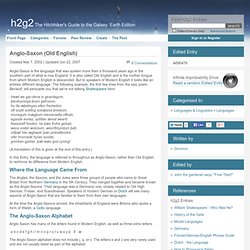
It is also called Old English and is the mother tongue from which Modern English is descended. But to speakers of Modern English it looks like an entirely different language. The following example, the first few lines from the epic poem Beowulf, will persuade you that we're not talking Shakespeare here: hwæt we gar-dena in geardagum, þeodcyninga þrym gefrunon, hu ða æþelingas ellen fremedon. Oft scyld scefing sceaþena þreatum, monegum mægþum meodosetla ofteah, egsode eorlas, syððan ærest wearð feasceaft funden; he þæs frofre gebad, weox under wolcnum, weorðmyndum þah, oðþæt him æghwylc þær ymbsittendra ofer hronrade hyran scolde, gomban gyldan. þæt wæs god cyning! (A translation of this is given at the end of this entry.) Where the Language Came From The Anglo-Saxon Alphabet a b c d e f g h i l m n o p r s t u w x y þ ð æ Reading Ancient Manuscripts d e f g t r s w.
Turning the Pages™, the British Library. Electronic Beowulf-Digital Collections Inventory. Council on Library Resources Commission on Preservation and Access Preliminary Results.
Resources for the Study of Beowulf. Beowulf at the British Library. Beowulf: sole surviving manuscriptBritish Library Cotton MS Vitellius A.XV, f.132Copyright © The British Library BoardA high-quality version of this image can be purchased from British Library Images Online.
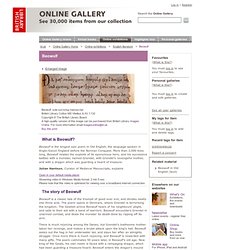
For more information email imagesonline@bl.ukBuy this print What is Beowulf? Beowulf is the longest epic poem in Old English, the language spoken in Anglo-Saxon England before the Norman Conquest. More than 3,000 lines long, Beowulf relates the exploits of its eponymous hero, and his successive battles with a monster, named Grendel, with Grendel’s revengeful mother, and with a dragon which was guarding a hoard of treasure. Beowulf Study Guide. A Study Guide Roy M. Liuzza Department of English University of Tennessee, Knoxville 301 McClung Tower Knoxville, TN 3796-0430 email rliuzza@utk.edu Right: London, British Library, MS Cotton Vitellius A.xv, fol. 179r: the first page of Beowulf.
Primary History - Anglo Saxons - Who were they? History - Viking Quest. Anglo Saxons. History - Overview: Anglo-Saxons, 410 to 800. Venom, To Thy Work, Buddy - Clips. HAMLET (FACEBOOK NEWS FEED EDITION). Written by Sarah Schmelling. Stick Figure Hamlet - The Greatest Work of Literature in Human History... Now With Pictures. What's Shakespeare to Us, and We to Him? Plenty. Bronte, Blake, Wilde – read their hand-written manuscripts online. South Park Does Hamlet's death scene.
Meet Mr. Shakespeare.