
This DIY Super Laser Can Cut Through A Ping Pong Ball. Teralab - Youngs Slit's Single Photon Diffraction with Live Interactive Experiment. Introduction Thomas Young showed the wave nature of light in 1801 with his famous double slit experiment.

The experiment described here does not just replicate Young's experiment, although that is interesting in itself. This experiment goes a step further by performing it one photon at a time to show the interference of single photons. This is not original, it has been done many times before in laboratories and universities. It is quite a demanding project to take on at home though. Achieving single photon interference actually only took about three months. I need the most basic circuit diagram for wireless energy transfer please - Electrical Engineering.
Building a radio telescope for a school science project. Diy Physics Blog - Experimental Modern and Quantum Physics for Do-It-Yourself Science Enthusiasts. A CD spectrometer. Do-It-Yourself Gadgets: Model of a particle accelerator. DIY Electron Accelerator: A Cathode Ray Tube in a Wine Bottle. As complex as the idea of a particle accelerator might seem, it's actually strikingly simple to implement.
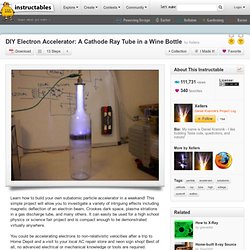
The design we will be using was first created in the late 19th century by J.J. Thomson and subsequently used to make several important discoveries about the fundamental nature of the atom and the electron. Later, in the early 20th century, Cockroft and Walton (yup, the same hooligans responsible for the voltage multiplier) used a similar design to build the first true electrostatic linear accelerator, or "static linac" for short. Nowadays, advanced versions of this type of accelerator are commonly used for radiotherapy and ion implantation. Essentially, our cathode ray tube is just two electrodes in a vacuum chamber with a high voltage applied between them. Some interesting effects that can be observed at this stage are sputtering and magnetic deflection.
Sputtering: Magnetic Deflection: Trying to measure the speed of light with an Arduino. Photons - What are the specific requirements for a do-it-yourself quantum double-slit experiment? I was shocked to recently learn that the double-slit experiment is not only possible to do with completely ordinary equipment (with photons of course), but it actually looks rather easy.

This is from a MIT tech video: That time stamp starts around the description of their device. Here are some of the specifications: Stand 10-20m away from a light source in an otherwise mostly dark environment1/4 -1/2 mm separation between the two pinholes (which act as the slits for this double-slit experiment), around 4:56 in the video It looks like the holes are made about 1/4 mm in diameter, but this isn't explicitly statedObviously observe or resolve the pattern maybe 10 cm behind the slits with ambient light shielded out.
Now, the obvious question is why these parameters work. Physics 331: DIY Projects. DIY experiments are purposely vaguely stated.

The purpose is to let you solve the problem of the best way to run an experiment. In the possible projects (listed below) there may be some similarity with what you have looked at in one of the regular experiments, although they are not identical. PDF of the Guidelines and Projects PDF of Lab Procedure and Report Outline Guidelines A one page proposal is due Tuesday Nov. 9 at 9:30 AM People working together may submit a common proposal.
Include a short statement about the basic physics and references, as appropriate, to Hecht or another book.Indicate what parameters will be measured, what the independent variables are, and how they will be varied. DIY Lab Procedure Prepare in advance: Algebra that will be needed to extract result. Homemade michelson interferometer. Homebuilt Ruby Laser. Classical mechanics - How can I measure the mass of the earth at home? Yes we/you can.

I recall seeing a famous video of a homemade version of the Cavendish torsion balance experiment from the early 1960's, made I think for the PSSC high school course. Basically, the physicist hung a torsion balance from a high ceiling by a long (>10 m?) Piece of computer data tape (chosen because it would not stretch). He carefully minimized air currents. The torsion masses were two .5 kg bottles of water on a wooden bar (no magnetic interference). I found an Italian dubbed version of the video on Youtube. It looked really crude but qualitatively it worked. I also found some other do it your self experimenters with crude equipment, experimental tips (try fishing line) and different masses. The best summary and historical exposition I found is at . Editorial (I'll move this positive rant to meta soon) - given the obviously widely varied audience on this site, I would very much like to see more questions like this one relating to amateur or home experiments.
Thermodynamics - Home experiment to estimate Avogadro's number? Your best bet is to try to replicate the experiments of Perrin who first measured Avogadro's constant.

This is a common lab in "Advanced Lab" courses in undergraduate or graduate courses, so you can probably find writeups and such via google. How do you measure the distance between Earth and the Sun? How do we calculate the distance of the Sun from the Earth, or the actual size of the Sun, or the speed of travel of Earth in its orbit around the Sun?

Clearly, from an answer to one of these questions one can find out the answers to the others. Electromagnetism - Home experiments to derive the speed of light? I don't know if it qualify as home experiment, but you can use the internet to get access to thousands of kilometres of optical fibres for free.

It allows you to measure the speed of light in the fibres, which is c/n, where n is the refractive index of glass, i.e. 1.5. This corresponds to 2×10⁸ m·s⁻¹. Using ping, you measure a roundtrip time, that is it should correspond to 100 km/ms of roundtrip. From Paris, I ping the website of Columbia, in New-York, I have The minimum roundtrip time is 108 ms, which would correspond to 10800 km instead of 5839 km.
Quantum optics - How to count photons. Measurement - Home experiments to measure the RPM of a pedestal fan without special equipment? Let me first list all of the possibilities I considered that I later rejected.

This is far from exhaustive, and I'm looking forward to seeing other people's creativity. Bad Ideas Sit on a tire swing with the fan pointing to the side. Peltier Cooler Based Cloud Chamber. This cloud chamber is now available for purchase!

Discuss cloud chambers / radioactive samples at the nothinglabs.com forums Cloud chambers let you see paths left by radioactive particles as they pass through a supersaturation of alcohol vapor. Vapor trails are formed when the radiation ionizes the alcohol. They need to be very cold (about -15f) - so most designs require dry ice. Originally developed by Rich Olson - this design uses inexpensive electrical "Peltier" coolers instead.
See the Make a Cloud Chamber using Peltier Coolers (Instructable) for full details on making your own. It's fairly easy to construct - and should only cost about $100 (less if you use a cheap ATX power supply).