
Improve Your Business Performance: Why Meaningful Data is more important than Big Data. Any business looking to sell more, spend less or build better customer relationships first needs to understand how their organisation really operates.
By far the most accurate way of doing this is by analysing data. However, Business Intelligence (BI) is failing and Big Data has become a catch-all term that is irrelevant to many companies. What decision makers really need is Meaningful Data. This Bright North article explains how meaningful, relevant data can help solve business problems, optimise performance and make accurate predictions about future behaviour. Successful business optimisation is grounded in understanding. By far the most accurate way of doing that is by analysing data. The Business Intelligence (BI) industry has been built around the premise of capturing and presenting this data. A global survey by Avanade found that the majority of respondents felt overwhelmed by the volume of information being thrown at them. The Failure of BI. Why Big Data Is Not Truth. Photo The word “data” connotes fixed numbers inside hard grids of information, and as a result, it is easily mistaken for fact.
But including bad product introductions and wars, we have many examples of bad data causing big mistakes. Big Data raises bigger issues. A Giant Step Forward for the Internet of Things and Big Data. Andy Stanford-Clark, IBM Master Inventor Andy Stanford-Clark, an IBM Master Inventor who lives in the United Kingdom, jokes that his goal was “world domination” in 1999 when he and Arlen Nipper of Eurotech invented a protocol aimed at greatly improving machine-to-machine communications.
This was at the time when another British technology pioneer, Kevin Ashton, coined the term “Internet of Things” to describe how the Internet could be connected to the physical world via a vast network of sensors. Stanford-Clark believed that his protocol, now called MQ Telemetry Transport, or MQTT for short, would enable organizations to quickly and affordably gather, integrate and make use of all of that sensor data. It would be an essential underlying technology for the Internet of Things. Fast forward to today.
We need a data democracy, not a data dictatorship. ( gigaom.com ) -- The democratization of data is a real phenomenon, but building a sustainable data democracy means truly giving power to the people.
The alternative is just a shift of power from traditional data analysts within IT departments to a new generation of data scientists and app developers. And this seems a lot more like a dictatorship than a democracy — a benevolent dictatorship, but a dictatorship nonetheless. These individuals and companies aren’t entirely bad, of course, and they’re actually necessary.
5 strategic tips for avoiding a big data bust. "Big data" has arrived as a big business initiative.
But the hip, experimental, ad hoc veneer of blending data streams to surface bold discoveries belies a massive cultural and technological undertaking not every organization is ready for. Without a strategic plan that includes coherent goals, strong data governance, rigorous processes for ensuring data accuracy, and the right mentality and people, big data initiatives can easily end up being a big-time liability rather than a valuable asset. [ InfoWorld's Andrew Lampitt looks beyond the hype and examines big data at work in his new blog Think Big Data. | Download InfoWorld's Big Data Analytics Deep Dive for a comprehensive, practical overview. ] Following are five strategic tips for avoiding big data failure.
In many cases, the advice pertains to any data management project, regardless of the size of the data set. Big Data and a Renewed Debate Over Privacy. Big Data’s Evolution: 5 Things That Might Surprise You. Over the past several years, Big Data has gone from being a somewhat obscure concept to a genuine business buzzword.
As is often the case with buzzwords, when you dig a little deeper you find that many people have substantial misconceptions about what Big Data is, where it came from and where it is going. Here are a few things that might surprise you about the evolution of Big Data: There are more “failures” out there than you’d think. We’re bombarded with the hype, but the reality is that this is still an early technology. As people are unfamiliar with the tech components of Big Data, they’re often prone to thinking that they can jump in and do everything themselves. Dave Spenhoff is the VP of Marketing at Infochimps. API > Knowledge, Examples, White Papers, Articles and Templates on Performance Management, Balanced Scorecard, Key Performance Indicators, BI.
The Advanced Performance Institute (API) is pleased to announce the findings of a worldwide study conducted in conjunction with Actuate Corporation.
We have taken the 20th anniversary of the Balanced Scorecard - one of the most popular performance management tools - to conduct a global study to understand the current state of business performance management (BPM). The study 'Measuring and Managing Performance - A Global Study' incorporated responses from over 3,000 companies across the globe, making it one of the largest and most comprehensive surveys ever conducted in the field of performance management.
The newly released white paper 20 Years of Measuring and Managing Performance: From KPIs and Dashboards to Performance Analytics and Big Data outlines the findings of the study and provides a BPM maturity model. More mature BPM approaches generate significantly higher business benefits. The seven factors that were common among more mature BPM approaches were: Seven dirty secrets of data visualisation. Net magazine is the number one choice for the professional web designer and developer.

It’s here that you find out about the latest new web trends, technologies and techniques – all in one handy package. Each issue boasts a wealth of expert tips and advice, including in-depth features and over 30 pages of advanced front- and backend tutorials on subjects as diverse as CSS, HTML, JavaScript, WordPress, PHP, and plenty more. net compiles the hottest new sites from around the web, and being the voice of web design, our mission is to source the best articles written by the best people in the industry and feature interviews and opinions crammed with inspiration and creative advice.
In short, If you're serious about web design and development, then net is the magazine for you. Editorial. Big Data Disaster. The World's Top 10 Most Innovative Companies in Big Data. 1_Splunk For deploying its data crunchers to improve operations for its 5,000 clients, from Zynga to Rutgers University to Comcast to the FBI. 2_Quid.
Privacy hampers big data development. Business schools’ big data revolution. ©Ferguson In which country would a company with fewer than 50 employees decide to limit its own growth?
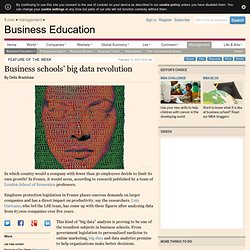
In France, it would seem, according to research published by a team of London School of Economics professors. Employee protection legislation in France places onerous demands on larger companies and has a direct impact on productivity, say the researchers. Luis Garicano, who led the LSE team, has come up with these figures after analysing data from 67,000 companies over five years. DARPA Funds Python Big Data Effort - Government - Information. Department of Defense has dished out $3 million for Python big data analytics libraries from a $100 million fund for big data research and development. Military Drones Present And Future: Visual Tour (click image for larger view and for slideshow) The Defense Advanced Research Projects Agency, which is spending $100 million over four years to advance big data technologies, recently awarded $3 million to develop data analytics and data processing libraries for popular computer programming language Python.
The funding, awarded to data visualization and analytics company Continuum Analytics, will go toward the development of a scientific computing library for Python called Blaze and a visualization system called Bokeh, Continuum announced in a blog post. A More Perfect Union, Part 2. This is Part 2 of our in-depth profile of the big data techniques that gave Barack Obama a second term in office.
Read Part 1. The Experiments. We don’t need more data scientists — just make big data easier to use. Virtually any article today about big data inevitably turns to the notion that the country is suffering from a crucial shortage of data scientists. A much-talked-about 2011 McKinsey & Co. survey pointed out that many organizations lack both the skilled personnel needed to mine big data for insights and the structures and incentives required to use big data to make informed decisions and act on them.
What seems to be missing from all of these discussions, though, is a dialogue about how to steer around this bottleneck and make big data directly accessible to business leaders. We have done it before in the software industry, and we can do it again. Big Data Is on the Rise, Bringing Big Questions - Tech Europe. OXFORD—The next Next Big Thing is Big Data. Evangelists claim it has the power to reveal hidden truths about our companies, about our lives, about society as a whole. So important is it that last week’s Silicon Valley Comes to Oxford annual event was built around the topic.
Inevitably the real world crashes into digital utopia. According to Peter Tufano, the dean of Oxford’s Said Business School, which played host to the event, while awareness of the topic was high among enterprises, only about 6% of companies have got beyond a pilot stage, and 18% are still in one. “That means three-quarters of industries are looking at this and saying ‘what is this all about?’” From Big Data Science to Big Data Action. From the dawn of civilisation through to the year 2003, Google calculates that humans have produced 5 exabytes of data.
That’s a lot of stone tablets. But with the explosion of mobile devices, 3G and 4G networks and social networks, we now produce 5 exabytes of data every two days. That means that every photo you upload to Flickr or Facebook, every video you share with friends on YouTube or Vimeo and every one of the billions of tweets broadcast on Twitter is contributing to the avalanche of data. How Important Each Day of the Year Is, Visualized. How Big Data Sparks Creativity And Culture In Startup Land. Where are big data and BI heading in 2013? - in-memory processing, big data, technology trends 2013, cloud BI, business intelligence. Digesting Big Data [Egestion vs. Excretion] Big Data Spending Will Reach $20 Billion by 2016. Welcome to the Wednesday edition of the IP news roundup. Structured vs. Unstructured Data. Big Data: Big Brother Business on Steroids? (Big Data Part 1 looked at Big Data’s potential impact on political campaigns.) Welcome to the world of Big Data, that tsunami of information flowing through the Internet from billions upon billions of handheld devices and machines like coffee makers or on-board automobile navigation systems.
Every time we use the Internet to search the web or a cell phone to text or make a call, we contribute to the Big Data deluge. In an echo of the Internet boom of the late 1990s, companies like Alteryx, mentioned in the first part of this series, are springing up like flowers after a desert rain. This prompts huge questions with no immediate answers. Will Big Data yield another economic boom like the Internet at the end of the 1990s? Big Data ultimately will make available information that heretofore was impossible to capture, analyze, or exploit. Should not businesses that benefit from the data the rest of us generate compensate us in some way for it? Visual Analytics Brings Big Data in Google's Cloud to Life.
Big Data’s Importance to Business Marketing. Photos du journal. Mobile Consumer Spending: Big Data Insights for Holiday Retailers. Mobile devices captured nearly 20 percent of all online shopping in Q3 2012, which bodes incredibly well for online retailers heading into the holiday season. Over the past year, total shopping sessions from has risen 161 percent, while smartphones are not far behind with a 119 percent increase. Big Data: The Hidden Opportunity. YouTube. Failure to Manage the Three Vs Is Not an Option - Robert Plant. Mobile Sponsored by: register login Home Bloggers Messages Polls Resources Strategy Analytics Technology Financial Services Healthcare Government Education. Deja VVVu: Others Claiming Gartner’s Construct for Big Data. Personal data transfers: Google Cloud SQL service offers EU-only processing and storage capability. A step closer to cleaning up the mobile cloud mess. The Principles of Gray-Box Testing.
Chartio launches its ‘beautiful intelligence’ tool to make data easier on the eye (and wallet) Study: 39% Of Google Search Referrers Now "Not Provided" The Top 5 Keyword Mistakes Regarding Your Search Engine Optimization. Multi-cloud 101: Tips for navigating public, private, and hybrid clouds. 3rd Workshop on Ontology Patterns – WOP2012 (Proceedings at CEUR) Gartner tips rise of the chief digital officer - Strategy. SAP Takes Big Step Putting CRM On Hana - Software - Enterprise. Google opens up on seven years of its data center history — Cloud Computing News.
3. Come for the data. Stay for the insight. Data Nerd's Corner. Big Data - You Can Start Small. Big Data’s Big Moment. Big Data: A Pile of Nuts. GoGrid Partners with Boston Big Data Research Group hack/reduce With Free Cloud Hosting. Headline Story. Is Technology Making You More (or Less) of a Jerk? - Michael Schrage. Big Data Means Big Bucks for Small Business. Analytics – What is Smarter Analytics.
MicroStrategy Uses Cloud to Deliver Self-serve Business Intelligence. 5 trends that are changing how we do big data — Data. The foundations of a new personal data ecosystem. Using data to create successful strategies. Brands have too much data and not enough talent. Big Data Leading to New Breed of Service Provider CIO. Big Data in Law: Cloud Challenge, Analytics Opportunity. MDM: It’s Not about One Version of the Truth. Humanizing Big Data. Aussie small businesses waking up to big data: SAS. Adopters, Not Vendors, Stand to Gain the Most from Big Data. Insight: Crunching the numbers to boost odds against cancer. Treasury CIO: Our big-data 'Greek tragedy' is ongoing. Are the Dimensions of Data Quality Real? The 4 Phases Of Big Data. Does Your Business Have Obsessive Compulsive Big Data Disorder?