
Complicating Factors. Kids Care Clubs. Volunteer. Character Education - Free Resources, Materials, Lesson Plans. Curriculum Quarterly: Winter 2005. Chrysanthemum by Kevin Henkes (grades Pre K-1) Curriculum Quarterly: Winter 2005. Nothing Wrong with a Three-Legged Dog. Curriculum Quarterly: Winter 2005. The Revealers. Curriculum Quarterly: Winter 2005. The Skin I'm In. The Anti-Bullying Machine: Turn Your Cruelty into KINDNESS! In honor of National Bullying Prevention Awareness Week, I have been facilitating classroom guidance lessons about bullying.
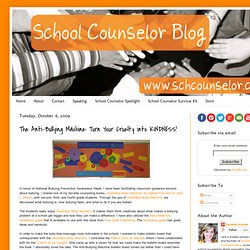
I shared one of my favorite counseling books, Good-Bye Bully Machine, by Debbie Fox and Dr. Alan L. Beane , with second, third, and fourth grade students. Through the use of Good-Bye Bully Machine, we discussed what bullying is, how bullying feels, and what to do if you are bullied. The students really enjoy Good-Bye Bully Machine . In order to make the bully-free message more noticeable in the school, I wanted to make bulletin board that corresponded with the Good-Bye Bully Machine.
To make the bulletin board, we enlisted the help of students in an after-school program that I run. To make the cogs, the students traced circle patters and a pattern that I created. The students brainstormed cruel words and put-downs that they could put in mean end of the Anti-Bullying Machine and kind words that would come out the kind end.
CHARACTER COUNTS!: Resources: Children's Books that Build Character. Community Service, Helping Others at Building Blocks. Free E-Cards for Children at Building Blocks. Free E-Cards for Children at Building Blocks. Building Self-Confidence in the Classroom. Teachers are some of the most powerful influences in a child’s life.
As a teacher, you can help children increase their self-confidence as you provide them with a chance to build on their achievements and be successful in and out of your classroom. Classroom activities provide children with infinite opportunities to affirm their abilities. As students strive to do more in and out of the classroom, they increase their self-confidence in performing specific activities and completing assignments. As a teacher, it is important for you to recognize your students’ accomplishments and provide positive reinforcement.
Purpose: To help children recognize and appreciate their growth and success and to increase performance levels. Look What I Can Do at Building Blocks. Netsmartz. Powered by Google Docs. Tip Sheets. Author, Speaker and Educational Consultant Dr. Michele Borba. Teasing is one of those unpleasant aspects of growing up, but the plain truth is certain kids sure do seem to get more than their fair share.
Of course, we tell our children to just “shrug it off” and “not take it so seriously,” but some kids just can’t. Those verbal barbs sting! While we can’t stop kids from saying nasty stuff to our children, we can do things to reduce the chances our sons and daughters will be targeted. The best way is by teaching them how to respond in a way that discourages future teasing. With the number of mean-spirited kids these days who seem to get a charge from picking on their so-called friends, learning those come back strategies can be an essential part of every child’s friendship aptitude arsenal. I’ve included the most effective come-back strategies from my book, NOBODY LIKES ME, EVERYBODY HATES ME, that kids tell me have worked for them.
Choose a Comeback Strategy to Take the Sting Out of the Tease Question it. Send a Strong “I Want” message. Agree. 1. Author, Speaker and Educational Consultant Dr. Michele Borba. Many of today’s students lack an understanding of respect because their experiences with this essential character trait have been minimal.
Think about it: If you are rarely around people who display respect and if you aren’t treated as though you are a valued and worthwhile individual, how can you possible “catch the behavior?” That’s the secret of learning new character building behaviors—they’re caught by watching others do them well. Today’s schools and classrooms are enormously significant institutions because for many students these places may be the only times appropriate character building traits can be taught. If you recognize this premise, you’ll also recognize the power of educators. Tune up the behavior you want to be caught and accentuate it. Reference Database. List of all KWC spotlights. Kids Who Care. LP Centennial Sunflowers. Special Sunflowers Description: Laurence Anholt's Camille and the Sunflowers provides an excellent way to introduce a discussion about feelings and ways to care about others.
Camille and his family warmly welcomed Vincent Van Gogh to their town. Camille's friends and the rest of the townspeople made fun of Van Gogh and he eventually moved away. This story offers a way to discuss with students the importance of treating others kindly because every person is special. NSOC Search Form Details. Character Education Theme - Lesson Plans, Thematic Units, Printables, Worksheets, and More from A to Z Teacher Stuff.
Opportunities for Student Action. Character isn't what we think, it's what we do.
Here are some opportunities for students to apply the values we associate with good character. As Aristotle said, when we do good things we become good people. Souperbowl of Caring. Service Learning Primer. Sorry about the length of this page.
The first half is K-5; the bottom half is grades 6-12. Happy scrolling! Hudson Public Schools, Massachusetts Our service learning program begins in kindergarten with all kindergartners being involved in several efforts: a handicapped awareness program that extends into a "hop'ning" that raises funds for the March of Dimes; a student run recycling program tied to a environmental studies science unit; and a holiday toy drive linked to a social studies unit on community. Like our kindergarten, each grade develops its own initiatives. For example, a group of our first graders have an ongoing relationship with senior citizens at our local Senior Center that helps teach students basic literacy skills.
Denise Eichel, 2001 St. How to Do Character Education. This article first appeared in the Sept/Oct 2004 issue of Today's School under the title: "You Are A Character Educator.
" et’s get one thing perfectly clear – you are a character educator. Whether you are a teacher, administrator, custodian, or school bus driver, you are helping to shape the character of the kids you come in contact with. It’s in the way you talk, the behaviors you model, the conduct you tolerate, the deeds you encourage, the expectations you transmit. Service Learning Primer. By David Elkind and Diana Flasher Service learning is a form of project based learning in which academic goals are accomplished through community service.
Service learning develops citizenship and good character, and provides a rich context for academic instruction and student learning. This primer is intended to provide guidance to school teachers and others who wish to engage their students in service learning projects, but aren't sure exactly what to do or how to do it. Service Learning Web Resources. Respect - Lesson Plan - The Six Pillars of Character - Character Counts - Popcorn Park. If you are using the video, ask the first question before viewing. 1.
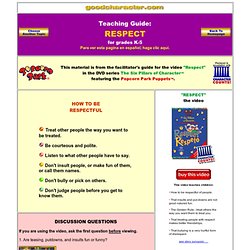
Are teasing, putdowns, and insults fun or funny? Questions to ask after showing Act I 2. What happened in the video so far? 3. 4. 5. 6. Caring - Compassion - Lesson Plan - The Six Pillars of Character - Character Counts - Popcorn Park. If you are using the video, ask the first question before viewing. 1. If I told you I thought you were a very caring person, what would that mean? What is a caring person? Questions to ask after showing Act I 2. 3. Bullying Prevention - Teasing - Lesson Plans - Elementary. 1. For younger children, following recess or lunchtime, have students identify, without using names, situations they observed where bullying behavior occurred.
List these situations on a chart with the date. Discuss how the situations could be handled better. Continue this each day for a week and have children observe if there are any changes in the number of bullying situations or how they are handled. For older students, have each student keep a journal to record bullying situations he or she observes each day. Controlling Anger - Managing Anger - Getting Along - Lesson Plans - Elementary. If you are using the video, ask the first three questions before viewing. 1. What are some things that make you angry?
(Make a list.) 2. Is it okay to get angry sometimes? Listening to Others - Getting Along - Lesson Plans - Elementary. 1. Have students keep a daily journal of how listening or not listening affected their day. Younger children can draw pictures in their journals. Discuss at the end of the day some of these experiences. 2. Read a story to the class that illustrates listening or not listening skills. Responsibility - Lesson Plan - The Six Pillars of Character - Character Counts - Popcorn Park. If you are using the video, ask the first question before viewing. 1. Have you ever let somebody else take the blame for something you did? What happened? How did the other person feel about it? Questions to ask after showing Act I. Monthly Newsletter Archive. Lesson Plans - Character Education - Life Skills - Elementary School. Ea links. Microsoft%20Word%20-%20Student%20Climate%20Survey(1) Evaluation Information. Types of Evaluation. Medication Chart to Treat Attention Deficit Disorders. Links. CE lp template with resources.
You can use the template below to create your own character education lesson plans. The resources listed at the bottom provide plenty of ideas for how to integrate character and the core ethical values into all curricular areas. LP Tips PACES. STEP 1: Think about your curriculum. Character Education Ideas, Activities and Stories. Over 1850 ideas available, categorized under 30 traits! Free Character Education Stories. Child-Rearing and Making Love Deposits. Motivating Character Quotes. Quotes on the Primacy of Character Education Warren Buffett, America's most successful investor, on the primacy of character in choosing a business partner: ''I think you'll probably start looking for the person that you can always depend on; the person whose ego does not get in his way; the person who's perfectly willing to let someone else take the credit for an idea as long as it worked; the person who essentially won't let you down, who thought straight as opposed to brilliantly.'' (Quoted by Andrew Kilpatrick in ''Of Permanent Value'') "Try not to be a person of success, but rather a person of virtue.
" — Albert Einstein On the football program at the University of Georgia, which has a full-time assistant coach for character and leadership. 9/11/2001: The Day That Changed America. A Day for ReflectionA 9/11 Memorial (PDF): Thousands of Americans will participate in the memorial observances to be held on 9/11/02, at the World Trade Center site.
Millions more will watch the events on TV. Offer your students a preview of the memorials by using this schedule-reading activity together in class. Books on Character. Orfalea founded Kinko's in 1970, growing it into a $1.5 billion-a-year company. Fortune named it one of the world's best places to work. Yet, he struggles to read and write. Character Education lesson plans. I. Learn From Life’s Hard Knocks. II. Character Education: Lesson Plans. Character_education. Process Model. BP Table. SUNY Cortland: index. Get the Building Blocks E-mail Updates. Classroom Management Strategies for Elementary Teachers. To Enable Learning, Put (Emotional) Safety First. A New Model of Schooling: Creating Knowledgeable, Responsible, Nonviolent, Drug-Free, Caring Kids.
Make Like a Goat: The Art of Distracting Unruly Students. ?domain=eqparenting. Social and Emotional Learning Lab. Social Development Research Group Presentations. Social Development Research Group: Families Facing the Future. Social Development Research Group: Families Facing the Future. Social Development Research Group: Families Facing the Future. Social Development Research Group: Raising Healthy Children Program. Social Development Research Group: Raising Healthy Children Program. Social Development Research Group Publications. Social Development Research Group Links. Are Schools Responsible for Teaching Manners?
Social and Emotional Learning and the Start of School. Acts of Kindness. Randomactsofkindness. Browse Kindness Ideas. Kindness Ideas. Acts of Kindness. HRM Video - Our Products - Real Character/Real People Series: Profiles in Perseverance. Data Collection Tools Guide. Inspirational Values. Your Everyday Heroes - Motivational Stories & Inspirational Stories. Your Motivational Stories & Inspirational Short Stories. Inspirational Quotes - Motivational Quotes - Inspirational Stories. Pass It On TV Spots - Inspirational Stories - Good Character. Lessons of the Raspberries. School Counseling Curriculum Objectives - School-Counselor.org.